
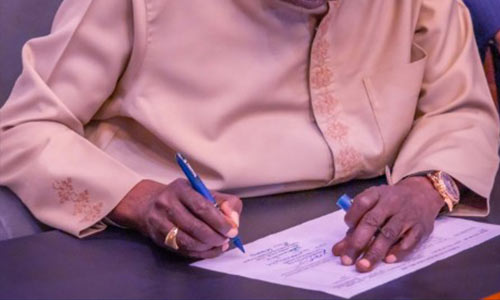
President Bola Tinubu has transmitted a bill to the House of Representatives seeking the repeal and re-enactment of the 2026 Appropriation Act, proposing a reduction in the Federal Government’s aggregate expenditure from ₦68.323 trillion to ₦65.176 trillion, while retaining planned borrowing of ₦29.218 trillion.
The President also forwarded a revised 2026 Federal Government Fiscal Framework to the House for consideration and approval, explaining that the proposed adjustments were necessary to align the federal budget with existing financial obligations and available resources.
The requests were contained in a letter read during plenary by the Speaker of the House of Representatives, Tajudeen Abbas, on Monday, November 23, 2026.
Under the revised fiscal framework, aggregate federal expenditure is proposed at ₦65.176 trillion, representing a reduction of ₦3.147 trillion from the ₦68.323 trillion approved in the original 2026 budget.
The revised framework projects federal revenue, including receipts from government-owned enterprises, at ₦33.720 trillion, while aggregate capital expenditure is estimated at ₦26.232 trillion.
Despite the proposed reduction in total expenditure, the fiscal deficit remains at ₦31.457 trillion, representing 5.64 per cent of Nigeria’s Gross Domestic Product (GDP).
Tinubu explained that the proposed amendments were designed to accommodate existing government financial obligations, particularly expenditures already incurred by the Nigerian National Petroleum Company Limited (NNPCL) on behalf of the federation.
According to the President, the adjustments would also address debt-service obligations that were not adequately provided for in the original budget, while recognising previously issued capital warrants and supplementation commitments.
The revised fiscal framework would further provide for refunds to Ministries, Departments and Agencies (MDAs), as well as special government accounts.
Tinubu explained that capital provisions for MDAs under the revised proposal consist largely of amounts already covered by issued warrants, while a limited number of new capital and overhead provisions have been introduced to address priority national interventions.
He identified the completion of critical road infrastructure projects as one of the major areas requiring additional provisions under the revised budget.
Other priority interventions include measures to protect agricultural production, reduce production costs, improve farm yields and enhance access to markets.
The President also highlighted measures aimed at addressing water vulnerability as part of the interventions incorporated into the revised expenditure framework.
On borrowing, Tinubu disclosed that the planned new borrowing for the 2026 fiscal year would remain unchanged at ₦29.218 trillion, despite the proposed reduction in aggregate expenditure.
The borrowing provision comprises ₦18.428 trillion in domestic borrowing and ₦10.790 trillion in foreign borrowing.
He further explained that the proposed external borrowing of $7.7 billion, equivalent to approximately ₦10.368 trillion at an exchange rate of ₦1,346.50 to one United States dollar, was intended to finance the existing foreign borrowing provision in the budget.
According to the President, the proposed external loan would not increase the borrowing ceiling already contained in the fiscal framework.
Tinubu maintained that the adjustments were intended to prioritise existing commitments, strengthen the credibility of the capital budget and improve its implementation.
He also emphasised that the proposed revisions were designed to maintain fiscal restraint while ensuring that outstanding government obligations were adequately addressed.
The President consequently appealed to the National Assembly to give the bill expeditious consideration and passage to enable the Federal Government to implement the revised budget in an orderly manner and settle outstanding financial commitments.
The proposed repeal and re-enactment of the Appropriation Act would require legislative consideration and approval before the revised expenditure framework could take effect.
The House of Representatives is therefore expected to consider the proposed amendments alongside the revised fiscal framework as part of its constitutional responsibilities concerning federal expenditure and appropriation.
The proposal comes with a reduction in the overall spending envelope but retains the existing borrowing provision and fiscal deficit, reflecting the administration’s stated intention to accommodate outstanding obligations while adjusting expenditure priorities within the 2026 fiscal year.
Post Title: “₦3.147trn Budget Cut, ₦29.218trn Borrowing Retained” — Tinubu Seeks National Assembly Approval To Repeal And Re-Enact 2026 Appropriation Act By Naijaonpoint.