
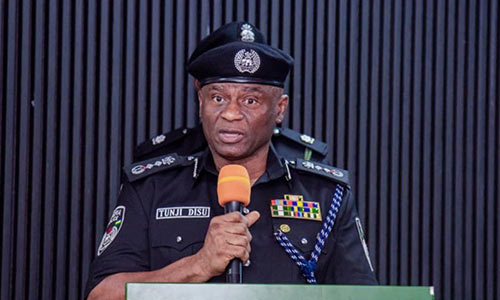
The Inspector-General of Police, Olatunji Disu, has assured Nigerians that the Nigeria Police Force (NPF) will not be used as a political tool during the 2027 general elections, warning that officers found supporting political parties or candidates will face disciplinary action.
The IGP also pledged that the police under his leadership would not become an instrument of oppression in the hands of politically motivated individuals, particularly through the misuse of the Cybercrime Act against journalists and other citizens.
Disu gave the assurances on Tuesday, November 24, 2026, during the second day of the Media Development Conference organised by the Centre for Journalism Innovation and Development (CJID) at the Abuja Continental Hotel.
Speaking during a panel session titled “People-Centred Public Safety and State Policing in Nigeria,” the police chief maintained that effective policing must be anchored on public trust, professionalism and accountability rather than the indiscriminate use of force.
He stressed that the Nigeria Police Force would remain accountable to all Nigerians and operate in accordance with the law, irrespective of the political interests or affiliations of individuals involved in the electoral process.
“Any police officer found to be partisan, to have taken sides, or to have aided any candidate or the party will face disciplinary action under the force’s code of conduct,” Disu warned.
The IGP maintained that officers had a responsibility to protect the rights of all Nigerians and ensure that political activities were conducted peacefully without intimidation or preferential treatment.
Addressing concerns over the alleged misuse of the Cybercrime Act to harass journalists and suppress critical reporting, Disu pledged that the police would not willingly serve as a tool of political oppression.
He acknowledged the importance of press freedom and described journalists as essential partners in national development and democratic accountability.
According to him, journalism is not a crime, and media practitioners must be allowed to perform their professional responsibilities without unlawful interference.
The police chief, however, urged journalists and other citizens to familiarise themselves with the provisions of the Cybercrime Act, explaining that some actions considered minor in the digital environment could constitute offences under the law.
He disclosed that since assuming office, the police had organised two symposiums to examine cybercrime legislation and offences arising from activities conducted through digital platforms.
Disu added that personnel assigned to the Force’s cybercrime units were receiving training and equipment to strengthen their capacity to investigate and respond to emerging digital offences.
The IGP also expressed concern over the growing threat posed by misinformation and disinformation to the peaceful conduct of elections.
He warned that modern electoral processes could be disrupted not only through physical violence but also through fabricated information circulating online.
According to him, fake videos, manipulated audio recordings, coordinated social media falsehoods and fabricated news reports could create confusion, inflame political tensions and trigger violence.
He therefore stressed the importance of responsible communication, effective media engagement and cooperation between journalists and law enforcement agencies ahead of the 2027 elections.
Speaking on the proposed establishment of state police, Disu sought to address concerns that state governors might use such institutions to advance personal or political interests.
He assured Nigerians that safeguards were being developed to prevent the proposed state police structures from being hijacked by political officeholders.
The IGP explained that the proposed framework would include mechanisms for federal intervention where circumstances required it, particularly in situations involving abuse or a breakdown in the proper functioning of state policing institutions.
He disclosed that the National Assembly and other relevant stakeholders were working towards developing a policing framework suited to Nigeria’s peculiar circumstances rather than simply adopting models from other countries.
Disu further emphasised the need for standardised police training across the federation.
According to him, officers serving in different states, including Lagos and Kano, should receive training based on uniform professional standards, notwithstanding differences in their operational responsibilities.
He maintained that such standardisation would help promote professionalism, accountability and consistency in the discharge of policing duties.
Turning to relations between the police and the media, Disu acknowledged that misunderstandings sometimes arose because journalists and investigators approached information from different professional perspectives.
He observed that while journalists were often under pressure to publish information promptly, police investigators sometimes needed to protect sensitive operational details to avoid compromising investigations.
The IGP recalled a research paper he wrote during a management course at the Police Staff College in Jos, in which he advocated closer cooperation between journalists and police officers during serious criminal investigations.
He explained that allowing journalists to accompany police personnel during certain field operations could improve mutual understanding and help media practitioners appreciate the challenges confronting investigators.
Disu, however, cautioned that premature publication of sensitive information could jeopardise security operations.
Recalling an incident from his time as Commander of the Rapid Response Squad in Lagos, he narrated how premature reporting during an operation to rescue a kidnapped Lagos State Accountant-General allegedly alerted associates of the kidnappers, who were demanding ransom.
According to him, the publication complicated the situation and demonstrated the importance of discretion when reporting ongoing security operations.
The IGP maintained that the incident illustrated why journalists and security agencies needed to establish working relationships based on trust, professionalism and an understanding of their respective responsibilities.
He also recalled another experience during his tenure at the Rapid Response Squad, when police officers assisting a stranded motorist reacted aggressively after noticing someone filming them.
Disu attributed the reaction to anxiety among some officers over previous incidents in which viral videos had resulted in disciplinary action or job losses.
He nevertheless stressed that such concerns did not justify hostility towards journalists or members of the public exercising their lawful rights.
The IGP said police personnel were being sensitised to respect and protect journalists covering public events and to avoid unnecessarily preventing them from performing their professional duties.
He also acknowledged that while press freedom in Nigeria was relatively better than in some neighbouring countries in the Sahel region, improvements were still necessary in the relationship between journalists and law enforcement agencies.
As part of efforts to strengthen cooperation ahead of the elections, Disu disclosed that Commissioners of Police had been directed to hold regular meetings with media practitioners within their areas of responsibility.
He also announced plans for joint lectures and pre-election training programmes in Abuja and other states.
According to him, the initiatives would provide journalists with opportunities to interact with police commanders and officers responsible for election security before the commencement of major electoral activities.
The programmes are also intended to improve communication, promote responsible election reporting and reduce misunderstandings between journalists and security personnel.
Disu expressed support for the deliberations at the CJID conference, saying he hoped the exchange of ideas would generate useful recommendations for strengthening Nigeria’s media environment and improving police accountability.
In a goodwill message, the Chairman of the CJID Board of Trustees, Professor Umaru Pate, commended the Inspector-General for his assurances concerning police professionalism, political neutrality and accountability.
Speaking on behalf of the organisation’s Board of Directors, management, staff and participants, Pate stressed that mutual trust was fundamental to maintaining productive relationships between citizens and law enforcement agencies.
He described trust as an essential element of police legitimacy, warning that its absence encouraged suspicion and weakened public confidence in security institutions.
Pate also acknowledged the differences in how journalists and police officers handled information.
According to him, journalists often sought to reduce public uncertainty by reporting developments quickly, while police officers regarded certain information as sensitive investigative material that required careful handling.
He maintained that these competing responsibilities sometimes created tensions between media practitioners and law enforcement personnel.
The CJID Board Chairman consequently called for greater dialogue, mutual education and institutional cooperation to improve understanding between both professions.
Referring to Disu’s earlier research on police-media relations, Pate agreed that sustained engagement could reduce anxiety, strengthen professional relationships and encourage a shared commitment to Nigeria’s national development.
He also commended the daily sacrifices made by police officers in the discharge of their responsibilities.
Pate pledged the Nigerian media’s continued support for democracy and peaceful political participation ahead of the 2027 general elections.
The conference provided an opportunity for the police leadership and media stakeholders to examine the relationship between public safety, press freedom, digital communication and political neutrality as preparations intensify for the forthcoming elections.
Disu reiterated that the Nigeria Police Force would be guided by professionalism and the law, warning that officers who compromise their neutrality by supporting political candidates or parties would be subjected to disciplinary measures.
Post Title: “Any Police Officer Found To Be Partisan Will Face Disciplinary Action” — IGP Disu Assures Nigerians Of Police Neutrality Ahead Of 2027 Elections By Naijaonpoint.