
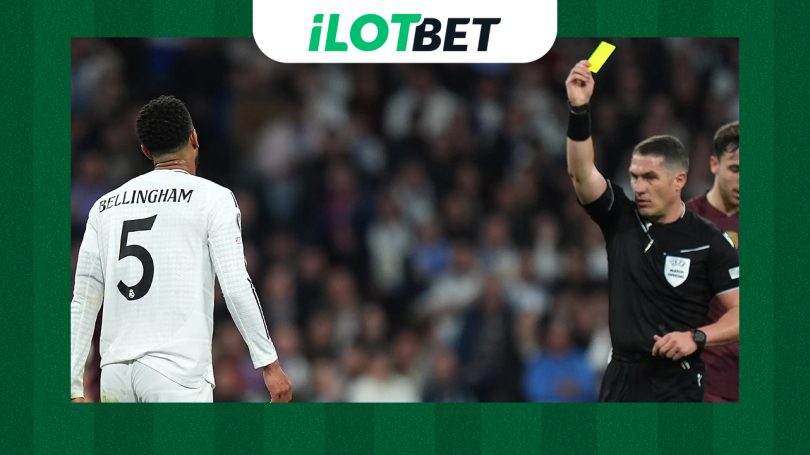
Imagine this scenario.
England are preparing for a huge World Cup quarter-final against Brazil. Jude Bellingham has already picked up a yellow card earlier in the tournament. One more booking and he risks suspension for the semi-final.
At previous World Cups, that danger would have hung over every tackle, every protest and every late challenge.
At the 2026 FIFA World Cup, however, the rules will be different.
FIFA has introduced a new yellow card “amnesty” system for the expanded tournament in the United States, Canada and Mexico, a change designed to reduce the chances of top players missing major knockout matches because of accumulated bookings.
For supporters, it is one of the most significant rule adjustments ahead of the first 48-team World Cup.
So what exactly is changing?
What is changing?
In simple terms, FIFA will now wipe single yellow cards at two different stages of the tournament. Yellow cards collected during the group stage will be cleared before the Round of 32 begins. Then, yellow cards accumulated during the knockout rounds will be wiped again after the quarter-finals.
The change comes because the 2026 World Cup will be larger than any edition before it. Instead of 32 teams, there will now be 48, increasing the total number of matches and adding an extra knockout round. Teams reaching the final could potentially play eight matches instead of seven.
FIFA believes the old system carried too much disciplinary risk across a longer competition. Under previous rules, players who picked up yellow cards in separate matches before the semi-finals faced a one-match suspension. Yellow cards were only wiped after the quarter-finals, mainly to ensure nobody missed the final because of a booking in the semi-final.
How would it work in practice?
The new system effectively creates two separate disciplinary phases.
Take Kylian Mbappé as an example.
Imagine Mbappé receives a yellow card during France’s second group-stage match. Under the previous system, he would carry that caution into the knockout rounds. Another booking in the Round of 32 or Round of 16 could then rule him out of a quarter-final.
Under the new rules, however, that group-stage booking disappears once the group phase ends. Mbappé would start the knockout rounds with a clean slate.
Now imagine he picks up another yellow card in the Round of 32 and a second one in the Round of 16. He would still be suspended for the quarter-final because both cautions happened within the same disciplinary phase.
But if he reaches the semi-finals carrying only one yellow card from the knockout rounds, that caution would be erased after the quarter-finals.
In practical terms, players will only trigger a suspension for yellow-card accumulation by receiving two bookings during the three group-stage matches or two bookings across the Round of 32, Round of 16 and quarter-finals combined.
Will players still be suspended?
Yes.
The amnesty does not remove suspensions entirely.
A player who receives two yellow cards in the same disciplinary phase, or a red card
can still be banned.
What changes is how long yellow cards remain active.
The reset points simply stop cautions from following players throughout the entire tournament.
Could this benefit attacking players?
Possibly.
Creative and attacking players are often frequent targets for tactical fouls and emotional confrontations in knockout football.
In previous tournaments, players sometimes approached quarter-finals or semi-finals cautiously to avoid suspension.
Now, football fans are more likely to see the biggest names available for the latter stages.
Why fans may welcome the change
World Cups are remembered for iconic matches and legendary players.
Few supporters want to see a semi-final or final overshadowed because a star player picked up two bookings across five or six matches.
FIFA’s new approach attempts to strike a balance between maintaining discipline and ensuring the tournament’s biggest moments feature its biggest stars.
Whether everyone agrees with the change is another matter.
Some critics argue suspensions are part of tournament football and reward disciplined teams.
Others believe fans deserve to see the best players on the pitch when the stakes are highest.
Either way, the yellow card amnesty is set to become one of the defining rule changes of the 2026 World Cup.