
By Moses Kolo
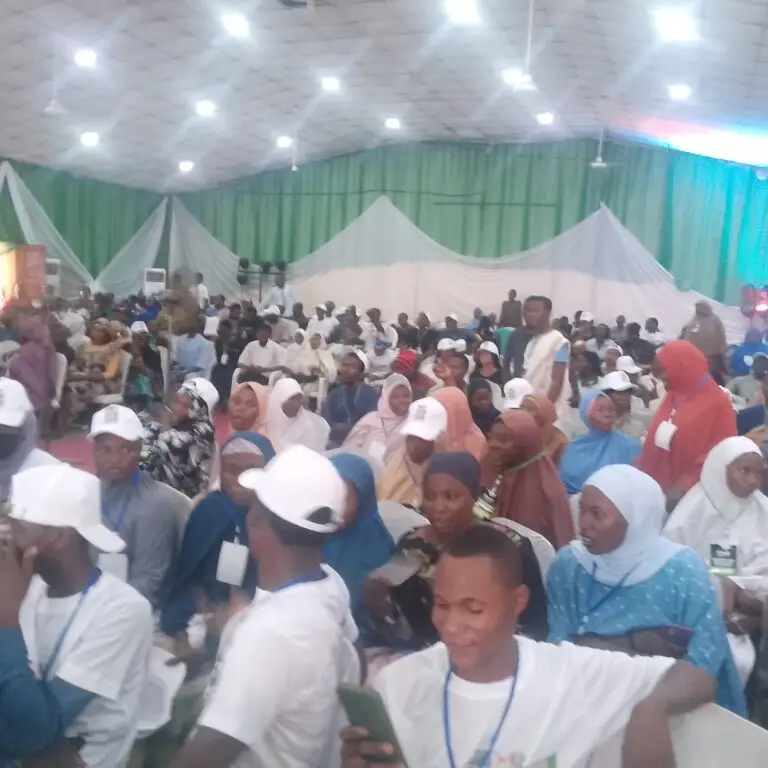
Northern political stakeholders, academics, youth groups and civil society actors on Saturday converged at Arewa House Kaduna for a town hall organised by the PBAT Door-To-Door Movement to appraise the reforms of President Bola Ahmed Tinubu.
The event, themed “Critical Appraisal of Government and Reforms Under President Bola Ahmed Tinubu and the 2027 Question,” featured discussions on economic reforms, governance, infrastructure development, fiscal policies and national stability.
Speaking in his opening remarks, Mr Sunday Adekanbi, National Coordinator of the Movement, said the forum was convened to encourage honest conversations around the administration’s policies and to counter what he described as misconceptions surrounding ongoing reforms.
Adekanbi said the engagement also provided an avenue to interrogate the “2027 question,” insisting that continuity of the current reform agenda remained necessary for sustainable national development.
According to him, President Tinubu has demonstrated leadership through what he described as a “silent yet systematic revolution” across critical sectors of the economy.
“He touched every critical aspect of this country through reforms aimed at economic recovery, institutional strengthening, infrastructure development and youth inclusion,” he said.
Delivering the keynote address, Mr Sunday Dare, Adviser to the President on Media and Public Communication, said Nigeria was gradually moving from reforms to recovery following bold economic measures introduced by the administration.
Dare noted that although the reforms had brought temporary hardship, they were necessary to reposition the country for long-term prosperity and competitiveness.
He said the removal of fuel subsidy, foreign exchange reforms and revenue restructuring were difficult but inevitable decisions needed to avert fiscal collapse.
According to him, previous administrations avoided such measures despite the growing distortions in the economy.
“Leadership is not about comfort; leadership is about responsibility. The President took decisions others were afraid to take because the country could no longer continue on the old path,” he said.
The presidential aide added that the administration was investing heavily in infrastructure, human capital development and economic modernisation to prepare Nigeria for the demands of the 21st century.
Dare cited interventions such as the Nigerian Education Loan Fund (NELFUND) as part of efforts to expand access to education and empower millions of young Nigerians.
Also speaking, Prof. Solomon Gushibet, said the Tinubu administration inherited an economy burdened by structural distortions, fiscal leakages and declining investor confidence.
Gushibet, who also is Head, Center for Financial Economics, National Institute for Policy and Strategic Studies (NIPSS) Kuru-Jos, said reforms such as fuel subsidy removal and foreign exchange unification represented a transition from economic dependency to productivity-driven development.
According to him, no nation achieves transformation without sacrifice, adding that the administration had shown political courage by undertaking reforms previous governments avoided for decades.
Gushibet said signs of economic stabilisation were gradually emerging through improved revenue generation, reduced fiscal leakages, increased investor engagement and relative stability in the foreign exchange market.
The professor, however, acknowledged existing challenges, including insecurity, rising cost of living, debt pressures and implementation gaps in some policy areas.
He urged the Federal Government to strengthen social intervention programmes and improve communication around reforms to address public concerns and reduce economic hardship.
Gushibet maintained that continuity remained essential for the reforms to achieve long-term impact, stressing that major economic transformations globally often require several years before yielding full benefits.
He warned that abandoning ongoing reforms midway could reverse progress already achieved and undermine investor confidence.
On his part, Mr Ahmed Maiyaki, Kaduna State Commissioner for Information, said increased federal allocations following the removal of fuel subsidy had enabled the Kaduna State Government to expand social intervention programmes and improve service delivery across key sectors.
Maiyaki noted that a major outcome of the policy was the introduction of 100 Compressed Natural Gas (CNG) buses providing free transportation to civil servants, students and residents, which he said had saved over N2.8 billion within 10 months.
He further explained that the administration of Uba Sani had prioritised education through a 50 per cent reduction in tuition fees, infrastructural upgrades and accreditation of academic programmes in state institutions.
According to him, Kaduna State University and Nuhu Bamalli Polytechnic had recorded notable improvements, with several courses receiving full accreditation due to sustained government investment.
Maiyaki also highlighted progress in security and healthcare, stating that previously volatile areas such as Birnin Gwari, Igabi, Chikun, Kajuru and Kachia were witnessing improved peace and economic activity.
He added that the state had upgraded 255 primary healthcare facilities, recruited thousands of health workers and improved welfare conditions to strengthen healthcare delivery across Kaduna State.
The stakeholders at the forum generally called for sustained national dialogue, policy consistency and inclusive governance to consolidate the gains of ongoing reforms and strengthen democratic stability ahead of the 2027 elections. (NAN)