
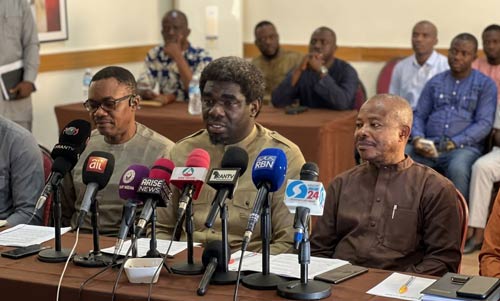
The Nigeria Labour Congress (NLC) and the Trade Union Congress of Nigeria (TUC) have resolved their disagreement over the Federal Government’s ₦70,000 monthly transport allowance for workers, agreeing to put aside their differences and strengthen cooperation in the interest of Nigerian workers.
The reconciliation was announced on Wednesday, November 18, 2026, during a joint press conference in Abuja, following weeks of public disagreements between NLC President Joe Ajaero and TUC President-General Festus Osifo over the allowance and the authority of either labour centre to negotiate with the Federal Government on behalf of workers.
In a joint statement signed by Ajaero and Osifo, the unions acknowledged that their disagreement had played out publicly but maintained that their shared history and collective responsibility to defend workers’ rights were more important than institutional differences.
They described the dispute as a family misunderstanding that was amicably resolved following the intervention of former leaders of both labour centres.
“The unity of the Nigerian working class is far greater than any disagreement between leaderships. Our common struggle, shared history, and collective responsibility to defend workers’ rights must never be sacrificed on the altar of misunderstanding or institutional differences,” the statement read.
The disagreement followed the Federal Government’s approval of a ₦70,000 monthly transport allowance for workers across different levels of government for six months.
While the NLC supported the agreement reached with the government, the TUC rejected the arrangement, arguing that workers required a salary increase rather than a temporary transport allowance.
The disagreement subsequently raised questions about the authority of the NLC to negotiate independently on behalf of organised labour without the participation or consultation of the TUC.
The controversy became public when Ajaero and Osifo appeared separately on Channels Television’s The Morning Brief, where they expressed conflicting positions on the negotiations and the representation of workers.
Ajaero maintained that the NLC could negotiate independently with the Federal Government, relying on principles of representation under the International Labour Organisation (ILO).
“TUC can negotiate along with NLC, but NLC can negotiate alone based on the principle of most workers’ representatives of the ILO,” the NLC President stated.
Osifo, however, rejected the argument, describing the ₦70,000 allowance agreement announced by Ajaero as an aberration because the TUC was not involved in the negotiations.
He challenged the NLC President to identify the ILO regulation authorising one labour centre to negotiate on behalf of another without consultation.
“He should show me in the ILO Regulations where it says one party is going to negotiate without the other one being there or consulted. He should show me! He should show Nigerians!” Osifo declared.
The TUC President-General maintained that the ILO’s framework recognised the rights of separate labour organisations to represent their members and did not permit one labour centre to assume the negotiating authority of another merely because it had more affiliated unions.
“There is nowhere in ILO regulations that says a trade centre cannot negotiate for its members. It is not there! It is just that if you are going to the ILO, it is tripartite the labour, government and the employers,” he argued.
Osifo further explained that although the NLC had more affiliated unions than the TUC, numerical strength did not automatically confer the authority to negotiate for workers represented by another labour centre.
“But what we are saying is that you have about 60 affiliates while we have about 40. You cannot! You cannot negotiate for a body that is represented, for a body that has a trade union,” he stated.
He maintained that both labour centres should participate in negotiations affecting their respective members.
“Yes, if we go to negotiations I sit down, you sit down, and we agree,” he added.
Ajaero, however, defended the NLC’s position by referring to the Trade Union Amendment Act 2005 and Section 40 of the Constitution of the Federal Republic of Nigeria, 1999, as amended.
According to him, the legislation made trade union membership voluntary and recognised the right of individual workers to determine the unions to which they belonged.
“The 2005 Trade Union Amendment Act made membership of trade unions voluntary.
“It is the worker who determines the union he belongs to.
“Section 40 of the Nigerian 1999 Constitution, as amended, was clear that every Nigerian worker has the right to belong to any trade union, political or religious institution of his choice, which gives every worker the latitude to belong to any union of their choice,” Ajaero stated.
The NLC President also questioned the TUC’s representation within the federal civil service, arguing that only one TUC-affiliated union belonged to the Joint National Public Service Negotiating Council.
He maintained that the council comprised eight union bodies, seven of which were affiliated with the NLC.
According to Ajaero, the TUC-affiliated union had also subjected its negotiating authority to the joint body.
Osifo disputed the legitimacy of the meeting that produced the transport allowance agreement, maintaining that it was not a formal meeting of the Joint National Public Service Negotiating Council.
He argued that neither the minister involved nor Ajaero was a member of the council and that its prescribed membership and quorum requirements had not been satisfied.
“But that meeting that took place was not the Council meeting. The Minister is not a member of the Council. Ajaero is not a member of the Council. The Council even has a quorum and the number of persons that must be seated to form a quorum. But at the end of the day, that meeting was not a JNC meeting. The members of JNC were not there!” Osifo stated.
He also argued that consequential salary adjustments following the last minimum wage review should have been considered through the appropriate negotiating structure.
Ajaero, in response, explained that the NLC’s engagement with the Federal Government followed an ultimatum issued over workers’ demands.
According to him, the government requested additional time to meet with the labour leadership before discussions resumed.
“We gave the government an ultimatum; we were supposed to start an action. The government asked for four days to meet with us, and we met, and they resumed sitting after four days.
“After the meeting, the 70k allowance came up,” he explained.
Ajaero further maintained that negotiations for a new national minimum wage required the establishment of a formal negotiating committee and broader consultations involving labour representatives, the government and employers.
Despite their opposing positions, the two labour leaders have now agreed to move beyond the disagreement and restore cooperation between the NLC and TUC.
The reconciliation comes as the Federal Government has approved the establishment of a high-powered committee to examine concerns raised by the TUC over workers’ salaries and demands for a new national minimum wage.
The TUC Secretary-General, Comrade General N. A. Toro, disclosed the development in a statement issued on Tuesday following a meeting between the union’s leadership and representatives of the Federal Government.
The meeting followed a letter dated October 8, 2026, titled “Request for an Urgent Meeting to Address Critical National Economic, Security and Labour Challenges,” submitted by the TUC.
The Secretary to the Government of the Federation, Senator George Akume, chaired the meeting, while the TUC delegation was led by Osifo.
Other members of the delegation included Toro, Deputy President Shehu Mohammed, Trustee Akintola Benjamin and Auditor II Kamal Ibrahim.
The Head of the Civil Service of the Federation and the Permanent Secretary in the Office of the Secretary to the Government of the Federation, Ibrahim Kana, also attended the meeting.
According to the TUC, it maintained its opposition to the six-month transport allowance arrangement and insisted that the government should instead implement a salary increase pending the commencement and conclusion of negotiations on a new national minimum wage.
“In the course of the deliberations, the TUC made its position unequivocally clear on the proposed ₦70,000 transport intervention for a period of six months, which it rejected, preferring instead a salary increase pending the commencement and conclusion of discussions on a new National Minimum Wage.
“This position, alongside the other demands and concerns raised by Congress, will form part of the issues to be thoroughly interrogated by the High-Powered Committee,” the statement read.
The TUC explained that the committee would examine the issues presented by organised labour, assess measures already taken by the Federal Government and identify outstanding demands requiring further attention.
“The Committee will therefore undertake a comprehensive review and reconciliation of the issues, establish the extent of actions already taken by the Government, identify outstanding matters and make appropriate findings and recommendations,” the union stated.
The committee comprises three representatives of the TUC and officials from the Office of the Secretary to the Government of the Federation, the Office of the Head of the Civil Service of the Federation, the National Salaries, Incomes and Wages Commission and the Federal Ministry of Labour and Employment.
It is expected to commence work immediately and submit its report to the Secretary to the Government of the Federation within two weeks.
The latest developments indicate that while the NLC and TUC have reconciled their leadership differences, discussions concerning the adequacy of the ₦70,000 transport allowance and the demand for improved workers’ salaries remain subjects of engagement with the Federal Government.
The joint reconciliation statement did not announce any change to the allowance or a final agreement on a new national minimum wage.
Rather, both labour centres reaffirmed their commitment to unity and cooperation, maintaining that disagreements between their leaders should not undermine their responsibility to protect the welfare and interests of Nigerian workers.
Post Title: “Workers’ Welfare Remains Non-Negotiable” — NLC, TUC End ₦70,000 Allowance Feud As FG Sets Up Committee To Review Salary Demands By Naijaonpoint.