
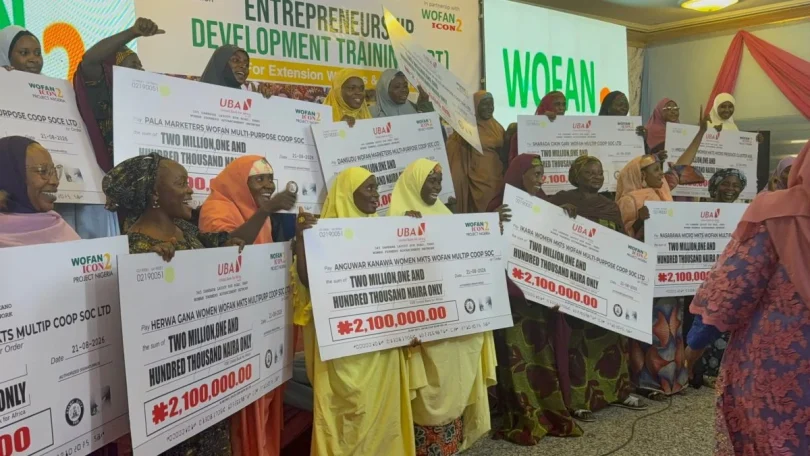
The Women Farmers Advancement Network (WOFAN) has disbursed N25.2 million to 12 high-performing cooperative clusters as part of efforts to deepen financial inclusion and strengthen women-led businesses at the grassroots.
Each of the 12 clusters received N2.1 million in additional support, with the intervention targeted at cooperatives that demonstrated strong savings discipline, enterprise growth and commitment to collective economic development.
The latest disbursement was unveiled during an entrepreneurship development training organised for extension workers and trainers from WOFAN’s North-West and North-East operational zones in Kano on Saturday.
The training focused on business pitching, crowdfunding, marketing, financial management, bookkeeping, sales strategies and business planning, with the aim of equipping women entrepreneurs with skills to build sustainable businesses and gradually transition from grant dependence to formal financial services.
Speaking at the programme, WOFAN Global Advocate and Executive Board Chair, Dr Salamatu Garba, said the organisation’s approach was designed to combine capital with skills, savings and accountability to create sustainable enterprises.
Garba said the beneficiary clusters had previously received about N1.5 million, while their savings and the latest intervention had substantially increased their capital base.
She explained that some beneficiaries who previously worked as roadside food vendors and farm labourers, as well as widows and heads of female-headed households, now control between N4 million and N5 million when their savings, previous support and latest intervention are combined.
According to her, the growth has positioned the women to expand their businesses and eventually access formal loans and other financial services.
“At WOFAN, we believe that when a woman is equipped with capital, skills and a supportive sisterhood, she does not merely survive, she transforms her destiny and that of her community. Every naira we invest in these cooperatives is an investment in Nigeria’s shared prosperity,” she said.
Garba explained that WOFAN’s support model was performance-based, with beneficiaries assessed according to their savings discipline, enterprise performance and ability to work collectively before receiving additional funding.
She said the approach was intended to encourage beneficiaries to grow their businesses and create successful entrepreneurs capable of serving as peer mentors to other women entering the business space.
The entrepreneurship training also introduced participants to crowdfunding and business pitching, providing them with alternative approaches to mobilising capital and presenting their businesses to potential investors and financial institutions.
WOFAN Business Development and Coordination Manager, Mr Taiwo Olawale, who facilitated sessions on business pitching, investor engagement, business orientation and business planning, said the training was designed to prepare beneficiaries for a transition from grants to loans.
He said women who had demonstrated the ability to responsibly manage grants could develop the capacity to obtain and repay loans from financial institutions.
“If they can manage their own grants now, it means that they can manage loans,” Olawale said.
He, however, cautioned that providing loans without first equipping entrepreneurs with financial management skills could undermine the sustainability of their businesses.
WOFAN Monitoring and Evaluation Officer, Sadik Zakariya, also trained participants on entrepreneurship, sales strategies, customer care and loyalty, enterprise sustainability monitoring and business plan development.
He stressed the importance of understanding customers, monitoring business performance and developing realistic plans to guide entrepreneurs in making sound business decisions.
Similarly, WOFAN ICON-2 Finance Manager, Abdurasheed Abdulaziz, took participants through basic accounting and bookkeeping, emphasising the importance of proper financial records in managing and expanding businesses.
Representatives of the beneficiary clusters commended WOFAN for combining financial support with entrepreneurship training, saying the approach had strengthened their savings culture and created new opportunities for women, particularly young women and those from disadvantaged backgrounds.
Hajiya Bara’ratu Baffa, a cluster leader from Tukuntawa, Hayin Kwari, whose cooperative was among the beneficiaries, said the N2.1 million support would enable members to strengthen their existing businesses and explore new opportunities.
She said WOFAN had also helped members develop a stronger savings culture, making them more conscious of saving and reinvesting profits.
“Before, women would do business without thinking about how to save the profits, but WOFAN has helped us to understand the importance of saving and growing our businesses,” she said.
Similarly, Samira Musa of the Tashar Dukku Women Agro-Marketers cluster in Gombe State expressed appreciation for the intervention, saying the support would encourage members to expand their businesses and explore new enterprises.
She urged other beneficiaries to maximise the opportunities provided through WOFAN’s interventions and use the additional capital to increase their contributions to their families and communities.
One of the participants and a Super Trainer, Alhaji Harisu Sani Hayatu, described the training as beneficial, saying it had increased his knowledge and confidence to train others.
Another participant, Hauwa Babayo, also commended the initiative and said the training had positively impacted her.
The initiative forms part of WOFAN’s broader efforts to deepen financial inclusion among grassroots women by linking grants, savings, skills development, accountability and access to finance.
Through its performance-based revolving support model, the organisation seeks to transform short-term financial assistance into sustainable enterprise development, enabling women beneficiaries to build stronger businesses and progressively connect with formal financial institutions.