
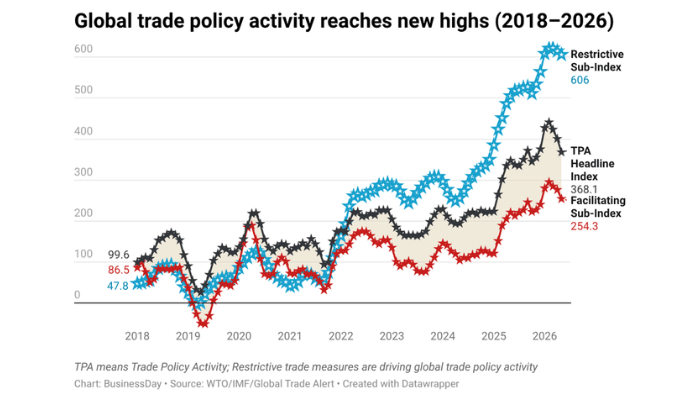
Nigeria’s strategy of building growth through non-oil exports is entering a more hostile global economy. A new World Trade Organization (WTO)-International Monetary Fund (IMF) Trade Policy Activity Index shows governments are intervening in trade more aggressively than at almost any point in recent history.
Average trade policy activity between January and May 2026 was nearly twice the 2024 level and about one-quarter higher than the 2025 average. More importantly, the increase is increasingly driven by restrictive measures such as tariffs, import bans and quantitative restrictions rather than policies that make trade easier.
For Nigeria, this changes the assumptions behind its export strategy. Diversification away from crude oil has become a central economic objective, supported by the African Continental Free Trade Area (AfCFTA) and renewed efforts to expand agricultural and manufactured exports. But a world where more countries are protecting domestic industries means accessing foreign markets is becoming harder precisely when Nigeria needs them most.
The WTO-IMF index differs from many indicators of trade uncertainty because it measures actual government actions rather than market expectations. Drawing on the WTO Trade Monitoring Database and Global Trade Alert, it tracks monthly policy measures including tariff changes, subsidies, import restrictions and customs reforms. In other words, it records what governments do rather than what investors fear they might do.
The latest data suggest the nature of global trade policy has shifted. While governments continue to introduce measures that facilitate trade, those policies have lost momentum. Restrictive interventions have accelerated much faster since 2025, becoming the dominant feature of the current trade landscape.
One of the report’s most significant findings is that this trend extends well beyond the world’s largest economies. Trade disputes are often portrayed as a contest between the United States and China, implying that smaller economies merely adjust to decisions taken elsewhere. The data suggest otherwise. Although G20 countries still account for the largest spikes in policy activity, non-G20 economies are also introducing substantially more trade measures than in previous years.
That matters for Nigeria because many of its fastest-growing export markets lie outside the G20. Regional African partners, emerging Asian economies and several Latin American markets have become increasingly important destinations for non-oil exports. If these countries are also raising tariffs, tightening import procedures or expanding subsidies for domestic producers, Nigerian exporters face additional barriers even where geopolitical tensions appear less pronounced.
The shift comes just as Nigeria is beginning to make meaningful progress in expanding non-oil exports. According to the Nigerian Export Promotion Council (NEPC), non-oil exports reached a record US$6.1 billion in 2025, led by cocoa, urea fertiliser and cashew nuts. Policymakers hope these sectors will reduce dependence on crude oil and strengthen foreign exchange earnings over the coming decade.
Yet export diversification depends not only on producing more goods but also on finding markets willing to buy them. Every additional tariff, import restriction or subsidy introduced overseas increases the cost of entering new markets and raises competitive pressure on Nigerian producers. Success increasingly depends on navigating policy barriers rather than simply improving production.
The consequences extend beyond exporters. Nigeria’s industrialisation agenda relies heavily on imported machinery, manufacturing inputs and intermediate goods. A more interventionist trading system raises the risk of higher input costs, supply-chain disruptions and delays as governments increasingly use trade policy to pursue industrial and geopolitical objectives. Trade restrictions imposed abroad therefore affect domestic manufacturing as much as export performance.
The WTO and IMF stop short of predicting that trade barriers will continue rising indefinitely. Their report includes an experimental nowcasting model that combines commodity prices, uncertainty indicators and Google search trends to estimate future trade policy activity. That model points to further increases, although the institutions caution that it remains under development and should be treated as an early-warning tool rather than a forecast.
The historical evidence is more persuasive. Trade policy activity has trended upwards for more than a decade but accelerated sharply after 2020. Each major global shock left governments more willing to intervene than before. The US-China tariff conflict, the COVID-19 pandemic, Russia’s invasion of Ukraine and renewed geopolitical tensions in 2025 all produced successive waves of trade restrictions. Crucially, activity never returned to its previous baseline after each crisis. Intervention became part of normal policymaking rather than an exceptional response.
That evolution carries an important message for Nigeria. Export diversification can no longer assume that global markets will become progressively more open. Policymakers will need to place greater emphasis on securing market access, strengthening trade diplomacy, expanding opportunities under AfCFTA and improving the competitiveness of Nigerian firms in an environment where trade barriers are becoming a permanent feature of international commerce rather than a temporary disruption.
The WTO-IMF index is therefore more than another global indicator. It suggests the rules governing international trade are changing in ways that favour resilience over openness. For a country betting its long-term growth on expanding exports beyond oil, adapting to that reality may prove as important as producing the goods themselves.