
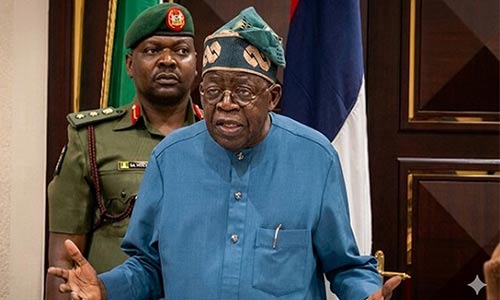
President Bola Tinubu has directed the Secretary to the Government of the Federation, George Akume, to establish a quarterly government-civil society policy dialogue forum to give citizens a structured role in shaping, implementing and evaluating public policies.
Tinubu issued the directive on Friday at the 2026 National Civil Society Organisation Summit in Abuja, where Akume represented him. He said the forum would create a regular channel for evidence-based advocacy and ensure that concerns raised at community level informed government decisions.
The President also pledged to expand Nigeria’s civic space and strengthen collaboration with accredited civil society organisations on public finance transparency, budget tracking and the monitoring of humanitarian and grassroots interventions.
He said these commitments were intended to strengthen public trust and institutional accountability as his administration continued its reform programme.
Coming shortly after Nigeria’s 66th Independence anniversary, Tinubu described the summit as an opportunity to reaffirm the social contract between the government and citizens. He acknowledged civil society’s longstanding contribution to Nigeria’s democratic development, including its advocacy for vulnerable groups, human rights, social justice, poverty reduction and the fight against corruption.
“My administration firmly believes that no nation can achieve inclusive, equitable and sustainable development without a vibrant, credible and responsible civil society operating within an open and enabling civic space,” he said.
Tinubu acknowledged the difficulties Nigerians had experienced following the economic reforms introduced by his administration since 2023. He maintained, however, that the country was moving from reforms towards prosperity, stressing that economic growth must lead to wider social inclusion.
He said achieving that objective required stronger cooperation between government, civil society and other stakeholders.
“Hence, we are reaching out to the left out,” the President said.
The proposed quarterly dialogue would address priorities including poverty reduction, youth and women empowerment, health, education, climate resilience and peace-building. Tinubu said it would allow community insights to feed into policy formulation, implementation and evaluation, while providing a platform for advocacy grounded in evidence.
He also said civil society organisations would play a larger role in bringing the Sustainable Development Goals into communities. Government, the United Nations system, development partners and the private sector would support the organisations through capacity building, institutional development and access to technical and financial resources.
On national cohesion, Tinubu urged civil society groups to help counter false information, promote interfaith dialogue and advocate inclusive governance.
He also called on them to participate actively in preparations for the 2027 general elections through voter education, election monitoring and advocacy for electoral reforms. According to him, the credibility of the electoral process would depend on coordinated efforts involving civil society, law enforcement agencies, the judiciary, the media and citizens.
The President’s directive came as civil society leaders at the summit called for a formal mechanism through which grassroots information, community concerns and early-warning signals could influence government policies and budget decisions.
The summit’s National Convener and Director-General of the Civil Society Organisations on Community Advancement and Humanitarian Empowerment Initiative, Ambassador Kunle Yusuff, said civil society networks possessed information that could help government identify emerging problems and respond more effectively.
Yusuff said CSCHEI worked with about 3,700 accredited civil society and community-based organisations across 485 areas. He described the network as a bridge between communities and government, providing access to local data and early-warning information that could improve planning and interventions.
“For too long, policy has been formulated for people without people,” he said.
He explained that the summit was proposing a sustainable partnership compact through which government, civil society and the private sector could work together on national priorities, overcoming the suspicion that had often characterised their relationships.
The proposed framework, he said, would enable civil society to monitor government policies, budgets and electoral promises while ensuring that information gathered from communities reached the authorities responsible for acting on it.
“We are not here to complain. We are here to make a positive contribution that will make Nigeria a better place to live,” Yusuff said.
He disclosed that civil society leaders had previously submitted nine recommendations to the Presidency, with three already receiving government attention.
Yusuff also urged businesses to align their corporate social responsibility programmes with national development priorities. Under the proposed partnership, civil society would contribute community information and early warnings, government would provide policy direction and implementation, and the private sector would supply resources and technical expertise.
Representing the Director-General of the National Institute for Policy and Strategic Studies, Ambassador Lawrence Olufemi said the institute remained committed to strengthening Nigeria’s democratic and political institutions.
He said NIPSS had developed programmes to improve democracy within political parties, promote political stability and strengthen peace, equality, diversity and transparency. Stronger political institutions, he added, were essential to sustaining democratic development and translating national priorities into effective policies.
The summit brought together government officials, civil society leaders and other stakeholders for discussions on national development, skills, technology, traditional institutions and governance.
... “We Are Reaching Out To The Left Out” — Tinubu Orders Quarterly Government-CSO Dialogue, Seeks Collaboration On Accountability And 2027 Elections ... TheNigeriaLawyer.