
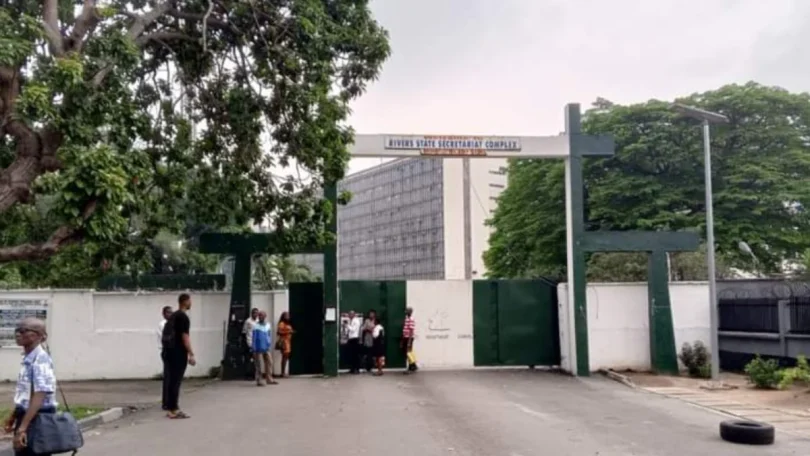
Rivers state workers have continued with their normal official duties despite the nationwide three-day warning strike announced by the Joint National Public Service Negotiating Council (JNPSNC).
Politics Nigeria observed the development at the Federal Secretariat Complex in Port Harcourt, where government workers were seen carrying out their regular activities on Friday.
The workers said they had not received any formal directive from their union leaders to withdraw their services as part of the planned warning strike.
The warning strike was reportedly called by the JNPSNC over the growing economic difficulties faced by workers and other Nigerians.
The council also raised concerns over the rising cost of fuel and what it described as the Federal Government’s failure to respond to issues contained in a letter earlier sent to President Bola Tinubu.
However, the directive appeared to have had little effect on activities at the Federal Secretariat in Rivers State, as offices remained open and official duties continued.
A civil servant at the secretariat said the situation was largely due to the absence of any formal communication from the relevant union leadership in the state.
“Our union leaders here are yet to formally inform us about the warning strike. We are just hearing rumours.”
The worker spoke on the condition of anonymity because he was not authorised to speak officially on the matter.
The development suggests that some federal workers in Rivers State were yet to have clear information on the implementation of the industrial action at the time of the visit.
Rather than abandoning their duty posts, the workers continued with their daily responsibilities while waiting for further communication from their union representatives.
The warning strike is linked to concerns over the economic situation in the country, particularly the effect of rising living costs on public servants.
The increase in the price of fuel has also continued to affect transportation and the cost of goods and services across the country.
For workers who rely largely on fixed monthly salaries, the rising cost of transportation, food and other basic needs has become a major concern.
The JNPSNC’s decision to call for the warning strike was therefore aimed at drawing the Federal Government’s attention to the issues raised by organised public sector workers.
The council had written to President Tinubu with a number of demands and subsequently directed workers to embark on the three-day action after what it considered inadequate attention to the concerns raised.
Despite the directive, the situation in Rivers appeared different, with workers at the Federal Secretariat saying they had not been formally mobilised for the action.
The absence of a formal notice from union leaders was particularly significant because workers usually depend on their unions for clear instructions during industrial disputes.
Without such communication, some workers said they could not simply leave their duty posts based on information circulating informally.
Meanwhile, the situation at the Rivers State Secretariat Complex in Port Harcourt could not be independently assessed in the same manner because the complex is currently undergoing renovation.
The state government had earlier directed civil servants, particularly junior workers, to operate from home while the renovation work continues.
The work-from-home arrangement is expected to remain in place until the renovation is completed in January 2027.
As a result, the state secretariat was not in a position to provide a clear picture of whether the warning strike had affected workers operating from the complex.
The situation also creates a distinction between federal workers operating from the Federal Secretariat and Rivers State civil servants affected by the existing work-from-home arrangement.
At the Federal Secretariat, workers were physically present and conducting official business despite the nationwide strike directive.
At the state secretariat, however, many workers are already operating under a separate arrangement introduced by the state government because of the ongoing renovation.
The JNPSNC warning strike comes against the backdrop of continued concerns about the welfare of public servants and the pressure created by the current economic environment.
Workers have increasingly raised concerns about their ability to meet their financial obligations as the prices of essential goods and services remain high.
Fuel prices have also remained an important issue because of their direct effect on transportation and other household expenses.
Nonetheless, there was no indication from the workers spoken to that they had been directed to shut down their offices or withdraw their services.