
As political conversations ahead of the 2027 general election continue to gather momentum, the Lagos-Calabar Coastal Highway has once again moved from being just an infrastructure project to becoming a major campaign talking point.
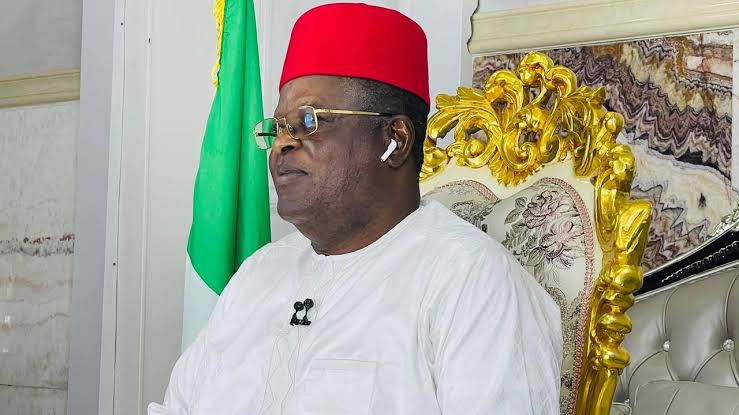
Minister of Works, Dave Umahi, has urged people of the Niger Delta to throw their weight behind President Bola Ahmed Tinubu’s re-election bid, arguing that continued support for the President is the surest way to guarantee the completion of the multi-trillion-naira coastal highway stretching across Nigeria’s southern coastline.
Speaking during an inspection of Section 4B of the Lagos-Calabar Coastal Highway in Ondo State, Umahi dismissed fears that the ambitious project could stall before reaching the Niger Delta, insisting that construction has already moved far beyond Lagos and is progressing simultaneously across multiple states.
The Minister’s remarks followed concerns recently raised by former Cross River State Governor, Donald Duke, who questioned whether the highway would truly extend beyond Epe in Lagos State.
But Umahi described such fears as misplaced.
According to him, the project is no longer confined to Lagos, as active construction is already taking place in Ogun, Ondo, Cross River and Akwa Ibom states.
He urged communities expected to benefit directly from the project to defend both the initiative and the administration driving it.
“It is up to the Niger Delta people to speak up for this project. They should defend it. They should defend the President. They must vote for the President to complete it,” Umahi declared.
‘The Highway Has Already Left Lagos’
Seeking to reassure sceptics, the Minister outlined the current progress made on various sections of the highway.
According to him:
Construction is ongoing on 28 kilometres of dual carriageway in Ogun State.
Work has commenced on 52 kilometres in Ondo State.
Another 27 kilometres are under construction in Cross River State.
The first 47-kilometre section in Akwa Ibom has already recorded significant progress.
Umahi disclosed that most of these sections are already more than 60 per cent completed, adding that work has also begun on what he described as the project’s longest stretch, a 180-kilometre dual carriageway in Akwa Ibom State.
The Minister insisted that the visible progress on multiple fronts should put to rest claims that the highway would never extend beyond Lagos.
Beyond connecting coastal communities, Umahi argued that the highway is already transforming local economies.
He said thousands of Nigerians have secured employment through the ongoing construction, while businesses around project corridors are beginning to experience increased commercial activity.
According to him, Hitech Construction Company alone has employed more than 1,000 workers on one section of the project, with many additional indirect jobs created through suppliers, transport operators and local businesses.
He also noted that security agencies and community vigilantes are working together to safeguard construction sites, creating a safer environment for both workers and host communities.
Umahi maintained that the project would stimulate agriculture, tourism, education and commerce across Nigeria’s coastal region long after construction is completed.
Why The Original Coastal Route Was Abandoned
Responding to criticisms over the alignment of the highway, the Minister defended the government’s decision to alter parts of the original route.
According to him, engineers discovered significant technical challenges during project planning, including unstable soil deposits reaching depths of nearly 50 metres in some locations.
He explained that sticking to the original alignment would also have required the construction of three massive bridges spanning approximately 3.5 kilometres each across ocean channels.
Umahi said those engineering realities would have dramatically increased the cost of the project and delayed completion.
Also Read: Organisations must train fire wardens or face sanctions – Fire service
“That option was not feasible. It would have been too expensive,” he explained.
The Minister also rejected suggestions that the coastal highway lacks financial transparency.
He described it as one of the most openly funded infrastructure projects undertaken by the Federal Government, revealing that Deutsche Bank, which is financing the first section, had expressed confidence in both the project’s design and execution.
According to Umahi, the financial institution was so impressed with the engineering standards that the loan facility for the project attracted subscriptions exceeding the required amount by $100 million.
He praised Hitech Construction Company for maintaining high construction standards while fostering positive relationships with host communities.
Umahi concluded with a strong endorsement of President Tinubu’s infrastructure agenda, describing the Lagos-Calabar Coastal Highway as one of the flagship projects under the Renewed Hope administration.
He expressed confidence that the President would fulfil his promise to complete the project, insisting that the roads being constructed under the current administration are designed to serve Nigerians for generations.
According to the Minister, while constructive criticism remains welcome, Nigerians should also acknowledge the scale of infrastructure currently underway across the country.
He maintained that the highway represents more than a road project, it is an economic corridor that could reshape transportation, trade and development across southern Nigeria if completed.