
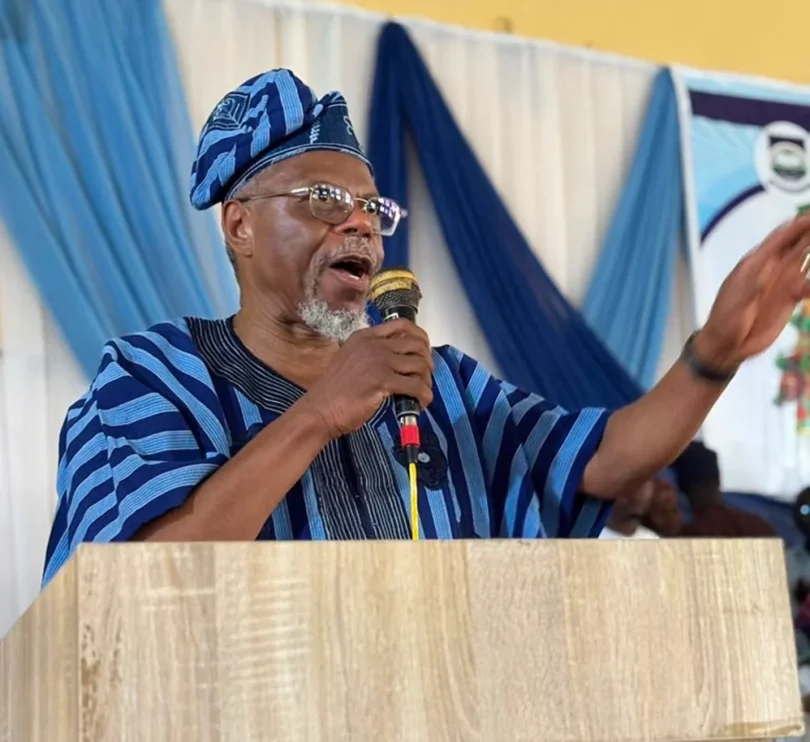
Professor Toyin Falola has called on Nigerian universities and other knowledge institutions to accord Yorùbá intellectual traditions the same academic recognition enjoyed by classical Western philosophies, arguing that African knowledge systems should no longer be treated as peripheral or inferior within global scholarship.
Delivering the keynote address titled “Yorùbá Mythologies and Their Relevance Today” during the inauguration of the Alaafin Institute of Yoruba Studies at Emmanuel Alayande University of Education, Oyo, Falola said the time had come for Nigeria to reposition indigenous knowledge as a central component of higher education and intellectual inquiry rather than a cultural relic.
The inauguration, themed “Preserving the Past, Educating the Future: The Renaissance of Yoruba Intellectualism,” attracted scholars, traditional rulers, academics, students, and cultural enthusiasts who gathered to celebrate the institutionalization of Yoruba studies and its place in national development.
Dignitaries from the traditional institution, academia and the cultural sector converged on Emmanuel Alayande University of Education for the inauguration, underscoring the national significance of the event. His Imperial Majesty, the Alaafin of Oyo, Iku Baba Yeye, Aláṣẹ Èkejì Òrìṣà, Oba Akeem Abimbola Owoade, Elewu-Etu I, served as the Royal Father of the Day. The university’s Vice-Chancellor, Professor Olanrewaju Olaniyan, was the Chief Host, while the Director of the Alaafin Institute of Yoruba Studies, Professor Akinkunmi Alao, coordinated the proceedings.
Falola argued that Yorùbá mythology represents far more than folklore or religious narratives, describing it instead as a sophisticated philosophical system that addresses enduring human questions about morality, governance, identity, justice, spirituality and existence.
According to him, the challenge confronting African knowledge is not a lack of intellectual substance but the unwillingness of academic institutions to accord it equal scholarly legitimacy.
ALSO READ: BREAKING: Court orders arrest of ‘fake’ agency DG, Adeyemi
“The issue is not whether Yorùbá mythology is significant. The issue is whether we, the intellectual and cultural institutions that generate and disseminate knowledge, the universities, the publishers, the museums, the policy organizations, are prepared to accept it as such,” he declared.
He urged universities to move beyond symbolic appreciation of African traditions and institutionalize them within mainstream academic disciplines.

“This implies putting it in philosophy courses with Aristotle and Descartes. To treat the corpus of Ifá as a serious object of scholarship, with the same resources as are devoted to Greek or Latin literature,” Falola said.
He maintained that such recognition should also extend to political philosophy, comparative religion, ethics, history, literature, anthropology and public policy.
“It involves seriously considering Yorùbá political thought while speaking about government in Africa and the diaspora. It involves seeing the Candomblé and Lucumí practitioners as the custodians of a profound living heritage of intellectualism, not as a picturesque cultural minority who need to be preserved,” he added.
Falola noted that one of the greatest consequences of colonialism was the systematic relegation of African intellectual traditions to the margins of global scholarship while elevating European traditions as universal standards.
He observed that this imbalance has endured long after political independence, forcing African philosophies to continually defend their relevance in ways Western philosophies never have to.
“I want to finish with a challenge… The term ‘relevance’ has a connotation that anything must justify its continuous existence by proving itself beneficial to the present. No one presents a lecture named ‘Greek Philosophy and Its Relevance Today’… The title itself reveals the burden unfairly placed on African intellectual traditions,” he argued.
According to him, requiring African philosophies to continually justify themselves reflects an inherited colonial mindset rather than any deficiency in the traditions themselves.
“It is the consequence of the ingrained, unspoken but ever-present attitude that African intellectual traditions are temporary, parochial, susceptible to revision, and must justify themselves in terms defined by others. We need to challenge this notion, and we need to do so by changing the discussion.”
Rejecting the notion that Yorùbá mythology requires validation from Western scholarship, Falola insisted that the tradition has already demonstrated its intellectual depth through centuries of survival, adaptation and global influence.
“Yorùbá mythology isn’t trying to be relevant. No audition required. It has already moulded the moral consciousness of millions of people on four continents, withstood some of the most brutal suppression ever visited upon any tradition, and offered a pattern of human flourishing that has proved surprisingly tough under radically different historical conditions.”
He traced the remarkable journey of Yorùbá philosophy across the Atlantic, explaining that despite slavery, colonial repression and attempts to eradicate African religions, Yoruba intellectual traditions survived and evolved into globally respected religious and philosophical systems.
He cited traditions such as Candomblé in Brazil and Lucumí in Cuba as evidence that African civilizations not only endured but reshaped the cultural and spiritual landscapes of entire regions.
According to him, the continued survival of these traditions demonstrates that African civilizations possess enduring philosophical foundations capable of addressing universal human concerns.
Falola further challenged the long-standing perception that African traditions are primarily ethnic or local in scope.
“The philosophical ideas that are built into this tradition, about the relational nature of the person, about the ethics of reciprocity, about the connection of the material and the spiritual, about the nature of time and ancestral duty, are not ethnically distinct. They are solutions to human questions, and human questions are everybody’s questions.”
He argued that indigenous philosophies should therefore be taught not because they belong to a particular ethnic group but because they enrich humanity’s collective understanding of ethics, politics, psychology and social organization.
The renowned historian also encouraged young scholars to engage Yorùbá traditions critically rather than romantically, emphasizing that preserving heritage does not mean resisting intellectual interrogation.
“The goal is not to keep the custom alive in amber or turn it into a museum of purity before colonization. To interact with it critically, artistically, and honestly. To question what it truly says, where it is genuinely enlightening, and where it is restricted, how it journeys across historical situations, and what it loses and gains in the voyage.”
He maintained that genuine scholarship requires dialogue with tradition rather than unquestioning acceptance or wholesale rejection.
“This is an interaction which is neither the unquestioning celebration which sees any challenge to tradition as cultural treachery, nor the uncritical rejection which sees any engagement with tradition as intellectual retreat. It means taking the tradition seriously enough to dispute with it.”
Falola concluded by urging Nigerian universities, research institutes and policymakers to place indigenous knowledge at the centre of national intellectual development, insisting that Africa’s future competitiveness depends partly on recovering confidence in its own philosophical heritage.
He said the inauguration of the Alaafin Institute of Yoruba Studies provides an opportunity to reposition Yorùbá intellectual traditions as globally relevant systems of knowledge capable of enriching scholarship, informing governance and contributing meaningfully to humanity’s search for truth and justice.