
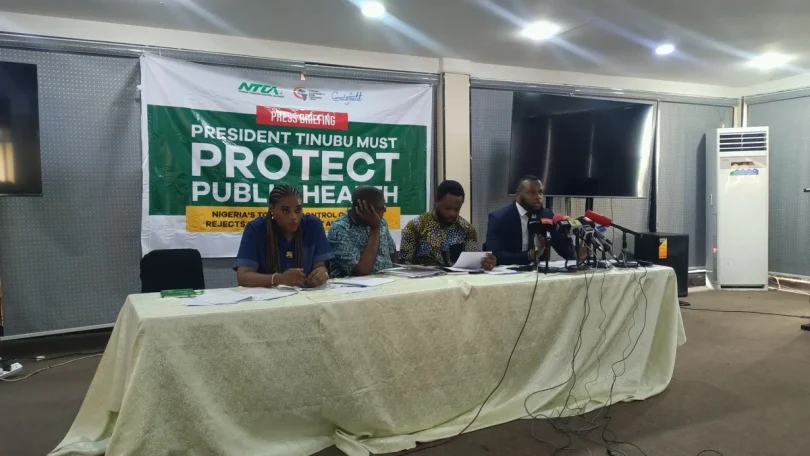
More than 100 civil society organisations, health advocates and public-interest groups under the Nigeria Tobacco Control Community have rejected the National Tobacco Control Act (Amendment) Bill 2025, alleging that the proposed legislation would create loopholes for the tobacco and nicotine industry while weakening existing public-health safeguards.
The groups, at a press briefing in Abuja, demanded the immediate withdrawal and comprehensive review of the consolidated bill, which they said could facilitate advertising, sponsorship, product sampling, online sales, and wider distribution of emerging nicotine products, including electronic cigarettes, heated tobacco products and nicotine pouches.
Reading the coalition’s statement, the Executive Director of Corporate Accountability and Public Participation Africa (CAPPA) said the groups supported updating the 2015 National Tobacco Control Act and its 2019 Regulations to address emerging products but rejected provisions they considered favorable to the tobacco industry.
“Our conclusion is that this bill does not protect Nigerians. It instead weakens existing safeguards and creates a wide-open market for tobacco and nicotine companies to thrive at the expense of public health,” the statement said.
The coalition particularly faulted the proposed inclusion of “tobacco harm reduction objectives” among the purposes of the Act, arguing that the concept could be used to justify weaker regulations for newer nicotine products.
“True harm reduction means breaking addiction, not enabling multinational corporations to recruit a new generation of youth,” it said.
The groups also criticised a provision that would define heated tobacco products as non-combustible products and exclude non-combustible items from the legal definition of tobacco products.
They argued that heated tobacco products contain actual tobacco and should therefore remain subject to the same regulatory framework as other tobacco products.
Another major concern was the proposed relaxation of the existing prohibition on tobacco advertising, promotion, and sponsorship.
According to the coalition, the bill would permit advertising of non-combustible products through adult publications, point-of-sale materials, and online platforms, while also allowing sponsorship of cultural, social, and recreational events ostensibly targeted at adults.
The groups argued that the proposed definition of an “adult publication” as one with at least 50 percent adult readership could still expose children to tobacco and nicotine advertising.
They further opposed provisions permitting online sales, remote orders, and courier delivery of non-combustible products, saying age-verification systems could easily be circumvented.
The coalition also raised concerns over a proposed provision allowing indoor vaping for product sampling, arguing that it could turn retail outlets into promotional and consumption points.
It said the bill would also permit cigars to be sold in packs of five instead of the existing minimum of 20, which it argued could reduce the cost barrier to experimentation among young people.
On packaging, the coalition said the bill would weaken existing health-warning requirements by allowing text-only warnings on vape liquids and smaller warnings on nicotine pouches, while exempting some e-cigarette and heating devices from carrying health warnings.
It also criticised provisions under which manufacturers would generate and internally approve their own safety dossiers, as well as a proposal giving the Minister of Health broad powers to exempt non-combustible products from provisions of the law.
The In-Country Coordinator of the Campaign for Tobacco-Free Kids, Michael Olaniyan, described the proposed legislation as a major rollback of Nigeria’s tobacco-control gains.
Olaniyan said the distinction between harm reduction and harm elimination was critical, particularly in protecting young people.
“Harm reduction is not harm elimination. What we are pushing for, what the National Tobacco Control Act 2015 is promoting, is harm elimination. We are saying children should not be exposed to harm of any size,” he said.
He argued that newer nicotine products could become an entry point for people who had never previously used tobacco.
“It is a pathway for introducing people who have never used cigarettes, who have never used the traditional tobacco products, to start using tobacco and nicotine products,” Olaniyan said.
He also questioned how the consolidbill Bill emerged, noting that two amendment proposals presented during a public hearing in November 2024 had subsequently resulted in a much larger document.
“Two documents totaling four pages were presented to the people of Nigeria for intervention… and then came out with a 31-page new document that has absolutely no bearing on the original two documents that were presented to Nigerians,” he said.
Olaniyan further criticised provisions that would permit advertising, prosampling,pling and online sales of non-combustible products, arguing that they would undermine existing tobacco-control measures.
He questioned the effectiveness of age verification for online purchases, particularly at the point of delivery.
“You and I know that there are several online platforms that all you need to verify your age is just click ‘Yes, I am 18 years old,’” he said.
He also warned against changing health-warning requirements from minimum standards to maximum limits, saying such a provision could allow manufacturers to substantially reduce the prominence of warnings.
“The standard gold practice is to put it at a minimum benchmark,” Olaniyan said.
According to him, the Bill would also give the minister broad powers to exempt certain products from the law, a provision he described as capable of creating opportunities for regulatory capture.
“The Nigerian health infrastructure cannot bear the burden of diseases and deaths that this bill, if passed, will bring upon us,” he said.
Olaniyan urged the Federal Ministry of Health and Social Welfare to take a stronger position on the bill.
“Public health is under attack in Nigeria, and the ministry that is vested with the responsibility of protecting the health of Nigerians must wake up to its responsibility,” he said.
Also speaking, a representative of the Nigerian Tobacco Control Alliance, Olawale Makanjuola, said tobacco-related deaths and healthcare costs demonstrated the need for stronger regulation.
“We lose over 20,000 Nigerians to smoking-related deaths every year,” Salaki said, adding that more than ₦201 billion was spent on health-related costs associated with smoking.
He expressed particular concern over Nigeria’s youthful population and the growing availability of novel nicotine products.
Makanjuola also warned that the proposed amendments could undermine Nigeria’s position as a model for tobacco control in Africa.
“Nigeria is a North Star for a lot of things happening in tobacco control across Africa,” he said, citing the country’s efforts to regulate tobacco promotion in the entertainment industry.
He accused the tobacco industry of seeking to expand its market under the guise of “harm reduction.”
“They see a country that is populated by young persons, over 60 percent. And so these people are also potential business interests. So they must do all they can to cultivate that business interest,” Salaki said.
Makanjuola said the proposed amendments appeared to prioritize commercial interests over public health.
“The industry’s interest can never, can never be put first on top of the public health and national security of this country. So we reject it,” Makanjuola said.
He called for the withdrawal of the bill and a transparent review involving relevant stakeholders, while urging the presidency to withhold assent if the legislation reached it.
“We reject this bill in its entirety. It does not stand for the interest of Nigerians,” he said.
The Executive Director of the New Thing International Foundation, Kenneth Anetor, also opposed the proposed product-sampling provision, warning that it could increase curiosity and initiation among young people.
“Sampling products at the point of sale creates an opportunity to increase curiosity amongst people that are not even using substances and even increase curiosity among youths. And this is an initiation,” Anetor said.
He also criticised the proposed sale of smaller packs, arguing that it could make tobacco and nicotine products more accessible to young people.
Anetor urged the National Assembly to recall the bill and provide an opportunity for wider stakeholder participation in its review.
He also appealed to President Bola Tinubu not to assent to the legislation in its current form, saying the move would help protect Nigerian children from exposure to addictive substances.