
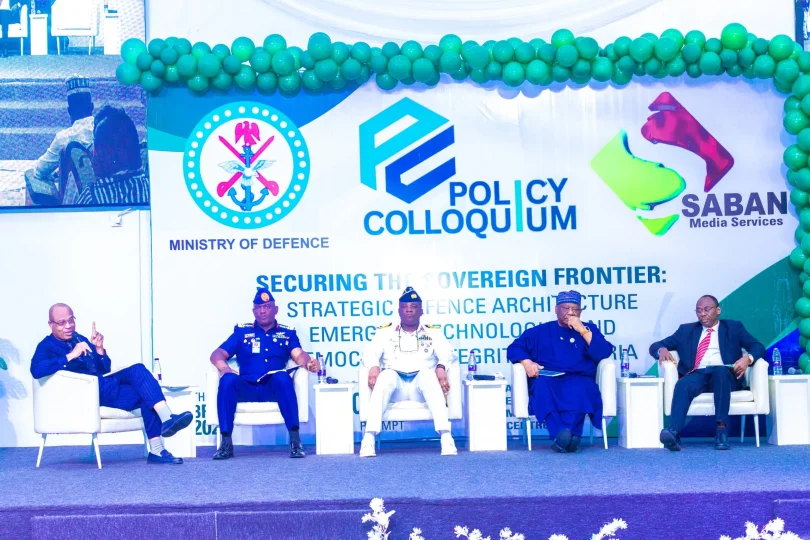
The Minister of Defence, Gen Christopher Musa (retd), has said that the administration of President Bola Ahmed Tinubu is prioritising national security to safeguard Nigeria’s sovereignty, preserve democratic institutions and promote national development.
Gen Musa stated this on Thursday while speaking at the 2nd Policy Colloquium 2026, held under the theme, “Securing the Sovereign Frontier: Strategic Defence Architecture, Emerging Technologies and Democratic Integrity in Nigeria.”
The Minister said President Tinubu had consistently reaffirmed the Federal Government’s resolve to strengthen national security and provide the Armed Forces with the capabilities required to protect the country.
According to him, “this strategic direction recognises that a secure and stable Nigeria is essential to the protection of our sovereignty, the preservation of our democratic institutions and the advancement of national development.
“In line with this priority, the Ministry of Defence remains focused on strengthening defence capabilities, advancing military modernisation and ensuring that the Armed Forces are adequately positioned to respond to the demands of the security environment,”
Gen Musa noted that Nigeria’s strategic frontier was increasingly being shaped by security challenges across the land, maritime, air and cyber domains.
He said addressing the challenges required a more integrated defence posture, supported by effective intelligence coordination, joint operations and interoperability among the Armed Forces and other relevant security institutions.
According to him, “our defence architecture must remain agile and forward-looking, with the capacity to anticipate threats, respond decisively and protect Nigeria’s territorial integrity and vital national interest”
Gen Musa also identified technology as an increasingly decisive factor in defence and national security, noting that rapid advances in artificial intelligence, unmanned systems, surveillance and reconnaissance, cyber capabilities and other emerging technologies were transforming military operations and the strategic environment.
He said Nigeria must remain at the forefront of these developments by investing in relevant technologies and strengthening the human, doctrinal and institutional capacity required to integrate them into the country’s defence capabilities.
This came just as the Special Adviser to President Bola Ahmed Tinubu on Media and Public Communications, Chief Sunday Dare, said that the withdrawal of some West African countries from the Economic Community of West African States in 2023 blunted key regional integration protocols, particularly those promoting the free movement of goods and services.
Chief Dare, who stated this while speaking on border management and regional cooperation at the occasion, pointed out that the development created a major regional crisis and undermined existing mechanisms for economic integration and regional cooperation.
He noted that the effectiveness of borders had implications not only for economic activities but also for regional security.
According to him, “the rupture that came in 2025 when the countries pulled out of ECOWAS created a major regional crisis. That pullout from ECOWAS simply blunted the ECOWAS protocol that promoted integration, free movement of goods and services,” Dare said.
“It eventually led to the creation of AES, another counter-regional body to ECOWAS. But it also challenged the other instruments and protocols that we have for regional cooperation,”
Chief Dare linked effective border management to both economic integration and regional security, stressing that borders served as the frontline for protecting regional stability.
“My research, which bordered at one and the same time the opportunity of regional cooperation, but also it serves as the front line for regional security,” he said.
He added that proper border management could facilitate economic integration, while poor management could contribute to instability.
Chief Dare also dismissed claims that Nigeria’s borders were closed, warning politicians against turning border security into an issue for electoral campaigns.
“The Interior Minister has stated the facts. Nigeria’s borders are open. And let me say for a fact, when it comes to the stability of our borders, when it comes to security, it should not be an arena of politicking or an arena to seek votes or to score cheap political points”
The presidential aide stressed that open borders did not mean uncontrolled borders, noting that immigration, customs and other security agencies remained responsible for regulating movements across the country’s borders.
“Our borders are critical. There are no open borders without controls. So you must understand there is a distinction,” Dare said.
Also speaking at the occasion, the Special Adviser to the Minister of Defence on Media, Leah Katung-Babatunde, said the Policy Colloquium was conceived to serve as a rigorous, non-partisan bridge—bringing together defence strategists, policy architects, technologists, civil society leaders, academics, the media and key state actors under one roof.
According to her, “We are not assembled here today merely to catalog challenges, but to forge actionable pathways, inform public policy, and construct a practical blueprint for national resilience,” she said.