
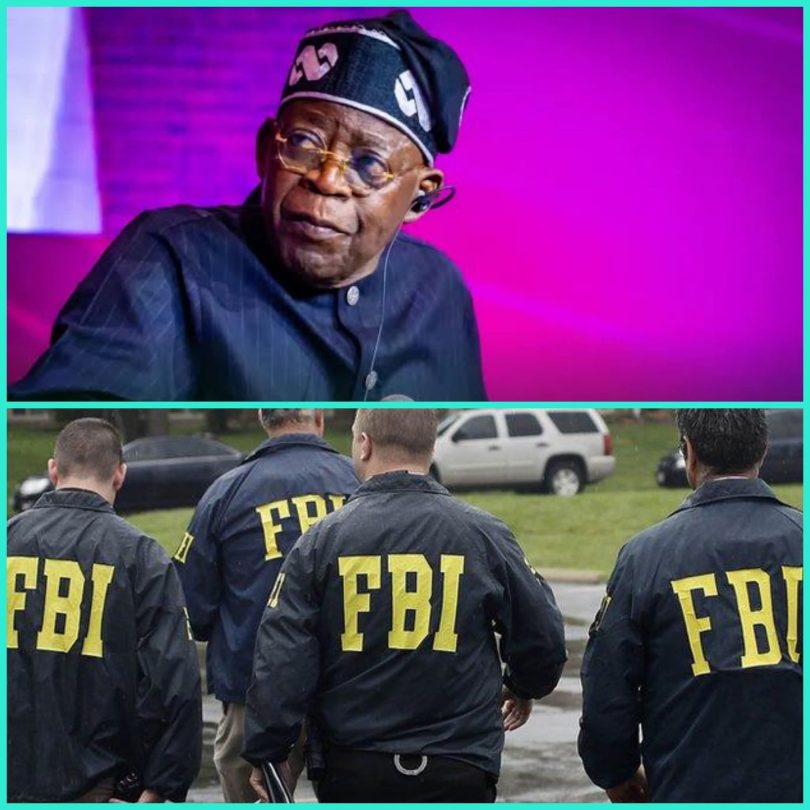
The United States Federal Bureau of Investigation (FBI) has warned that releasing some records relating to President Bola Ahmed Tinubu could endanger the lives or physical safety of individuals.
The agency made the disclosure in a court filing submitted before the US District Court for the District of Columbia on August 20, 2026, as it seeks permission to privately explain why portions of the records have been withheld.
The FBI asked the court to allow it to submit an ex parte, in camera declaration, meaning the agency would provide its full explanation privately to the judge and under seal.
According to the FBI, it cannot publicly disclose the complete basis for withholding certain records because doing so could reveal sensitive law-enforcement techniques and procedures.
The agency said it had relied on several exemptions under the US Freedom of Information Act (FOIA), including provisions relating to personal privacy, confidential sources, law-enforcement techniques and information that could endanger an individual’s life or physical safety.
> “The FBI has determined that it cannot provide on the public record the full basis for the application of Exemptions 7(E) and 7(F) to certain withholdings and that, therefore, an ex parte, under seal declaration is necessary,” the agency stated.
The records are being sought by Aaron Greenspan, founder of PlainSite, who submitted FOIA requests for records relating to Tinubu from 1992 and 1993, when Tinubu was in exile in the United States.
Among the materials requested are Tinubu’s FBI file and interview records connected to an FBI investigation.
The FBI said that, if the court grants its application, it intends to submit the confidential declaration before August 28.
Long-running FOIA dispute
The latest development forms part of a prolonged legal battle over requests for US government records concerning allegations linked to Tinubu and a Chicago drug investigation dating back to the early 1990s.
Greenspan had filed multiple FOIA requests with six US federal agencies, including the FBI and the Drug Enforcement Administration (DEA).
The agencies initially invoked so-called “Glomar” responses, declining to confirm or deny whether certain records existed.
However, in April 2025, US District Judge Beryl Howell ruled that the FBI and DEA had not sufficiently justified their refusal to confirm or deny the existence of records concerning Tinubu.
The judge subsequently ordered the agencies to lift their Glomar responses.
The latest filing indicates that the US Department of Justice is continuing to respond to subsequent court orders concerning the requested records.
Tinubu’s legal team had also sought additional time to respond in the matter, but Judge Howell reportedly declined the request for a 10-day extension.
The FBI’s latest application does not, by itself, establish the contents of the withheld records or prove any wrongdoing by President Tinubu. Rather, the agency is asking the court for permission to provide confidential justification for specific withholdings under the FOIA exemptions it has invoked.