
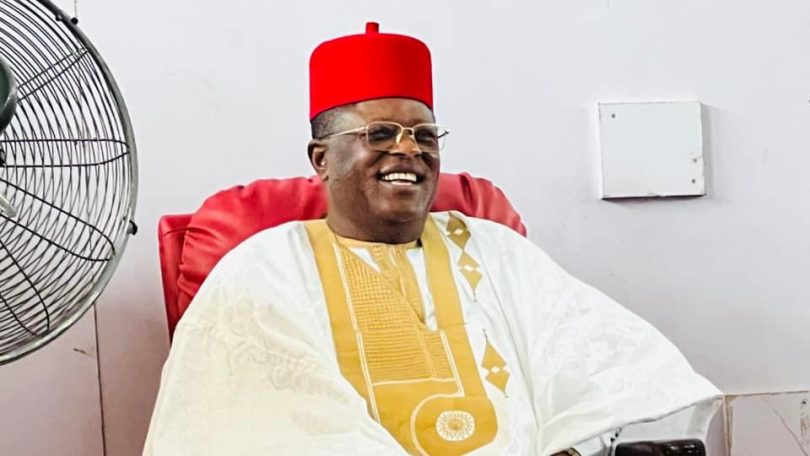
The Minister of Works, David Umahi, has said President Bola Tinubu’s administration is deliberately working to reunite the South-East and address what he described as longstanding problems affecting the region.
Umahi, a former governor of Ebonyi State, said the Federal Government’s growing investment in roads and other infrastructure across the South-East should be seen as part of a broader effort by Tinubu to reconnect the region with the rest of Nigeria and stimulate its economic development.
The minister made the claim in a statement issued on Thursday, while highlighting several infrastructure projects being undertaken by the Federal Government in the region.
According to Umahi, the South-East should recognise the scale of infrastructure being delivered under the Tinubu administration rather than dismissing the Federal Government’s efforts.
He argued that his presence as a minister from the region had helped attract attention to some of the projects currently being executed across the South-East.
Umahi said: “The President wants to bring the people of the South-East together. And I need to be really honest with you.”
He further claimed that some of the projects being implemented in the region might not have materialised without a minister from the South-East pushing for them.
“If I wasn’t the minister from South-East, we wouldn’t be able to get the projects we are getting right now. So, it’s a plan by the President to fix the problems in the South-East area.”
The former governor said he believed his role in the administration placed him in a position to give the region a stronger voice when decisions concerning major infrastructure projects were being made.
‘God Sent Me At A Time Like This’
Umahi also appeared to frame his position as a responsibility to speak candidly about the Federal Government’s activities in the South-East.
He said the people of the region would eventually recognise the significance of the projects being executed and the political circumstances surrounding their delivery.
“Because tomorrow, they will find out that, you know, God sent me at a time like this to tell the truth.”
His comments are likely to generate debate in a region where political disagreements over the Tinubu administration remain pronounced, particularly around questions of representation, development and the Federal Government’s relationship with the South-East.
The minister has also been at the centre of another heated infrastructure debate, this time over the Lagos-Calabar Coastal Highway.
Umahi recently challenged critics of the project to a public debate, insisting that construction was progressing and that the highway would play a major role in unlocking Nigeria’s economic potential.
Speaking at a press conference and stakeholders’ engagement on the project in Lagos, the minister rejected claims that construction would stall around Epe.
According to him, work had already moved beyond the area.
“Now, let anybody tell me any state that is not a construction site under President Bola Tinubu.”
Umahi also accused critics of deliberately undermining a project that he said would eventually benefit communities across the country, including the oil-producing Niger Delta.
‘The Road Has Passed Epe’
Responding to earlier criticism that the coastal highway would never extend beyond Epe, Umahi said such predictions had already been disproved by the progress of construction.
“You said, ‘This thing will not pass Epe.’ It has since passed Epe,” he said.
The minister questioned why some Nigerians were opposed to the project and suggested that certain critics did not want the Niger Delta and other regions to benefit from major infrastructure investment.
“They don’t want the Niger Delta where we drill the oil to benefit [from projects]. They darken counsel without knowledge.”
Umahi’s defence reflects the broader political argument surrounding the Tinubu administration’s infrastructure agenda: whether the government’s massive road projects are delivering genuine economic transformation or attracting more political controversy than public consensus.
For the Works Minister, however, the message is straightforward — the projects are moving, and he wants critics to put their arguments on the table and debate them publicly.