
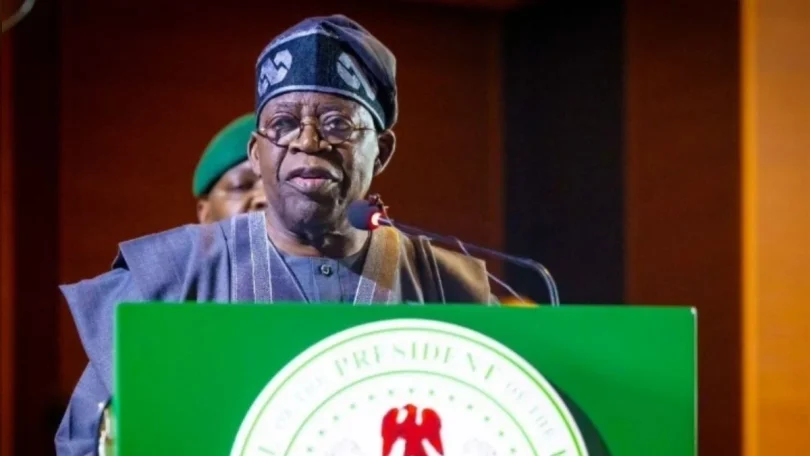
President Bola Tinubu will address world leaders at the 81st Session of the United Nations General Assembly in New York, United States, on Wednesday, September 23, 2026.
Tinubu is expected to deliver Nigeria’s national statement during the morning session on the second day of the high-level General Debate.
A provisional programme lists the Nigerian president as the 10th speaker, with his appearance expected between about 11:30 a.m. and noon New York time, equivalent to between 4:30 p.m. and 5 p.m. Nigerian time.
The General Debate is scheduled to take place from September 22 to 28 at the United Nations headquarters in New York.
The 81st session will bring together representatives of all 193 member states, including more than 150 heads of state and government.
Several other senior government officials are also expected to participate in the annual diplomatic gathering.
The theme of this year’s General Assembly is “Restoring trust, managing transformation: A United Nations that delivers for all.”
Brazilian President Luiz Inácio Lula da Silva is expected to open the high-level debate on September 22, followed by United States President Donald Trump as the leader of the host country.
Tinubu’s appearance will give Nigeria another opportunity to present its position on major international issues and highlight the policies of his administration before the global community.
The President is expected to speak on issues affecting Nigeria and the wider African continent, with economic development, international cooperation, peace and security expected to feature prominently.
Nigeria’s Permanent Representative to the United Nations, Ambassador Jimoh Ibrahim, had earlier confirmed that Tinubu would attend the meeting.
“The president was able to give us his word. Now, he will come to UNGA this September,” Ibrahim said.
The ambassador said Tinubu’s participation would allow Nigeria to present the reforms being implemented by his administration to the international community.
Ibrahim also disclosed that regional security would be one of the issues Nigeria intends to push during the gathering.
According to him, the Nigerian government is working with the United Nations on a regional border-policing initiative aimed at addressing security challenges arising from porous borders across West Africa.
“So, border policing will be fine. These are the kind of things that the UN is established for,” Ibrahim said.
Tinubu is also expected to participate in several meetings and side events during his stay in New York.
Issues such as climate action, rising sea levels and pandemic preparedness are among the subjects expected to feature during the high-level meetings.
The President is also expected to meet with outgoing UN Secretary-General António Guterres.
Guterres is scheduled to leave office at the end of 2026 after completing his second term.
Tinubu may also meet with UN Deputy Secretary-General Amina Mohammed, a Nigerian who has occupied the position since 2017.
There is also the possibility of a meeting between Tinubu and Trump on the sidelines of the General Assembly, although details of any such engagement have not been officially confirmed.
The upcoming appearance will also mark Tinubu’s return to the UN General Assembly after his personal attendance at the 78th session in 2023.
Vice-President Kashim Shettima represented Nigeria at the 79th and 80th sessions in 2024 and 2025.
During those sessions, Shettima delivered Nigeria’s national statement and maintained the country’s early position in the speaking programme.
The 81st session of the General Assembly will formally open on September 8, while the high-level General Debate will begin on September 22.
In a related development, the planned visit to New York comes amid renewed attention in the United States over records relating to past allegations involving Tinubu and US law enforcement agencies.
On August 28, the Federal Bureau of Investigation submitted records connected to the matter to Judge Beryl Howell of the United States District Court for the District of Columbia.
The records were not released publicly.
Instead, the FBI submitted them under seal for the judge’s private review after the court had directed the agency to comply with deadlines in the case.
The development was reported by Politics Nigeria after the FBI submitted the material to the court.
The records relate to investigations involving several individuals and allegations of drug trafficking dating back to the early 1990s.
The FBI said in its court filing that the records sought were generated as part of investigations involving multiple people suspected of drug-trafficking offences.
“The responsive records herein were compiled in furtherance of the FBI’s investigation of multiple individuals for drug trafficking crimes,” the agency stated.
The submission, however, does not amount to a finding that Tinubu committed a drug-related offence.
It also does not mean that the Nigerian president has been convicted of a crime in the United States.
The documents remain subject to the judge’s review, and the court will determine what material, if any, can eventually be released.
In April 2025, Judge Howell directed the agencies to search for and process records that were responsive to the FOIA requests, moving the dispute into another stage.
The controversy has been further amplified by Von Batten-Montague-York, a United States-based policy advisory and lobbying firm that has been campaigning for greater disclosure of the records.
On August 31, the firm claimed that a proposed private meeting between Tinubu and Trump during the UN General Assembly would not take place.
The firm alleged that members of the Trump administration had indicated that Trump would not hold a private meeting with Tinubu because of allegations concerning heroin trafficking.
The claim came from the lobbying firm and has not been presented as an official statement by the US government.
The firm has also continued to raise questions about records held by US law enforcement agencies.
Earlier this month, it claimed that the FBI and DEA were separately reviewing files connected to allegations involving Tinubu.
“Update: We can now confirm that, separate from the ongoing FOIA court review, the @FBI and @DEAHQ are reviewing files connected to the heroin-trafficking allegations involving Nigerian President Bola Tinubu,” the firm said in a statement posted on X.
The Nigerian Presidency has rejected attempts to portray the FOIA proceedings as a criminal case against Tinubu.
On September 3, Special Adviser to the President on Information and Strategy, Bayo Onanuga, said the matter was a civil dispute concerning access to government records.
“For clarity, the matter is a civil records-disclosure dispute under the United States Freedom of Information Act. It is not a criminal case against President Bola Ahmed Tinubu, nor has the court found him guilty of any criminal wrongdoing,” the Presidency said.
The government also stressed that the release or withholding of records under FOIA does not by itself establish criminal liability.
The Presidency further pointed to a February 4, 2003 letter from the US Consulate in Lagos stating that an FBI records check had found no criminal arrest records, wants or warrants for Tinubu at the time.
Tinubu has consistently denied wrongdoing in connection with the allegations surrounding the old US proceedings.