
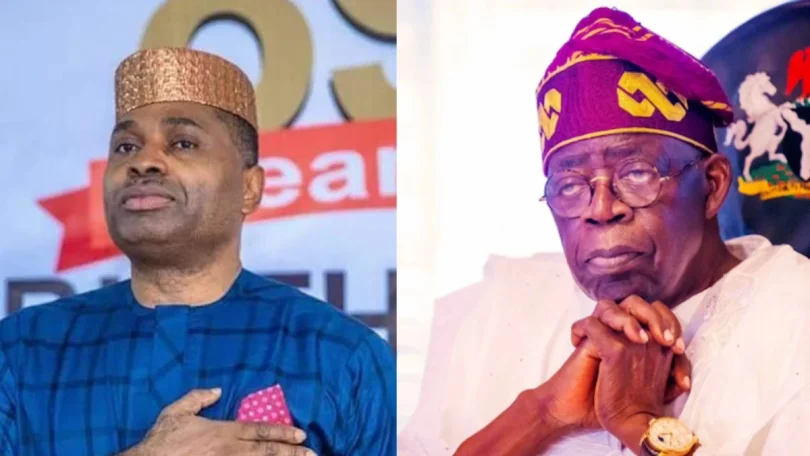
A Chieftain of the African Democratic Congress ADC, Kenneth Okonkwo has accused President Bola Tinubu’s administration of effectively bringing back petrol subsidy through its 30-day petrol price discount.
The lawyer insist that the government is only avoiding the name while introducing a measure designed to reduce the cost of fuel for Nigerians.
Okonkwo made the allegation during an appearance on Channels Television, where he challenged the Federal Government’s explanation that the temporary reduction in petrol prices was a discount and not a return to the controversial subsidy regime.
The former Labour Party spokesperson questioned the distinction between a subsidy and a discount, arguing that both measures could serve the same purpose when they are used to lower the amount consumers pay for petrol.
“Sorry to say this, Taiwo Oyedele lied when he said it was not subsidy. It was subsidy,” Okonkwo declared.
He argued that the government’s intervention was driven by the rising cost of petrol and the economic pressure on households and businesses.
According to him, the decision to reduce the pump price from about N1,500 to N1,350 per litre showed that the administration had recognised the need to provide relief to Nigerians.
“What were they trying to do? They were trying to reduce cost. They acknowledged by themselves that the cost was becoming unbearable for the people and they have to intervene to give relief for the people,” he said.
Okonkwo maintained that the government could not introduce a measure aimed at making petrol more affordable and then completely separate it from the concept of subsidy.
He argued that financial intervention intended to reduce the cost of a product for consumers could reasonably be described as a subsidy, regardless of the terminology adopted by the authorities.
“And they say it’s not subsidy. Then the whole idea of subsidy has to be redefined. Because what he did is exactly the definition of subsidy,” he added.
His comments were directed at Taiwo Oyedele, who has defended the government’s position on the temporary petrol price reduction.
The disagreement centres on whether the intervention should be understood as a subsidy or as a time-limited discount arrangement.
The Federal Government has maintained that the initiative does not amount to a restoration of the petrol subsidy that was removed in May 2023.
Okonkwo, however, argued that the distinction being made by the administration does not change the economic purpose of the intervention.
The controversy comes against the background of the sharp increase in petrol prices following the removal of the subsidy by Tinubu during his inauguration as president.
The policy led to changes in the Nigeria petroleum pricing system and has remained one of the most contentious economic decisions of his administration.
Before the removal, the government spent substantial sums to keep petrol prices below levels that would otherwise have reflected the full cost of supply.
The arrangement placed a significant burden on public finances, but it also helped shield consumers from the immediate impact of international oil prices, exchange-rate movements and domestic supply costs.
Following the policy change, petrol prices rose considerably in different parts of the country.
The increase affected transportation costs and contributed to higher prices for food and other essential goods, placing additional pressure on households already struggling with the rising cost of living.
For many Nigerians, the central concern has been the affordability of fuel and its wider effect on the economy.
Petrol remains an important input in transportation, power generation for businesses and the distribution of goods. Changes in its price therefore have consequences beyond what motorists pay at filling stations.