
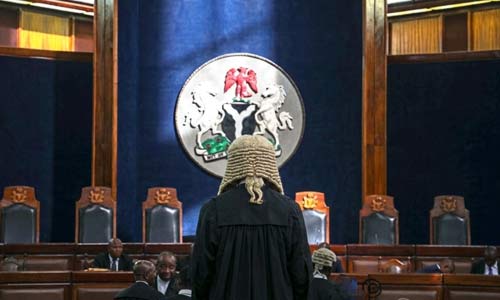
The Supreme Court has reserved judgment in an appeal by the Independent National Electoral Commission challenging the Court of Appeal decision that struck down key provisions of the Electoral Act 2026 regulating political party membership registers and the mode of conducting party primaries.
A seven-member panel of the apex court, presided over by Justice Adamu Jauro, heard arguments from the parties on Wednesday in Appeal No. SC/CV/495/2026 and said a date for judgment would be communicated to them.
The appeal arose from the July 16, 2026 judgment of the Court of Appeal in Abuja, which declared Sections 77(5), 77(6), 77(7) and 84(2) of the Electoral Act 2026 unconstitutional and void to the extent of their inconsistency with the 1999 Constitution.
The disputed provisions have significant implications for the conduct of political party primaries ahead of the 2027 general elections.
Under Section 77(5), only party members whose names appear in the membership register submitted to INEC are eligible to vote or be voted for during primaries, congresses and conventions. Section 77(6) bars a political party from using any register other than the one submitted to INEC, while Section 77(7) provides that a party that fails to submit its membership register within the prescribed period cannot field a candidate for the election. The Act requires the register to be made available to INEC not later than 21 days before a party primary, congress or convention.
Section 84(2), on the other hand, provides that political parties may nominate candidates for elective offices through direct primaries or consensus, effectively excluding indirect primaries under that provision.
The legal battle began when the Zenith Labour Party challenged the constitutionality of the provisions at the Federal High Court in Abuja.
The party argued that the requirements amounted to unconstitutional interference in the internal affairs of political parties and improperly restricted their powers to determine their membership and nominate candidates.
On May 5, 2026, Justice Mohammed Umar of the Federal High Court dismissed the suit, prompting the party to approach the Court of Appeal in Appeal No. CA/ABJ/CV/750/2026.
The Court of Appeal subsequently overturned the Federal High Court decision.
In a unanimous judgment delivered on July 16, a three-member panel led by Justice Balkisu Bello Aliyu held that the affected provisions conflicted with constitutional guarantees relating to political parties, particularly Sections 221 and 222 of the 1999 Constitution.
The lead judgment was delivered by Justice Eberechi Nyesom-Wike.
The appellate court reasoned that the National Assembly could not, through ordinary legislation, impose restrictions that interfered with powers constitutionally reserved to political parties or introduce statutory conditions that could prevent otherwise qualified persons from participating in the nomination process.
The Court of Appeal also rejected the portions of Section 77 that tied participation in party primaries exclusively to the membership register previously submitted to INEC and that prevented a party from fielding a candidate altogether if it failed to submit the register within the prescribed period.
The Court of Appeal also rejected the portions of Section 77 that tied participation in party primaries exclusively to the membership register previously submitted to INEC and that prevented a party from fielding a candidate altogether if it failed to submit the register within the prescribed period.
However, the appellate court did not invalidate Sections 77 and 84 in their entirety. Among other things, the general requirement that political parties maintain membership registers remained intact; it was the specified subsections imposing the disputed restrictions that were struck down.
INEC, dissatisfied with the judgment, took the dispute to the Supreme Court, placing before the apex court the broader constitutional question of how far the National Assembly and the electoral commission may regulate political party membership and candidate-selection procedures.
The Supreme Court’s eventual judgment will therefore determine whether Sections 77(5), (6), (7) and 84(2) remain invalid as held by the Court of Appeal or whether the statutory framework enacted by the National Assembly will be restored.
The matter is particularly consequential because the Electoral Act 2026 is the principal legislation governing the 2027 general elections. The Act itself expressly requires political parties seeking to nominate candidates to conduct primaries monitored by INEC, while the disputed Section 84(2) prescribes direct primaries or consensus as the available nomination methods.
For now, the Supreme Court has made no final pronouncement on the merits of INEC’s appeal. The seven-member panel merely reserved judgment after hearing the parties, with a date to be communicated when the decision is ready.