
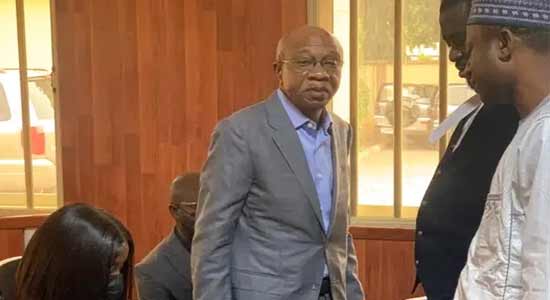
The Lagos State Special Offences Court sitting in Ikeja has overruled an objection raised by former Governor of the Central Bank of Nigeria (CBN), Godwin Emefiele, and admitted a certified true copy of a Supreme Court judgment concerning properties forfeited to the Federal Government in his ongoing $4.5 billion and ₦2.8 billion fraud trial.
Justice Rahman Oshodi, who delivered the ruling on Friday, admitted the Supreme Court judgment as Exhibit L, holding that a certified true copy of a judgment of the apex court is admissible as a public document under the law.
The judge rejected the defence’s argument that the document was incomplete because only the lead judgment had been tendered and that it should be excluded because of the circumstances in which it was delivered.
Justice Oshodi held that tendering only the lead judgment did not render the document incomplete or inadmissible.
However, the court restricted the purpose for which the document could be used, ruling that it was admissible only to establish what the Supreme Court decided in the previous proceedings.
The judge expressly held that the judgment could not be used as evidence for or against any party in the ongoing criminal trial.
The ruling followed an application by the prosecution, led by the Director of Public Prosecutions of the Federation, Rotimi Oyedepo, SAN, seeking to tender the certified true copy of the Supreme Court judgment through an investigator with the Economic and Financial Crimes Commission (EFCC), Alvan Gurumnaan.
The document concerned a previous Supreme Court decision relating to properties forfeited to the Federal Government and linked to the former CBN governor.
However, Emefiele’s lead counsel, Ojo Olalekan, SAN, opposed its admission, challenging both the form of the judgment and its relevance to the ongoing criminal proceedings.
Olalekan argued that the document was signed by only four justices, whereas decisions of the Supreme Court are ordinarily delivered by panels consisting of five or seven justices.
He further submitted that the judgment arose from non-conviction proceedings and was therefore irrelevant to the criminal charges being prosecuted against his client.
According to the defence, admitting the judgment in the circumstances would be inappropriate because the previous proceedings were different from the criminal trial before the court.
Counsel to the second defendant, Henry Omoile, Adeyinka Kotoye, SAN, aligned himself with the objection raised on behalf of Emefiele.
Kotoye urged the court to reject the document, particularly because it was being tendered after the proceedings had already commenced.
Responding to the objections, Oyedepo maintained that the document was a duly certified true copy of a Supreme Court judgment and satisfied the statutory requirements for admissibility.
The prosecution counsel specifically relied on Sections 102 and 104 of the Evidence Act, arguing that the document qualified as a public document and had been properly certified.
After considering the arguments of both sides, Justice Oshodi ruled in favour of the prosecution on the question of admissibility.
The judge held that the document was admissible notwithstanding the defence’s objections concerning the number of justices who signed it and the fact that only the lead judgment was tendered.
He consequently admitted the Supreme Court judgment as Exhibit L.
Justice Oshodi, however, drew a distinction between admitting the document into evidence and using it to establish the liability or guilt of any defendant.
The court restricted the judgment’s evidential purpose to showing what had been decided in the earlier case, rather than treating those findings as proof for or against any party in the present proceedings.
Following the ruling, the EFCC investigator, Gurumnaan, continued giving evidence and was subjected to cross-examination by Emefiele’s counsel.
During the cross-examination, Olalekan questioned the witness about his involvement in the investigation that led to the charges against the former CBN governor.
Gurumnaan told the court that he personally took statements from individuals connected with the investigation, analysed bank statements and coordinated the activities of other investigators assigned to the case.
He also confirmed that he interviewed the Managing Director of Zenith Bank, Dr. Ebenezer Onyeagwu, during the investigation.
However, when asked whether a statement was obtained from Onyeagwu following the interview, the witness said he could not immediately recall.
Gurumnaan further disclosed that the investigation involved hundreds of interviews with officials of the Central Bank of Nigeria, employees of commercial banks and personnel of other government agencies.
He explained that the investigative activities included gathering statements, examining financial records and coordinating information obtained by members of the investigation team.
Emefiele is standing trial on a 19-count charge bordering on alleged gratification, corrupt demands and abuse of office involving $4.5 billion and ₦2.8 billion.
His co-defendant, Henry Omoile, is facing a separate three-count charge relating to the alleged unlawful acceptance of gifts.
The charges remain allegations before the court, and the admission of the Supreme Court judgment does not constitute a finding of guilt against either defendant.
Following the proceedings, Justice Oshodi adjourned the case until December 17, 2026, for the continuation of the cross-examination of the EFCC investigator.
Post Title: “Supreme Court Judgment Is Admissible” — Court Overrules Emefiele’s Objection, Admits Judgment In $4.5bn, ₦2.8bn Fraud Trial By Naijaonpoint.