
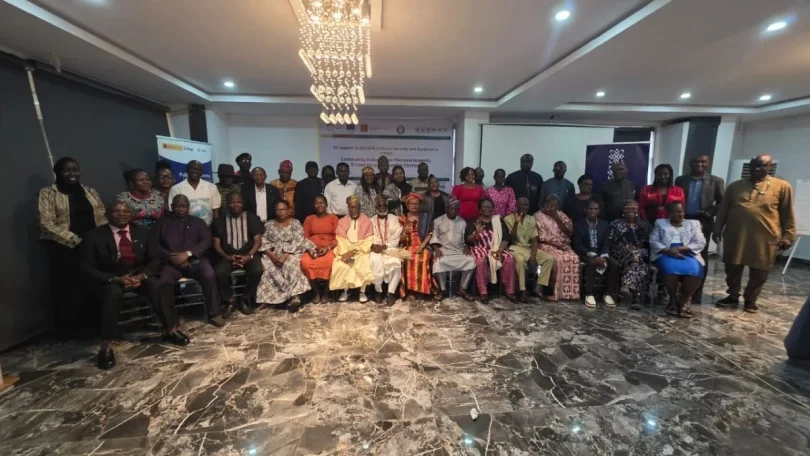
Stakeholders from civil society organisations, community leadership, the media, women and youth groups have called for peaceful, transparent, inclusive and credible elections in Nigeria, urging citizens and political actors to reject electoral violence, vote buying, hate speech, misinformation and other practices capable of undermining democracy.
The call was made at the end of a two-day Community Dialogue on Electoral Integrity, themed: ‘Trusted Voices for Credible Elections,” held from August 11 to 12, 2026, at Signature Tower Hotel, Ibadan, Oyo State.
ALSO READ: Coalition possible ahead of 2027 — ADC spokesperson, Abdulahi
The dialogue was organised by the Fundación para la Internacionalización de las Administraciones Públicas (FIAP), a Spanish Cooperation entity, under the European Union Support to ECOWAS in Peace, Security and Governance (EPSG) Project.
The event brought together 40 key stakeholders from seven states across Nigeria’s South-West and North-Central geopolitical zones.
Participants examined challenges confronting electoral integrity and democratic participation in Nigeria and discussed practical measures communities and other stakeholders could adopt to promote peaceful and credible elections.
They expressed concern over the persistent threat of electoral violence, calling on political parties, candidates and their supporters to reject violence, intimidation and inflammatory rhetoric as tools of political mobilisation.
The stakeholders declared, “No political ambition is worth the loss of a life or the destruction of our communities.”
They urged political actors to resolve disagreements through dialogue and lawful democratic processes, stressing that elections should be a means of choosing leaders rather than a trigger for violence.
“Our votes should determine our leaders, not violence. Our differences should strengthen our democracy, not destroy our communities,” they said.
The stakeholders also called on traditional and religious leaders, community influencers and youth leaders to use their influence to discourage the recruitment of young people into political violence.
“Young people must not be used as instruments of political violence. They should be empowered to participate meaningfully in democratic processes and become agents of peace and development,” the participants said.
The dialogue also emphasised the importance of restoring public confidence in electoral institutions.
Participants called for “greater transparency, accountability, effective communication and meaningful engagement between electoral institutions and citizens.”
They stressed that citizens needed timely and reliable information to participate effectively in elections and have confidence in electoral outcomes.
According to them, “An informed citizen is better positioned to make responsible electoral choices and demand accountability from political leaders.”
The stakeholders expressed particular concern over the growing spread of misinformation and disinformation, especially through social media and other digital platforms.
They warned that “unverified, misleading and inflammatory information can heighten political tensions, deepen social divisions and undermine confidence in electoral institutions.”
They therefore urged Nigerians to verify information before sharing it, while calling on media organisations and civil society groups to strengthen fact-checking, media literacy and public awareness initiatives.
“Citizens must learn to pause, verify and confirm information before sharing it, especially during election periods when false information can have serious consequences,” they said.
The stakeholders further called for stronger collaboration among electoral institutions, civil society organisations, the media, security agencies and communities.
They said, “No single institution can guarantee electoral integrity alone. We need coordinated action, information sharing and continuous engagement among all stakeholders.”
Participants also highlighted the need for greater participation of women and young people in Nigeria’s political and electoral processes.
They stressed that women and youths should not be regarded merely as voters or campaign supporters.
“Women and young people must have meaningful opportunities to participate as candidates, leaders, decision-makers, peacebuilders and agents of democratic development,” they said.
The stakeholders also called for deliberate measures to ensure that persons with disabilities and other marginalised groups were not excluded from electoral participation.
On electoral security, participants advocated stronger community-based mechanisms for identifying and responding to emerging threats to electoral peace.
They noted that community leaders, CSOs, media practitioners, women and youth organisations were often among the first to identify signs of political tension.
“Early warning must be matched with early response. We cannot wait until violence occurs before taking action,” the stakeholders warned.
They therefore advocated sustained community dialogue before, during and after elections to identify potential flashpoints and prevent conflicts from escalating.
At the end of the dialogue, participants committed themselves to becoming “Trusted Voices for Credible Elections” within their respective communities.
They pledged to “promote peaceful democratic participation, encourage informed electoral choices, counter misinformation, discourage vote buying and political intimidation, and support initiatives that strengthen confidence in electoral institutions.”
Representatives of FIAP and project partners reaffirmed their commitment to supporting democratic governance, peacebuilding and inclusive political participation across the ECOWAS region.
They emphasised that credible elections were essential not only for determining political leadership but also for promoting peace, stability, accountability and sustainable development.
The stakeholders concluded that electoral integrity was a collective responsibility.
They called on citizens, political parties, candidates, electoral institutions, security agencies, traditional and religious leaders, the media and civil society organisations to play their respective roles in ensuring that elections were conducted peacefully, transparently, inclusively and credibly.
“Credible elections cannot be achieved by electoral institutions alone. Every Nigerian has a role to play in protecting the integrity of our democracy,” they said.
The participants reaffirmed their commitment to working collectively towards peaceful, inclusive, transparent and credible electoral processes in Nigeria.