
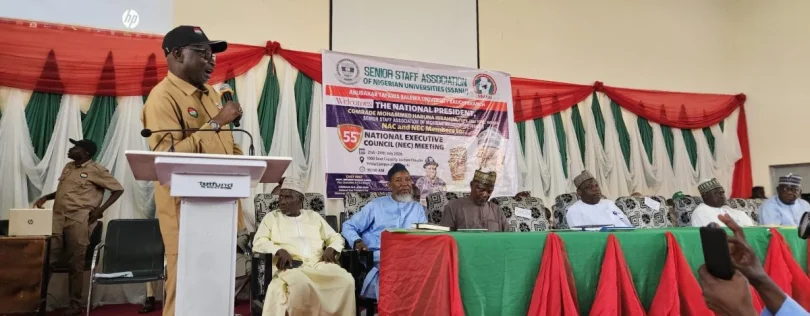
The Senior Staff Association of Nigerian Universities (SSANU) has called on the Federal Government to intensify efforts to secure the release of schoolchildren abducted in Borno State, urging authorities to deploy the same level of commitment that led to the rescue of abducted pupils in Oyo State.
The appeal was made by the National President of SSANU, Comrade Mohammed Hassan Ibrahim, while addressing delegates at the 55th National Executive Council (NEC) meeting of the association held at the Abubakar Tafawa Balewa University (ATBU), Bauchi, on Wednesday.
In his state-of-the-nation address, Ibrahim lamented that while pupils abducted in Oyo State had been rescued, children kidnapped on the same day in Borno State remained in captivity.
“Nobody knows their condition, whether they are dead or alive,” he said.
He stressed that meaningful national development could not be achieved in an atmosphere of insecurity.
“National progress must not be measured only by improving statistics, but by the security, dignity and quality of life experienced by the ordinary citizen,” he said.
According to him, kidnapping, banditry, insurgency, communal violence and other forms of criminality continue to threaten lives, disrupt economic activities and endanger schools, universities, highways and farming communities across the country.
Ibrahim recalled that pupils and teachers abducted from three schools in Oriire Local Government Area of Oyo State on May 15, 2026, were rescued after spending 56 days in captivity through a coordinated operation involving the military, police, intelligence agencies, the Nigeria Security and Civil Defence Corps, Amotekun, vigilantes and local hunters.
He noted that the Senate also approved N50 million in support for the families of two teachers and three security personnel who lost their lives during the abduction and rescue operation.
However, he expressed concern that 42 children abducted on the same day from Mussa Primary and Junior Secondary School and nearby homes in Askira/Uba Local Government Area of Borno State were still being held by their captors more than two months later.
Although the Borno State Government had expressed sympathy and promised to intensify rescue efforts, Ibrahim said parents continued to complain about the lack of information regarding the whereabouts of their children.
SSANU commended the commitment shown in securing the release of the Oyo victims but insisted that the same urgency and national attention should be extended to the Borno children and every other community facing similar tragedies.
“The life of every Nigerian child must have equal value, regardless of state, region, religion or ethnicity. What is good for one part of Nigeria must be good for all,” he said.
The SSANU president described the passage of the constitutional amendment on state police by the National Assembly as a significant step toward improving local security but noted that it still required approval by at least two-thirds of the state Houses of Assembly and presidential assent before becoming law.
He cautioned that strong constitutional safeguards must be put in place to prevent state police from being used against political opponents, workers, journalists and trade union leaders.
He also urged governments and university managements to strengthen campus security through perimeter fencing, surveillance systems, adequate lighting, emergency communication facilities, trained personnel and closer collaboration with security agencies.
“The protection of students, workers and communities must never be treated as an optional expense,” he said.
Speaking on the recently signed 2026 FGN-SSANU agreement, Ibrahim described it as a major milestone for non-teaching staff in Nigerian universities.
The agreement, signed on June 29, 2026, provides for improved remuneration, welfare, training, professional recognition and career progression, including a 35 per cent upward review of emoluments, enhanced earned allowances and progression opportunities up to CONTISS 15.
He said universities could not function effectively without the contributions of registry, bursary, audit, ICT, library, laboratory, engineering, health, security and other professional non-teaching personnel.
Although the agreement took effect from January 1, 2026, Ibrahim said full implementation was awaiting the necessary circular from the National Salaries, Incomes and Wages Commission.
“As at this morning, I received a call from the Secretary of the National Salaries, Incomes and Wages Commission confirming that only a few grey areas remain before the circular is signed. Any moment from now, we are good to go,” he said.
He urged universities and inter-university centres to implement the agreement fully and transparently once the circular is released, while calling for the immediate activation of the Agreement Implementation Monitoring Committee to ensure compliance.
Ibrahim commended the Federal Government’s student loan programme and the 2026 TETFund allocation of N2.53 billion to each public university but maintained that TETFund was only supplementary and should not replace adequate government funding or the outstanding N1.3 trillion university revitalisation commitment.
He cited the financial challenges facing universities, noting that many institutions struggle to meet basic operational costs, including electricity bills.
He praised the federal government’s solar power initiative in selected universities and called for its expansion to all public universities.
“Government should provide a transparent account of funds released, projects completed and outstanding obligations. Universities require reliable electricity, modern laboratories, digital infrastructure, research facilities and qualified personnel,” he said.
He added that digital transformation should enhance efficiency and staff development rather than lead to job losses or casualisation.
On the economy, Ibrahim observed that despite a marginal decline in headline inflation from 15.93 per cent in May to 15.91 per cent in June 2026, food inflation rose from 16.9 per cent to 17.52 per cent during the same period.
He said rising costs of food, housing, transportation, electricity, healthcare and education continued to erode workers’ purchasing power.
“Economic progress must be measured by its impact on citizens, not merely by improvements in national statistics,” he said.
He called for policies that would protect the real value of workers’ wages, improve pension benefits, expand affordable housing and transportation and strengthen social protection programmes.
Earlier, the Vice-Chancellor of ATBU, Prof. Ibrahim Garba, thanked SSANU for choosing the university to host the NEC meeting, describing it as a reflection of the cordial relationship between the union and the institution’s management.
He also commended Ibrahim’s leadership, saying it had strengthened the association and increased its visibility nationwide.
Prof. Garba assured members that the university management would continue to collaborate with SSANU and other unions to maintain industrial harmony and a conducive academic environment.
In his welcome address, ATBU SSANU Branch Chairman, Comrade Sulisma Dauda Jatau, said the cordial relationship between the union and management had produced significant progress.
He noted that members of the association had recently been appointed to head the Directorate of Procurement and the Directorate of Information and Communication Technology (DICT), expressing optimism that more opportunities would emerge through sustained engagement.
Jatau also thanked Bauchi State Governor, Senator Bala Abdulkadir Mohammed, for maintaining peace and security across the state.
“Our strength lies in our unity. We must continue to uphold solidarity, transparency and accountability. Despite the progress we have recorded, challenges such as the usurpation of non-teaching positions and career progression issues remain, and we hope they will be resolved through the ongoing review of the university’s conditions of service,” he said.
He described his seven-year tenure as branch chairman as a period of gains, challenges and opportunities, thanking the university governing council, management, staff, students and congress members for their support.