
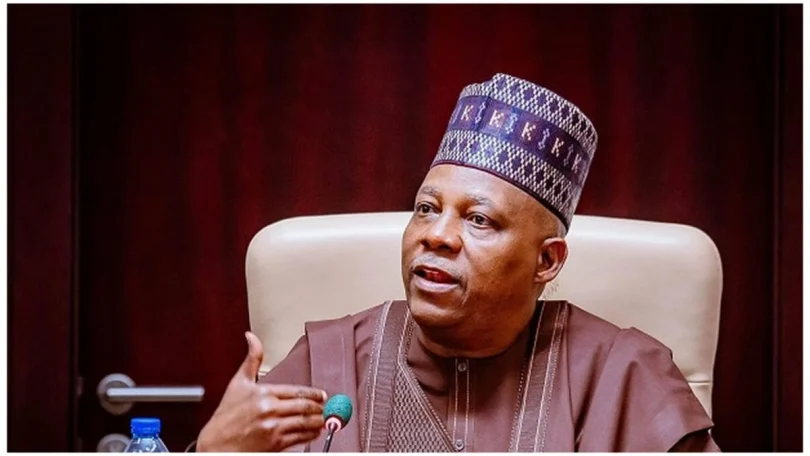
Vice President Kashim Shettima has appealed to Nigerians, friends, associates and well-wishers to shun public celebrations and congratulatory advertisements as he prepares to mark his 60th birthday on September 2, 2026.
Shettima, specifically, urged his associates not to place congratulatory messages in newspapers or broadcast celebratory messages on radio, television and digital platforms.
The Vice President said he preferred to keep the occasion low-key, stressing that public attention should remain focused on national development and the challenges confronting the country.
In a statement issued on Saturday by his Senior Special Assistant on Media and Communications, Stanley Nkwocha, Shettima said, “To ensure absolute propriety, I respectfully appeal that there should be no public birthday celebrations, congratulatory gatherings or goodwill advertorials across print, broadcast and digital media platforms.”
Rather than organising celebrations or spending money on birthday advertisements, the Vice President asked Nigerians and his well-wishers to direct their goodwill towards prayers for the country and President Bola Tinubu’s administration.
He specifically requested prayers for the success of the Federal Government’s economic reforms, sustainable solutions to insecurity, greater national unity, peace and prosperity for Nigerians.
According to Shettima, his 60th birthday should provide an opportunity for reflection, gratitude and renewed dedication to public service rather than personal festivities.
The appeal came as President Tinubu reaffirmed that national security remains central to his administration’s economic ambitions, insisting that sustainable prosperity cannot be achieved without protecting lives and property.
Tinubu stated this on Friday in Abuja during the graduation ceremony of participants of National Defence College Course 34, where he was represented by Shettima.
The President said the government’s economic strategy was built around stabilising macroeconomic fundamentals, strengthening local industries and attracting investment, but stressed that these objectives depended on a secure environment.
“Our economic ambitions accompany the duty to secure our people. The Armed Forces and security agencies continue to confront terrorism, banditry, kidnapping, piracy and organised criminality with courage and professionalism,” Tinubu said.
He pledged continued government support for the military and other security agencies through the provision of equipment, training, resources and institutional backing.
“Peace creates room for enterprise, and enterprise enlarges the citizen’s stake in peace. When communities recover security, opportunity must follow, because stability grows where people can work, trade, learn and hope,” the President added.
Tinubu also linked Nigeria’s security and economic prospects to broader African development, arguing that the continent’s long-term security would increasingly depend on productive economies, regional value chains, innovation and industries capable of providing employment for its growing youthful population.
He said the deepening of the African Continental Free Trade Area made industrialisation crucial to inclusive growth, reduced structural vulnerability and stronger continental bargaining power.
The President further highlighted his administration’s efforts under the Renewed Hope Agenda to create a more productive and competitive economy through private-sector investment, local value addition and infrastructure development.
He listed investments in roads, railways, ports, energy and digital connectivity, saying they would reduce business costs, link markets and strengthen national integration.
Tinubu added that the government was expanding capacity in agriculture, solid minerals, manufacturing, technology and the defence industry.
“Sovereignty acquires substance when a nation can absorb shocks, meet essential needs and defend its interests,” he said.
Addressing the 103 graduating participants, the President described the National Defence College programme as a reflection of the broad expertise required for modern statecraft, noting that it brought together personnel from the Armed Forces, Police, public institutions and friendly countries.
He congratulated the participants on completing the rigorous programme and urged them to use the networks established during their training to promote cooperation, peace and development across Africa and beyond.
Tinubu also commended the commandant, faculty and staff of the college for sustaining strategic education and policy-oriented research.