
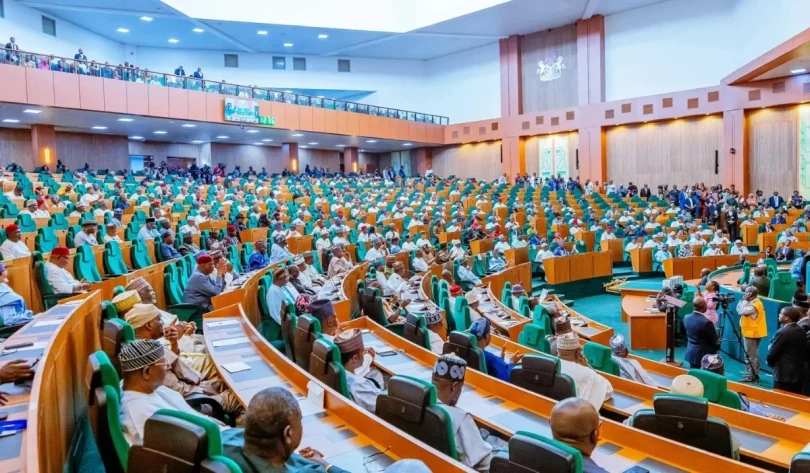
The House of Representatives, on Wednesday, questioned Hussein Ishak Magaji, the Registrar General of the Corporate Affairs Commission (CAC), regarding the N52.816 billion in revenue generated between October 2025 and June 2026.
During a revenue monitoring and oversight exercise conducted by the House Committee on Finance, chaired by Hon. Abiodun James Faleke, lawmakers also inquired about the reasons behind the delay in the payment of N13.9 billion in outstanding liabilities owed by the Commission, as reported by the Fiscal Responsibility Commission (FRC).
The situation escalated when lawmakers asked for the number of staff who retired from the Commission during the review period. In response, Mr. Magaji stated that there were no retirements, which led to further scrutiny over the small computer printout of the documents he submitted to the lawmakers.
While addressing the Committee’s questions, Mr. Magaji, who assumed his position in 2023, initially asserted that the Commission generated N52.8 billion during the specified period. He later argued that the Commission is a fully self-funded agency, but also claimed it is not a revenue-generating agency.
He explained that the Commission “generates its income solely from internally generated revenue and remits 50% same in compliance of the Finance Act of such income to the government as advance payment of operating surplus, pending the completion of annual audited accounts, when the actual operating surplus due to the government based on 80-20 sharing formula is established as provided under the Provisional Regulation of Section 22 of the Fiscal Responsibility Act.”
According to him, 50 percent of the accrued revenue amounting to N28.45 billion was deducted as direct remittance.
He also informed the Committee that the Commission registered 322,008 entities within the period under review, adding that each entity was registered at the sum of N10,000.
Unsatisfied by his response, the lawmakers who probed further demanded a breakdown of various categories of entities registered, including limited liability companies, and in his response noted that registration for reservation stands at N1,000 while business name is N10,000, and business enterprise costs N20,000, adding that each entity registration depends on its share capital.
In a swift response to his presentation, Hon. Faleke, who presided over the session, ruled that “rather than coming to you to do status inquiry, we will do status of inquiry on you tomorrow.”
Unsatisfied with his response, Hon. Stanley Adedeji underscored the need for the Commission and all revenue-generating federal Institutions to automate their revenue inflow to enable easy tracking.
Hon. Faleke said: “We are going to adjourn for you to come back and give us complete information. Rather than coming to you to do a status inquiry, we will do the status inquiry here tomorrow. When you come in tomorrow. Let me give you an example: Company incorporation, Enterprise. The names of all the enterprises you have registered. The amount created.
“You are laughing. You can give us soft copy now. You can download it to flash drives. We’ll come with our laptops here tomorrow. The ICT man has directed that we must come with laptops, and we have agreed. We all have laptops.
“So, for example, the limited liability company. You charge based on share capital, right? Categorise them from 1 million to 500 million.”
While responding to the N13.9 billion outstanding liability owed by the Commission, Mr. Magaji disclosed the Commission and the Fiscal Responsibility Commission “have reconciled, and they have accepted that they are keeping the payment plan for seven years,” adding that the Commission has since January 2024 commenced the payment of the sum of N500 million on quarterly basis to offset the liability.
However, Hon. Faleke who expressed displeasure over the position, said that the agreement is unacceptable to the Committee.
In his intervention on the need for the MDAs to automate the revenue generation system, Hon. Adedeji said: “I think in order for them to be better prepared for this exercise tomorrow and in the near future there will also be a need for an ICT audit so that that way, we can verify, monitor this income because right now we want to stop borrowing and everywhere we can find money we automate the process. So that there is transparency, that’s the whole idea it’s not because we are coming to witch-hunt you.
“We want to make sure that all the inflows coming into the different agencies are well-monitored by this Committee.”
To this end, the CAC manager team is expected to appear before the Committee on Thursday to provide all relevant documents for further legislative action.