
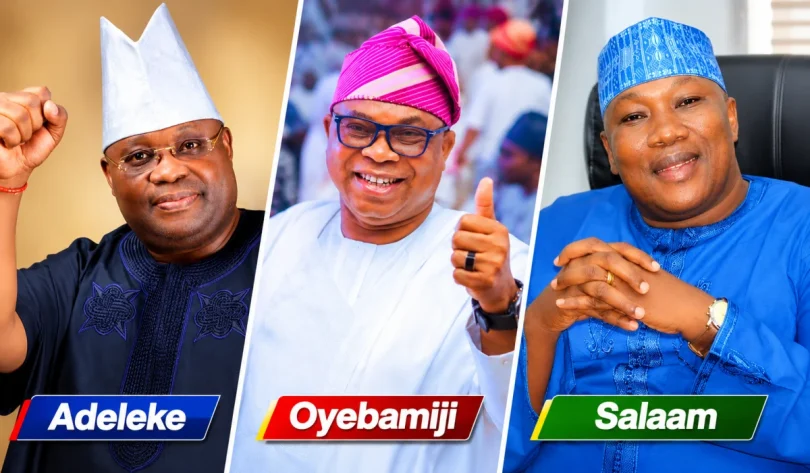
As #OsunDecides2026 approaches, public interest has increasingly focused on the political figures vying for the Bola Ige House, the seat of government in Osogbo.
Fourteen candidates are on the final ballot released by the Independent National Electoral Commission (INEC), but the contest has largely been shaped by the campaigns of three major contenders: the incumbent governor, Ademola Adeleke of the Accord Party; the All Progressives Congress (APC) candidate, Bola Oyebamiji; and the African Democratic Congress (ADC) candidate, Najeem Salam.
The three candidates bring different political backgrounds, experiences and support bases to a contest that has attracted considerable attention across the state, particularly because of the shifting political alliances surrounding the election.
Ademola Adeleke — The ‘dancing’ incumbent seeking another term

Governor Ademola Adeleke enters the #OsunDecides2026 race with the advantage of incumbency and the experience of governing Osun since 2022.
Adeleke, 65, is seeking re-election on the platform of the Accord Party. Before his emergence as governor, he represented Osun West Senatorial District in the National Assembly and had previously contested the governorship election. INEC’s final list confirms him as one of the candidates for the August 15 poll.
His campaign is anchored largely on his administration’s record in infrastructure, workers’ welfare and other areas of governance, while his opponents have questioned aspects of his administration’s performance.
For Adeleke, the election is essentially a referendum on his first-term record and his ability to secure another four years in office.
Bola Oyebamiji — The APC challenger

Bola Oyebamiji is the APC’s candidate and one of the major figures in the #OsunDecides2026 race.
A former Commissioner for Finance in the State, Oyebamiji has built his campaign around his experience in public administration and economic management. The 60-year-old is seeking to return the APC to power in the state after the party lost the governorship seat to Adeleke in 2022.
Oyebamiji’s candidacy has given the APC an opportunity to combine its political structure with a candidate whose campaign emphasises competence, economic management and continuity with the party’s broader political agenda, while also positioning him as a bridge between the State and the Federal Government.
Najeem Salam — The ADC’s third force

Najeem Salam represents the ADC in the election and comes into the contest with considerable political and legislative experience.
Salam, 60, previously served as Speaker of the Osun State House of Assembly and later represented Osun West in the House of Representatives. INEC’s final list identifies him as the ADC’s governorship candidate.
His candidacy has also added another dimension to the #OsunDecides2026 race, particularly with the emergence of the ADC as a significant political platform in the state.
Salam is therefore seeking to position himself as an alternative to both the incumbent and the APC challenger, drawing on his legislative experience and political network.
The battle beyond the candidates
Beyond the personalities of Adeleke, Oyebamiji and Salam, the election is also a contest between political structures, campaign narratives and competing claims about the future of Osun.
The 14 candidates on the ballot represent different political parties and perspectives, but recent assessments of the race have largely focused on the three leading contenders.
For Adeleke, the challenge is to convince voters that his administration deserves another term.
For Oyebamiji, the task is to turn the APC’s political structure and his experience into enough votes to unseat the incumbent.
For Salam, the immediate challenge is to translate the ADC’s growing political presence and his personal political experience into electoral strength.
The stakes for the August 15 gubernatorial election extend far beyond the names on the ballot; this contest will ultimately determine the leadership trajectory of Osun for the next four years.
More than just a partisan battle, the election serves as a critical litmus test for 2027 elections, the effectiveness of incumbency, the strength of party machinery, and the resonance of competing visions for the state.
As the final campaigns intensify, the focus shifts to the electorate, whose votes will decide the future occupant of the Bola Ige House and the direction of Osun’s governance.