
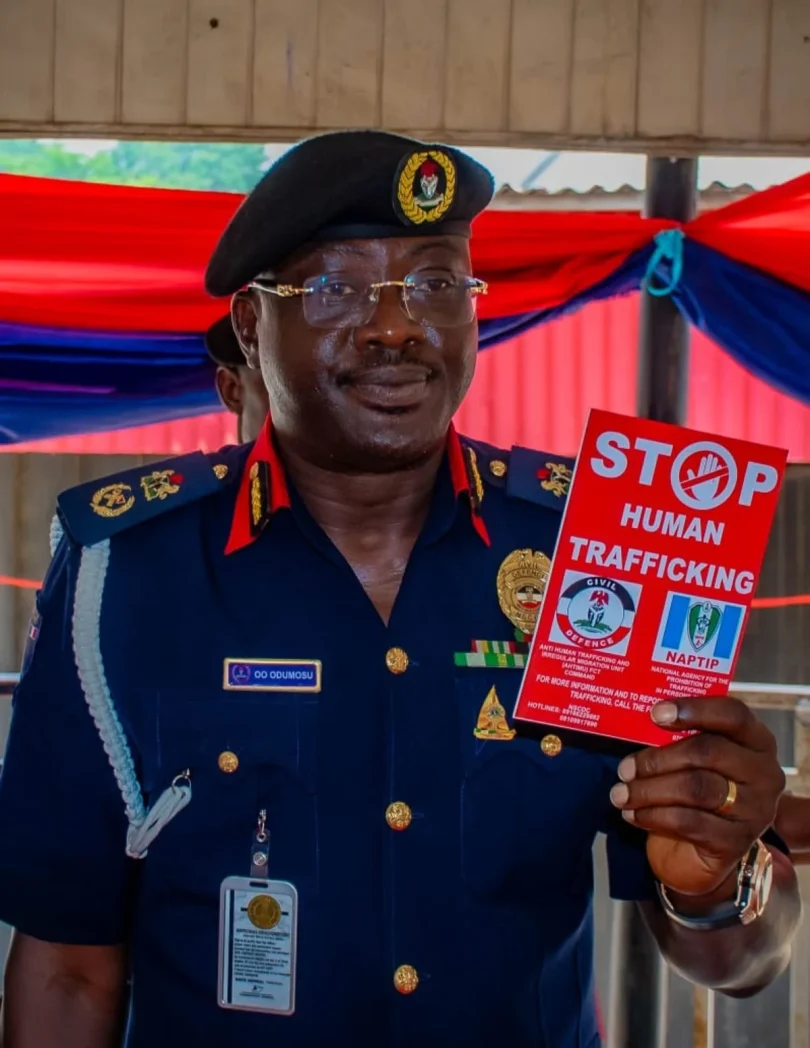
The Nigeria Security and Civil Defence Corps (NSCDC), Federal Capital Territory (FCT) Command, has rescued 80 victims of human trafficking and other related offences in the last three years.
FCT Commandant of the Corps, Dr Olusola Odumosu, disclosed this at a ceremony organized to commemorate the 2026 World Day Against Trafficking in Persons in Abuja.
Public Relations Officer of the Command, Monica Ojobi, in a statement on Tuesday, said the event, organized by the NSCDC FCT Command Anti-Human Trafficking and Irregular Migration Unit in collaboration with the National Agency for the Prohibition of Trafficking in Persons (NAPTIP), was held at the NSCDC FCT Command Headquarters, Wuse Zone 5.
The ceremony was attended by representatives of civil society organisations and other stakeholders, with students of ECWA Hills Academy, Abuja, making presentations.
The organizers also presented an award to the FCT NSCDC Commandant in recognition of his efforts.
Odumosu, who spoke on the theme “Human Trafficking and Technology: Trends, Challenges, and Security Approach,” also disclosed that the Command arrested 35 suspects within the period and successfully handed over 32 rescued victims to NAPTIP.
He called for the strengthening of the capacity of investigators and intelligence officers to deploy lawful digital intelligence, data analysis, online monitoring, and other appropriate technological tools to identify trafficking patterns and networks.
According to him, the theme of this year’s commemoration was particularly timely, given the increasing use of technology by criminal networks to recruit, deceive, transport, control, and exploit vulnerable persons.
“Human trafficking is not simply a social problem; it is a serious security, economic, human rights, and development challenge.
“Traffickers prey on vulnerability. They exploit poverty, unemployment, ignorance, displacement, family differences, and the legitimate aspirations of young people seeking education, employment, and better opportunities,” he said.
The Commandant noted that technology had transformed virtually every aspect of modern life, including communication, commerce, education, transportation, and social interactions, but warned that the same tools were increasingly being exploited by traffickers.
He said social media platforms, instant messaging applications, gaming environments, and other digital spaces had provided traffickers with unprecedented access to potential victims.
“The digital environment has fundamentally altered the operating methods of traffickers. We murecognizeise that the fight against trafficking has entered the digital battlefield.
“Criminal networks can adopt new platforms and tools faster than institutions can develop appropriate investigative capacity,” Odumosu stated.
He identified the rapid evolution of technology, digital anonymity, the cross-border nature of cyber-enabled trafficking, challenges relating to digital evidence, victim identification, and inadequate public awareness as some of the major challenges confronting security agencies.
To address the challenges, he said security responses must evolve from traditional approaches to intelligence-led, technology-driven, and victim-centered policing and security management.
Odumosu also stressed the need for stronger inter-agency collaboration among the NSCDC, NAPTIP, Nigeria Police Force, Nigeria Immigration Service, Economic and Financial Crimes Commission, Federal Road Safety Corps, relevant intelligence agencies, and other stakeholders.
He urged NSCDC personnel to remain vigilant at transportation corridors, public spaces, critical infrastructure, and other vulnerable locations where traffickers might operate.
The Commandant further called on parents to understand what their children do online while urging schools to teach digital safety and religious and traditional institutions to intensify public awareness on the dangers of human trafficking.
He also called on the government to strengthen employment and empowerment opportunities as part of measures to address the vulnerabilities that traffickers exploit.