
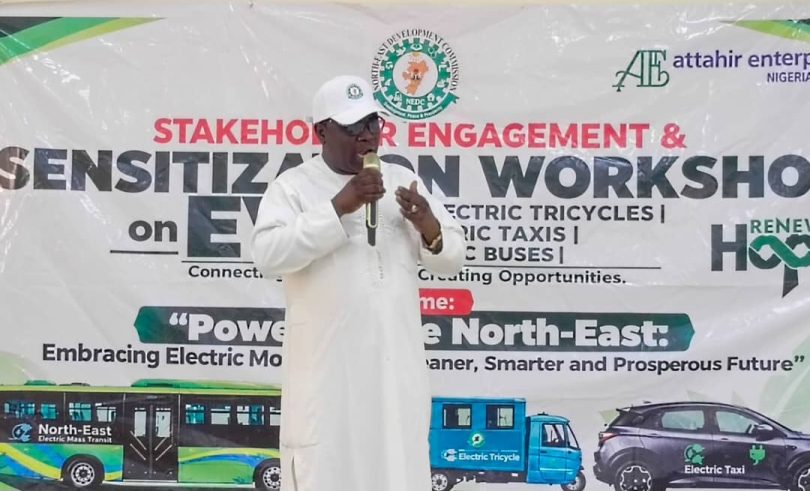
The North-East Development Commission (NEDC) has engaged stakeholders in Bauchi State on its plan to deploy 10,000 electric tricycles, 300 electric taxis and 30 electric buses across the six states of the North-East to reduce transportation costs, create jobs and promote environmentally friendly mobility.
The initiative, being implemented in partnership with Attahir Enterprises Nigeria Limited, was unveiled at a stakeholders’ engagement and sensitisation workshop held in Bauchi.
Speaking at the end of the two-day workshop on Friday, the NEDC State Coordinator, Alhaji Aliyu Isiyaku, said the project was designed to provide affordable, safer and more sustainable transportation for residents of the region.
The workshop, themed “Powering the North-East: Embracing Electric Mobility for a Cleaner, Smarter and Prosperous Future,” brought together transport operators, security agencies, traditional rulers, religious leaders, civil society organisations and other stakeholders.
Isiyaku said the engagement was necessary to ensure stakeholders understood the project and contributed to its successful implementation, particularly at the grassroots.
He said the initiative is expected to reduce transport costs, create jobs for young people, protect the environment and lower carbon emissions.
According to him, the success of the first phase would determine the expansion of electric vehicle deployment across the North-East.
He urged stakeholders to support the project and create awareness to ensure its acceptance and sustainability.
Giving details of the initiative, the Chief Executive Officer of Attahir Enterprises Nigeria Limited, Gudu Umar Abacha, said the electric vehicles can travel up to 300 kilometres on a full charge.
He said the electric buses and taxis will operate mainly within urban centres, with three charging points to be established to support their operations.
Abacha said the electric tricycles will be deployed to local government areas to extend the benefits to rural communities.
He added that each tricycle will come with two charging units to enable operators to charge at home.
According to him, the vehicles will be handed over to respective state governments for distribution to beneficiaries, and beneficiaries will be trained before they are allowed to operate them.
The District Head of Shafa, Lawal Mohammed Kirfi, pledged the support of traditional institutions in creating awareness about the initiative. He said traditional rulers will help sensitise communities on the benefits of electric mobility and encourage residents to embrace the programme.
He noted that the involvement of traditional institutions would be critical to gaining acceptance, especially in rural communities.
Meanwhile, transport unions in Bauchi have commended the NEDC and the Federal Government for the initiative, describing it as a potential means of reducing transport costs and improving operators’ livelihoods.
However, they urged the commission to distribute the vehicles through recognised transport associations to ensure transparency, accountability and fairness.
The Bauchi State Chairman of the National Union of Road Transport Workers (NURTW), Comrade Ismail Abubakar, commended the commission and called for the involvement of unions in the distribution process to ensure the vehicles reach genuine operators.
Similarly, the Chairman of the Bauchi State Motorcycle and Tricycle Operators’ Association, Alhaji Bala Dauda, expressed the association’s readiness to support the implementation.
The Zonal Chairman of the Road Transport Employers Association of Nigeria (RTEAN), Comrade Abdullahi B. Muhammad, also welcomed the initiative, saying it could reduce costs and create jobs.
“We are very excited and happy about the project because of the benefits it will bring to the people,” Muhammad said.
He however stressed the need for proper management and sustainability.
“My advice is that adequate attention should be given to the sustainability of the project because we believe it will benefit the masses,” he said.
Muhammad cautioned against distributing the vehicles without clear conditions on their use and maintenance, and urged Nigerians not to see them as their share of the national cake.
He expressed concern that distribution through political structures could lead to beneficiaries being selected on political grounds, and proposed that the vehicles be shared equitably across the three senatorial zones.
According to him, working directly with recognised transport unions, which operate under established constitutions and rules, would improve transparency.
He identified the high cost of petrol, currently about N1,460 per litre, as a major challenge for transport operators, noting that electric vehicles could ease the burden. He said the vehicles are expected to cover up to 300km on a full charge, with charging cost estimated at about N5,000.
The General Secretary of the Nigerian Automobile Technicians Association (NATA), Aminu Abubakar Muhammad, pledged the association’s support for the programme, particularly in maintenance.
“Our role in this laudable programme is to ensure that the vehicles are properly maintained by qualified technicians,” he said.