
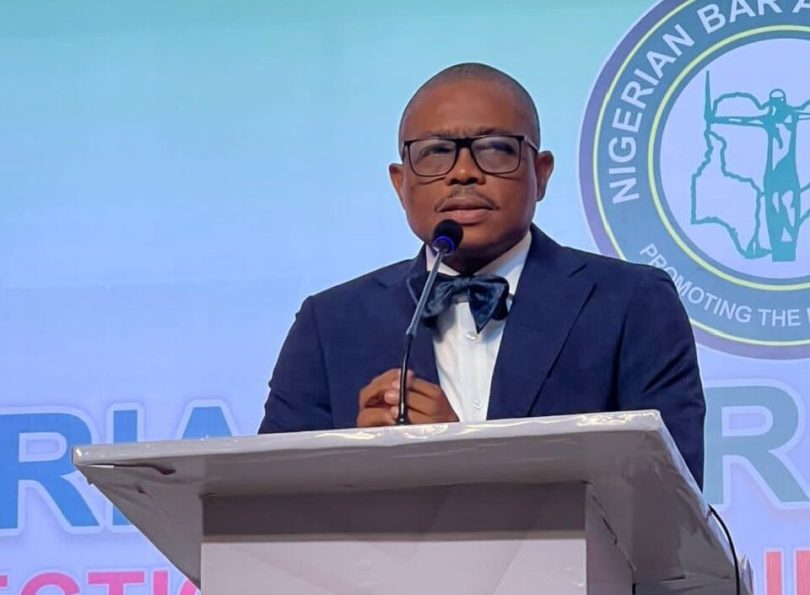
The Nigerian Bar Association (NBA) has criticised the Economic and Financial Crimes Commission (EFCC) over its reported restriction of the Osun State Government’s bank account, arguing that the anti-graft agency lacks the constitutional authority to impose a blanket freeze on a state’s finances without following due legal procedures.
Outgoing NBA President, Afam Osigwe, said any directive preventing withdrawals from a state government account could cripple governance and amount to an abuse of power if not backed by a valid court order.
Speaking on Wednesday, Osigwe acknowledged that the EFCC had the power to investigate suspected financial crimes and seek judicial orders against specific accounts linked to wrongdoing, but insisted that freezing all accounts belonging to a state government was unlawful.
“No government agency or any person has the right or the power to restrict withdrawals from the account of any state because, first of all, the order has the effect of grounding the activities of a government,” he said.
He added that if the EFCC suspected a particular account was being used for fraudulent activities, it could approach the court for appropriate orders, but “it cannot make a blanket order freezing the accounts of any state.”
Osigwe further stated that any restriction placed on the finances of an individual or government institution must be supported by sufficient legal grounds and proper judicial approval.
Although he said he was not certain whether the EFCC had issued such a directive, the NBA president advised banks against complying with any instruction that sought to halt transactions across all state government accounts.
“If they made such an order, I would advise that no bank should obey such an order,” he said.
The controversy followed the EFCC’s directive on Wednesday restricting withdrawals from Osun State Government’s statutory allocation account as part of an ongoing investigation.
A letter dated August 5, 2026, signed by Assistant Commander of the EFCC, Adenike Babalola, on behalf of the Director of Investigation, directed First Bank to place a post-no-debit restriction on the account pending the conclusion of the investigation.
The affected account was identified as the “Osun State Government Statutory Allocation” account.
In a statement issued Wednesday night, the EFCC said the action was triggered by suspicious movements of funds linked to an investigation into the alleged mismanagement of about N11 billion in Ecology Funds, Intervention Funds and Federal Account Allocation Committee (FAAC) allocations.
The statement, signed by the commission’s Head of Media and Publicity, Dele Oyewale, said the investigation into the Osun State Government began in March 2026, with some officials, including the state Accountant-General, already questioned by investigators.
According to the EFCC, unusual transfers detected from August 2, 2026, prompted the decision to restrict transactions.
“The Commission noticed huge transfers of funds into different corporate entities and had to swiftly halt the trend by freezing the accounts from which such heavy funds were being moved,” it said.
The commission rejected allegations that the move was politically motivated despite coming days before the August 15 Osun governorship election, insisting that it had a responsibility to protect public funds.
The EFCC said it could not suspend investigations simply because an election was approaching, adding that Osun was not the only state under scrutiny.
Several Senior Advocates of Nigeria have also weighed in on the controversy, with opinions divided over the legality of the EFCC’s action.
Adeyinka Olumide-Fusika questioned whether the commission had obtained a court order before restricting access to the account, arguing that Nigerian courts had repeatedly held that anti-corruption agencies could not freeze accounts without judicial approval.
“There is a no-debit order on Osun State’s account. My question is: Does the EFCC have the power to do that? I don’t think they got any order from the court,” he said.
Similarly, Isiaka Olagunju described the move as a possible violation of the 1999 Constitution and federalism principles, arguing that the EFCC should identify specific allegations against officials rather than restrict an entire state government’s finances.
However, Damilola Olawuyi defended account restrictions as a legitimate preventive measure in fighting financial crimes, provided they were exercised within legal limits.
He said such measures were recognised internationally as tools for disrupting illicit financial flows but warned they should not become instruments for political disputes.
Another Senior Advocate, Wolemi Esan, explained that the EFCC could issue a temporary stop order of up to 72 hours without a court order under the Money Laundering (Prevention and Prohibition) Act.
However, he said any restriction beyond that period would require judicial approval.
Mike Ahamba also expressed doubts about the existence of legal authority allowing the EFCC or federal government to freeze a state government account.
The Osun State Government has vowed to challenge the EFCC’s action in court.
The state Attorney-General and Commissioner for Justice, Oluwole Jimi-Bada, said he had received approval from Governor Ademola Adeleke to commence legal proceedings against the commission.
Jimi-Bada said the EFCC could investigate state accounts but could not freeze them without a court order.
“I have the mandate of the governor to proceed to the Federal High Court to challenge this move. EFCC can investigate the accounts but it can’t freeze the accounts without order of court,” he said.
The Osun Commissioner for Finance, Sola Ogungbile, also alleged that police officers visited First Bank’s main branch in Osogbo and arrested some bank employees following the restriction.
He maintained that Governor Adeleke was not using government funds for his reelection campaign and warned that the EFCC’s action could negatively affect residents.
Civil society groups and political parties have reacted differently to the development.
The Executive Director of the Civil Society Legislative Advocacy Centre, Auwal Musa Rafsanjani, advised the Osun Government to seek legal redress if it believed the restriction was unlawful.
Meanwhile, Debo Adeniran, Chairman of the Centre for Anti-Corruption and Open Leadership, said the EFCC would be justified if it acted based on reasonable suspicion of financial misconduct but must prove that its decision was based on evidence rather than political motives.
Ezenwa Nwagwu of the Peering Advocacy and Advancement Center in Africa said the EFCC must have had reasons for its action but warned that the agency must avoid political interference.
Opposition parties, including the African Democratic Congress (ADC), Labour Party (LP), Nigeria Democratic Congress (NDC), Social Democratic Party (SDP), and Young Progressives Party (YPP), condemned the account restriction and accused the Federal Government of using state institutions to influence the forthcoming election.
The ADC described the action as “political terrorism,” alleging that it was aimed at weakening the Osun State Government ahead of the governorship poll.
The YPP also criticised the move, saying freezing state funds during an election period raised concerns about abuse of government institutions.
The SDP warned that the situation posed a threat to democracy and urged all sides to uphold peace and the rule of law.
The Labour Party took a more cautious position, acknowledging the EFCC’s investigative powers but stressing that all actions must comply with constitutional requirements and due process.
The ruling All Progressives Congress (APC), however, defended the EFCC, saying the commission likely acted based on information unavailable to the public.
APC Director of Publicity, Bala Ibrahim, said the EFCC was established to investigate financial crimes and would not have frozen a government account without justification.
He added that the affected funds belonged to the Osun State Government and not Governor Adeleke personally.
The dispute is expected to move to the courts as both the EFCC and the Osun State Government maintain opposing positions over the legality and justification of the account restriction.
... No Agency Has Power To Freeze State Government Accounts Without Court Order – NBA ... Naijaonpoint.