
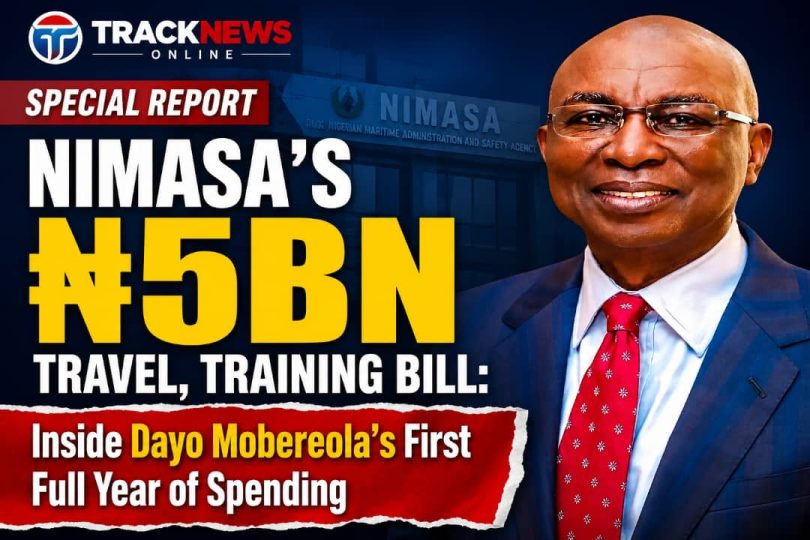
……..Documents raise questions over billions allocated to staff travel, international training, executive trips and retirement-related training
By NaijaonpointOnline Investigative Desk
The Nigerian Maritime Administration and Safety Agency (NIMASA), under the leadership of its Director-General, Dr. Dayo Mobereola, recorded billions of naira in expenditure and budgetary provisions for travel and training-related activities, according to financial documents reviewed by NaijaonpointOnline.
The figures, covering multiple travel and training expenditure lines, raise questions about the scale, justification and transparency of spending at the maritime regulatory agency at a time Nigerians are grappling with severe economic pressures.
Mobereola was appointed Director-General of NIMASA in March 2024 with a stated commitment to building what he described as a purpose-driven organisation anchored on transparency, efficiency and improved performance.
However, documents reviewed by NaijaonpointOnline show that several travel and training lines running into billions of naira were either reportedly spent or provided for during the period under review.
Taken together, the figures examined by our investigative team amount to more than ₦5 billion across the identified travel and training expenditure lines, although the precise distinction between actual expenditure, approved allocation and proposed budgetary provision varies from one line to another.
The records therefore warrant further clarification from NIMASA on the beneficiaries, purposes, locations, duration and procurement processes behind the expenditures.
NEARLY ₦1BN ON LOCAL STAFF TRAVEL
One of the most striking figures in the documents is the amount attributed to local staff travel.
According to the records, ₦951,646,237.80 was reportedly spent on local staff travel in 2024.
For 2025, the corresponding figure rises to ₦1,332,304,732, representing an increase of approximately 40 per cent.
The scale of the expenditure raises questions about the frequency and nature of official movements undertaken by NIMASA personnel across the country.
NaijaonpointOnline could not establish from the documents reviewed a comprehensive travel schedule, staff manifest, route-by-route breakdown or detailed justification showing how the nearly ₦1 billion 2024 expenditure was incurred.
Such information would ordinarily help the public understand whether the expenditure represented routine operational requirements, inspections, enforcement activities, stakeholder engagements, project supervision or other official assignments.
₦341M FOR EXECUTIVE MANAGEMENT TRAVEL
Separate from the staff travel allocation is another substantial expenditure line attributed to executive management local travel.
The documents put the 2024 figure at ₦341 million.
The existence of a separate multi-million-naira travel allocation for executive management, alongside the much larger staff travel expenditure, raises questions about the overall structure of NIMASA’s travel spending.
NaijaonpointOnline could not independently establish from the documents reviewed the number of trips undertaken by executive management, the officials involved, destinations, duration of trips or the specific official engagements for which the funds were expended.
ANOTHER ₦777.5M FOR STAFF TRAINING TRAVEL LOGISTICS
The expenditure becomes even more substantial when travel connected to staff training is considered.
According to the documents, ₦777.5 million was reportedly spent in 2024 on transport and travel logistics associated with staff training.
This amount, the records indicate, relates to the movement and logistics of personnel attending training rather than the cost of the training programmes themselves.
That distinction is significant.
When combined with the actual training expenditure, the total cost of developing and moving personnel for training becomes considerably higher.
Yet, NaijaonpointOnline did not find in the documents reviewed a comprehensive breakdown showing the number of employees trained, destinations, duration, training providers or the cost per participant.
₦437.18M ON SHORT-TERM LOCAL TRAINING
NIMASA also reportedly spent ₦437,187,812 on short-term local training in 2024.
Again, questions remain about the composition of the expenditure.
The documents reviewed by our investigators did not provide sufficient details to establish the full list of courses, participating staff, trainers, duration of the programmes or the individual cost of each training activity.
For a public agency operating with taxpayers’ money, such details are critical in determining whether expenditure represents value for money.
₦50.82M ON LONG-TERM LOCAL TRAINING
Another ₦50,820,000 was reportedly spent on long-term local training during the same year.
While long-term professional development can be necessary for a specialised agency such as NIMASA, the absence of detailed beneficiary and programme information in the documents reviewed makes it difficult to independently assess the value derived from the expenditure.
₦1.54BN INTERNATIONAL SHORT-TERM TRAINING BILL
Perhaps the most eye-catching figure in the documents is the amount attributed to international short-term training.
According to the records, NIMASA reportedly spent ₦1,543,456,653 on international short-term training in 2024.
That is more than ₦1.5 billion in one year.
The figure raises several questions:
Who travelled?
How many employees benefited?
Which countries and institutions hosted the programmes?
How long did the programmes last?
What were the costs of flights, accommodation, tuition and allowances?
And, perhaps most importantly, what measurable benefits did the agency derive from the programmes?
NaijaonpointOnline did not find sufficient information in the documents reviewed to answer these questions.
₦148.8M ON INTERNATIONAL LONG-TERM TRAINING
The agency also reportedly spent ₦148.8 million on international long-term training in 2024.
When combined with the international short-term training expenditure, the identified international training bill amounts to approximately ₦1.69 billion.
This represents a substantial financial commitment and underscores the need for a transparent breakdown of beneficiaries and programmes.
₦182.84M FOR STAFF EXITING THE AGENCY
Another expenditure line that demands explanation is the ₦182,843,750 reportedly allocated to training for staff exiting the agency.
The expenditure raises questions about the nature and purpose of such training, particularly where beneficiaries are employees approaching retirement or otherwise leaving the agency.
NaijaonpointOnline is not suggesting that training outgoing personnel is automatically improper. However, the rationale, statutory basis, beneficiaries and measurable objectives of the expenditure require clarification.
₦245M FOR OPERATIONS DIRECTORATE TRAINING
The documents further indicate that the Operations Directorate received approval for ₦245 million for training in 2024.
Given the specialised responsibilities of the directorate, training may form part of its legitimate operational requirements.
Nevertheless, the amount warrants scrutiny alongside the agency’s other training expenditures.
The public interest questions remain straightforward: What programmes were funded? Who attended? Where were they held? Who supplied the services? How much was paid to each provider? And what deliverables were produced?
₦340M FOR CABOTAGE, MARITIME LABOUR AND SHIP OWNERSHIP DEVELOPMENT
The records also show ₦340,047,150 spent on training for personnel within the Cabotage, Maritime Labour Services and Ship Ownership Development Directorate.
These are critical areas of Nigeria’s maritime economy, and professional capacity-building in such departments can be justified.
However, the magnitude of the expenditure makes transparency even more important.
A detailed disclosure of beneficiaries, training institutions, procurement procedures, course fees, travel expenses and post-training outcomes would help establish whether the expenditure represented prudent investment in human capital.
BILLIONS WITHOUT A CLEAR PUBLIC AUDIT TRAIL?
The issue emerging from the documents is not simply that NIMASA spent money on travel and training.
A maritime regulator with extensive responsibilities may legitimately require substantial expenditure on staff development, inspections, international engagements and operational travel.
The central question is whether the billions of naira reportedly spent were supported by adequate documentation, competitive procurement, clearly defined beneficiaries and measurable outcomes.
For an agency entrusted with regulating Nigeria’s maritime sector, financial accountability is particularly important because its activities have direct implications for shipping, port operations, maritime safety, seafarers and the wider Nigerian economy.
The figures reviewed by NaijaonpointOnline suggest that travel and training constituted a significant financial commitment during the period.
But without detailed schedules, beneficiary lists, invoices, procurement records and programme reports, taxpayers are left with the figures without sufficient information to independently determine whether the expenditure represented value for money.
WHAT NIMASA NEEDS TO EXPLAIN
NaijaonpointOnline is therefore asking NIMASA to provide clarification on the following:
1. The complete breakdown of the ₦951.6 million local staff travel expenditure in 2024.
2. The basis for the proposed ₦1.332 billion local staff travel figure for 2025.
3. Details of the ₦341 million executive management travel expenditure.
4. The names or number of staff who benefited from the ₦777.5 million training-related travel logistics expenditure.
5. Details of the ₦437.18 million short-term local training programmes.
6. Beneficiaries and institutions involved in the ₦50.82 million long-term local training.
7. A complete breakdown of the ₦1.543 billion international short-term training expenditure, including countries visited, institutions, beneficiaries and duration.
8. Details of the ₦148.8 million international long-term training expenditure.
9. The justification and statutory basis for the ₦182.84 million training expenditure for exiting staff.
10. Details of the ₦245 million Operations Directorate training expenditure.
11. The programmes and beneficiaries covered by the ₦340.05 million Cabotage, Maritime Labour Services and Ship Ownership Development training expenditure.
12. Whether all the identified expenditures underwent the required procurement, financial approval and audit processes.
TRANSPARENCY TEST FOR NIMASA
The figures contained in the documents do not, by themselves, establish wrongdoing or financial impropriety.
But they do establish a compelling public-interest accountability question.
If the expenditures were legitimate and properly incurred, NIMASA should be able to demonstrate that through transparent documentation.
The agency can provide the travel schedules, staff manifests, training registers, contracts, invoices, payment records, procurement approvals and reports showing the outcomes of the programmes.
That would allow Nigerians to determine whether the billions spent produced commensurate value for the country’s maritime sector.
At a time when government agencies are under increasing pressure to reduce waste and demonstrate fiscal responsibility, the management of public funds cannot be separated from the demand for transparency.
For NIMASA, the question is therefore not merely how much was spent.
It is who benefited, what was delivered, how the contracts were awarded, and whether Nigerians received value for every naira spent.
NaijaonpointOnline will continue to examine the documents and follow the money.
NaijaonpointOnline’s findings are based on documents reviewed by the newspaper. The figures and allegations contained in this report are presented for public-interest scrutiny and remain subject to clarification by NIMASA and other relevant authorities.