
Nigeria’s online shoppers are buying through Facebook and leaning on artificial intelligence at rates that outstrip most of the 29 countries surveyed in DHL eCommerce’s newly released E-Commerce Trends Report 2026, placing the country among a small group of markets where consumer behaviour is running ahead of business capacity to serve it.
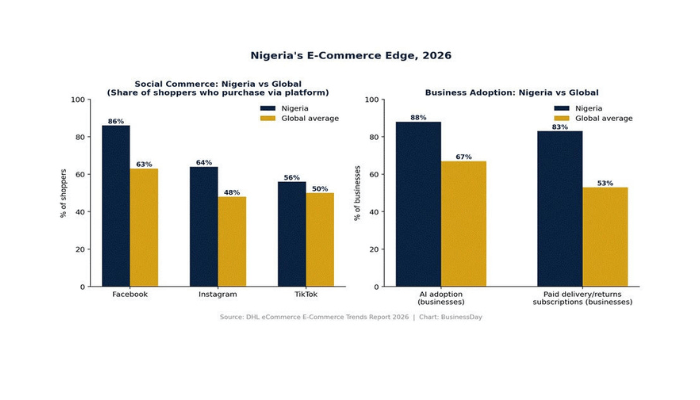
The report, drawn from 29,000 online shoppers and 5,800 e-commerce businesses across 29 countries, finds that 86 percent of Nigerian shoppers use Facebook to buy, against a global average of 63 percent. Instagram follows at 64 percent, compared with 48 percent globally, while TikTok stands at 56 percent against a global figure of 50 percent.
On artificial intelligence, 46 percent of Nigerian shoppers use AI-powered chat tools when shopping online, the fourth-highest share among the 29 countries, behind India, the UAE and China.
Among businesses, adoption runs deeper: 88 percent of Nigerian e-commerce companies already use some form of AI on their platforms, and 94 percent expect usage to rise over the next five years, both well above the global business averages of 67 percent and 70 percent.
Muyiwa Adeseyoju, country manager for DHL Express Nigeria, said the numbers reflect a market moving faster than many of its peers. “Nigeria is one of the most dynamic e-commerce markets in Sub-Saharan Africa, with strong digital adoption and an ambitious business community,” he said.
Read also: Nigerians turn to AI for shopping while demanding stronger fraud protection – Report
“Shoppers and businesses are adapting quickly to new ways of buying and selling online, and expectations are rising just as fast.”
Jumia remains the dominant marketplace, used by 84 percent of Nigerian shoppers and sold on by 83 percent of Nigerian businesses, according to the report.
The findings also point to a logistics market that has moved past basic delivery. Eighty-three percent of Nigerian e-commerce businesses now offer paid delivery and returns subscriptions, more than 30 percentage points above the global average of 53 percent, and among the highest shares recorded in the survey.
Home delivery still dominates, used by 78 percent of shoppers, but returns have diversified: 51 percent of Nigerian shoppers use parcel shops or convenience stores to send items back, 34 percent use home collection, and 15 percent use parcel lockers.
Pablo Ciano, chief executive of DHL eCommerce, framed the shift in terms of speed rather than scale. “The ability to understand and respond to customer needs has always defined success, but our new trend report shows that AI is now redefining that advantage at hyperspeed,” he said.
“Consumers can identify the best offer in milliseconds, and retailers can gain insights that allow them to instantly capitalise on changing demand.”
The report also places Nigeria among markets leading on circular and sustainable commerce, alongside India, Malaysia, the UAE and Saudi Arabia, part of a wider Sub-Saharan African pattern that DHL records as the most sustainable in the world, 91 percent of shoppers and 69 percent of sellers in the region identify as sustainability-conscious, the highest of the six regions covered.
Applied futurist Tom Cheesewright, in the report, cautioned that fast digital adoption carries its own risk. “In a future where technology is the great equalizer, there is a challenge of being ‘too’ frictionless,” he said.
“Build in some moments of connection, building brand and trust, or customers will slip through your fingers just as easily as they slip through the shopping process.”