
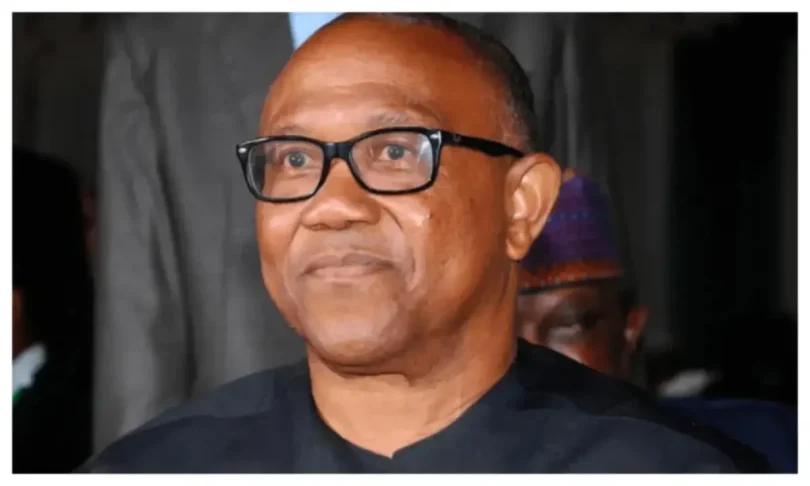
The Presidential Candidate of the Nigeria Democratic Congress (NDC), Peter Obi, has said Nigeria’s major challenge is not a lack of resources but the failure of successive governments to convert the country’s abundant resources into human development, productivity, security and shared prosperity.
Obi, who stated this in his Independence Day address to Nigerians on Thursday, said the 66th anniversary of the country’s independence should serve as a period for sober reflection on Nigeria’s progress and the direction of its development.
He said national leaders and citizens must continually ask where the country was, where it wanted to be and how it could move from its present situation to its desired destination.
According to him, despite the promises made by the All Progressives Congress (APC)-led administration in 2023, Nigerians continue to contend with poverty, insecurity, food insecurity, unemployment, poor access to education and healthcare, drug abuse and low life expectancy.
Obi cited figures which he said showed that more than 140 million Nigerians were living in poverty and severe hardship, while more than 18 million children were out of school.
He also said more than 35 million young Nigerians were unemployed or underemployed, while more than 40 million Nigerians could face extreme hunger by the end of 2026.
The NDC candidate further expressed concern over insecurity, saying terrorism, banditry and kidnapping continued to threaten lives and livelihoods across the country.
He said Nigeria’s challenges could not be attributed to the country being “cursed”, arguing that the nation had sufficient human and natural resources to achieve development.
“Our greatest problem is not a lack of resources; it is the failure to convert our enormous resources into human development, productivity, security and shared prosperity,” Obi said.
He spoke after returning from a two-day visit to Sokoto State with the NDC Vice-Presidential Candidate, Senator Rabiu Musa Kwankwaso, where he said they consulted with residents on insecurity, poverty, out-of-school children, youth unemployment and drug abuse.
Obi said the delegation also visited an Internally Displaced Persons (IDP) camp at Ramin Kura in Sokoto metropolis, where he described the conditions of displaced women and children as troubling.
He said many of the children at the camp lacked access to education, while mothers and children had limited access to basic healthcare.
According to him, the situation demonstrated the consequences of insecurity on communities, as people who should be farming, attending school, running businesses and contributing to the economy were instead living as displaced persons.
“What we saw in Ramin Kura is not an isolated story. It is a reflection of the suffering experienced, in different forms, across many parts of Nigeria,” he said.
Obi said the NDC would seek to change the situation if elected, promising to make governance measurable, accountable and centred on the welfare and productivity of Nigerians.
He said Nigerians would begin to see what he described as the tangible impact of effective leadership within the first year of his administration.
On security, Obi pledged to confront insecurity in order to enable farmers to return to their farms, children to return to school and businesses to operate without fear.
He also promised to facilitate the safe and dignified return of Nigerians displaced by insecurity to their communities.
The former Anambra State governor said his administration would also seek to shift the economy from what he described as consumption-driven growth to a productive economy based on job creation, agriculture, manufacturing, human-capital development and enterprise.
He identified education, healthcare, security and productive enterprise as priorities, saying they were foundations of a functioning nation rather than luxuries.
Obi also promised that, if elected president, he would spend his holidays within Nigeria during his four-year tenure.
He specifically mentioned Zamfara, Borno, Kwara, Ebonyi, Edo and Ekiti states among places he intended to visit during his holidays.
“I want to continue to see Nigeria. I want to know Nigeria. I want to spend time with Nigerians, listen to them, understand their challenges and celebrate their resilience,” he said.
The NDC candidate called on Nigerians to approach the country’s future with hope and determination, saying the country could overcome its current challenges through accountable leadership and citizen participation.
He said his administration would seek to build a Nigeria where children had access to education, mothers could obtain basic healthcare, farmers could safely access their farms and young people could find opportunities to work and prosper.
Obi also said public resources should be deployed strictly for the public good.
He urged Nigerians to use the Independence anniversary to reflect on the country’s achievements and challenges while demanding greater accountability from those entrusted with public office.
“The Nigeria we desire will not be built by prayers alone, nor by promises alone. It will be built by leadership that understands that public office is a sacred trust, by citizens who demand accountability, and by all of us who refuse to accept failure as our destiny,” he said.
He called for the building of what he described as a new and productive Nigeria founded on unity, peace, justice and prosperity.