
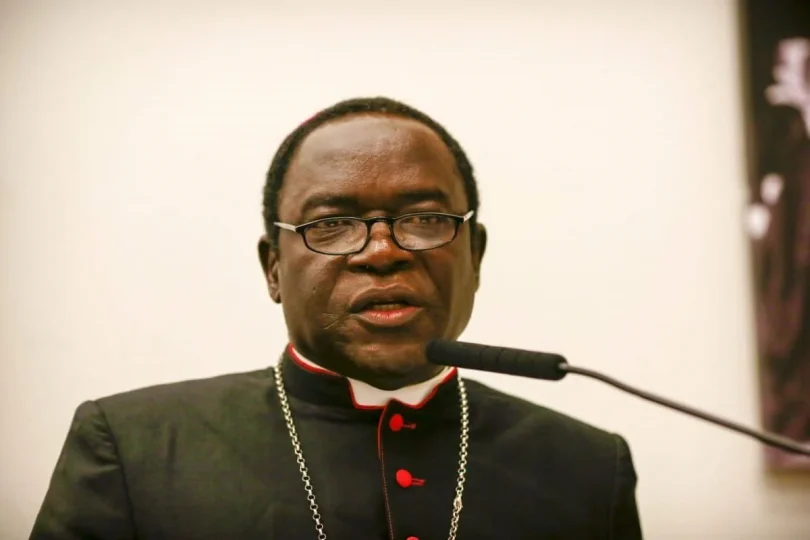
The Catholic Bishop of Sokoto Diocese, Bishop Matthew Hassan Kukah, has lamented what he described as the gradual erosion of Catholic values in Nigeria’s public and private life, urging the Church to renew its commitment to service, education and human development.
Kukah spoke on Friday at St. Finbarr’s College Auditorium, Akoka, Lagos, while delivering a lecture titled, “To Conquer or to Serve? Thoughts on the Contributions of the Catholic Church to Human Development and the Making of a Good Society in Nigeria.”
The lecture was delivered as part of activities commemorating the life and legacy of the late Rev. Fr. Denis Slattery, whom Kukah described as one of the finest representatives of the Irish missionary enterprise in Nigeria.
Reflecting on the concept of “soft power” developed by the late Harvard scholar, Joseph Nye, Kukah said the principle closely aligned with the teachings of Jesus Christ and the approach adopted by missionaries who established schools, hospitals and other institutions across Nigeria.
He said, “Soft power was the antidote, he argued. He then defined soft power as the ability to shape the preferences of others to want what you want, to get what you want through attraction, by co-opting them through the attractiveness of your culture, political values and your policies, rather than coercing them with military force or buying them with money.”
Kukah challenged former students of Catholic institutions to reflect on whether the values they acquired in Catholic schools had continued to influence their decisions in their professional, political and private lives.
“Today, you address yourselves as conquerors. This is what you were inspired to aim at. In order to be conquerors, you were given codes of conduct that focused on spiritual formation built around a disciplined life,” he said.
“The challenge now is, when you look back, how much of these values remained with you and how many of them still impact your life?”
The bishop argued that competing social, political, ethnic and fraternity affiliations had increasingly influenced the choices of many Catholics, sometimes at the expense of commitment to the Church.
He said, “Where we repeatedly invest our time, resources, friendships and ambition eventually forms us. If the parish receives the remnants of our time while other associations receive our best energy, we should expect those associations to exercise greater influence over our public choices.”
Kukah also warned that failure to transmit Catholic values to younger generations could weaken the Church’s influence in society.
“Once we are unable to hand on to our children, a moral banner of Catholic values without stain, the future is in danger because, as we can see, over time, these moral values erode, diminish and finally even vanish from our moral choices,” he said.
He traced the historical contribution of Catholic missionaries to Nigeria’s development, particularly in education and healthcare, saying the missionaries regarded the improvement of earthly life as an important component of their Christian mission.
“The Catholic Church illustrated that its mission was salvation, but salvation not as some inaccessible esoteric claims about a world that existed elsewhere. The missionaries believed that thoughts of heaven began from here on earth,” Kukah said.
He added that missionaries therefore established schools and healthcare facilities as part of their evangelisation and human development efforts.
“The missionaries knew that education was the foundation of the good life. A good life, they thought, would have come from a healthy body. This is why next to education they embarked on building health facilities irrespective of how remote the communities were,” he said.
Kukah cited Catholic Church statistics indicating that the Church operates more than 231,000 schools and universities in 171 countries, educating about 72 million students.
He also said Catholic Church statistics put the number of Catholic nursery, primary and secondary schools in Nigeria at about 5,100, excluding tertiary institutions.
He said the institutions represented important channels through which the Church had contributed to Nigeria’s human capital development, but stressed that their values must extend beyond the classroom.
“These Catholic schools, universities, hospitals and parishes still remain the major portals by which millions still pass through to have the best education. Yet, their values do not travel with the same force into our homes, professions, politics and public choices,” he said.
“Renewal requires these schools, hospitals and universities to carry conviction again into the lives of those who pass through them.”
Kukah also highlighted several Catholic missionary schools that produced prominent Nigerians, including Christ the King College, Onitsha; Queen of the Rosary College, Onitsha; Holy Rosary College, Enugu; St. John’s College, Jos; St. Louis College, Jos; St. Louis College, Kano; St. John’s College, Kaduna and St. Augustine’s College, among others.
He said the contributions of missionaries should be assessed in the context of the institutions they established and the generations of Nigerians who benefited from them.
The bishop, however, argued that narratives about missionary activities in Africa had sometimes been distorted by ideological interpretations of colonial history.
He maintained that missionaries and colonial authorities should not automatically be treated as one entity, arguing that the missionaries’ emphasis on education, healthcare and the dignity of human beings provided a different dimension to the colonial experience.
Kukah urged the Catholic community to reflect on its historical legacy and consider how it could renew its contribution to building a just and morally responsible Nigerian society.
He said the challenge before the Church was not merely to preserve its institutions but to ensure that the values that inspired their creation continued to shape the conduct of those who passed through them.