
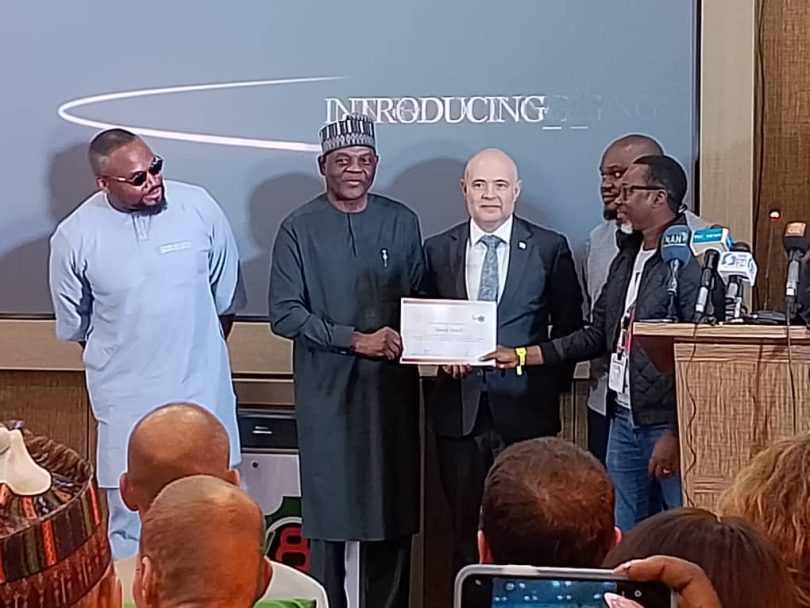
Nigeria and Israel have strengthened their partnership in research, innovation and entrepreneurship with fresh investment in the Israeli-Nigeria Innovation Fellowship for Aspiring Inventors and Researchers (iFAIR). The two countries announced funding for the fifth cohort of the programme while graduating the fourth cohort of innovators in Abuja.
The renewed commitment, backed by the Embassy of Israel in Nigeria and the Tertiary Education Trust Fund (TETFund), is expected to deepen research commercialisation, technology transfer and startup development, with iFAIR 5 scheduled to begin in October 2026.
Announcing the new investment at the iFAIR Cohort 4 Closing Ceremony and Innovation Showcase Challenge, the outgoing Israeli Ambassador to Nigeria, Michael Freeman, said the programme had become a symbol of the growing innovation partnership between the two countries.
“I am so proud to stand here today and announce that we have secured, with our partners, funding for iFAIR 5, and iFAIR 5 will be launching in October 2026,” Freeman said.
Describing the event as his final major public engagement before completing his four-and-a-half-year diplomatic assignment in Nigeria, Freeman said iFAIR was built on the principle of empowering Nigerian innovators to develop local solutions with support from Israeli expertise.
ALSO READ: NUC approves AI-Integrated postgraduate programmes for American Open University
“This programme has never been about bringing Israeli solutions to Nigeria. It’s been about helping brilliant Nigerian innovators develop Nigerian solutions to Nigerian challenges, supported by Israeli experience, mentorship and innovation,” he said.
He added that the initiative had brought together government, academia, investors and entrepreneurs to transform ideas into businesses capable of creating jobs and driving economic growth.
Freeman said the partnership between the two countries had expanded beyond innovation to agriculture, healthcare, education, water management and technology. He expressed confidence that stronger collaboration would continue after his departure.
The Executive Secretary of TETFund, Arch. Sonny Echono, reaffirmed the Fund’s commitment to sustaining investment in innovation-driven research, saying commercialising research outputs remained central to Nigeria’s economic development.
“It is for these reasons and more that TETFund has been supporting the iFAIR programme from its inception as one of its principal partners… I stand here today with full assurances that this support will continue,” Echono said.
He explained that iFAIR complements TETFund’s broader research initiatives, including Research for Impact and TETFAIR, by connecting researchers with industry and investors.
According to him, the programme has become “a veritable platform” for strengthening collaboration among government, academia and industry while creating pathways for research findings to become commercially viable products.
Echono also announced plans for a National Research Fair later this year at Abuja’s Eagle Square, where Nigerian innovators will engage policymakers, financial institutions and investors to scale their products.
Urging young Nigerians to remain focused despite prevailing challenges, he said: “I believe the time is now for us to begin to harness those talents, take advantage of these young people, their great ideas and their solutions, and create pathways for them to take our economy to the heights that we desire.”
Delivering a keynote address, Iyinoluwa Aboyeji, co-founder of Andela and Flutterwave and founder of Future Africa, described the Israel-Nigeria relationship as one founded on genuine knowledge exchange rather than dependency.
“What matters most is not what you can do, but whether you’re willing to help us do it as well,” Aboyeji said.
He argued that Nigeria must rapidly build indigenous capacity in artificial intelligence and emerging technologies to remain globally competitive, warning that relying solely on imported technologies would limit the country’s future productivity.
Earlier, Tolulope Aina, Head of Programmes and Ventures at Innov8 Hub, said the organisation had supported more than 3,000 innovators, researchers and entrepreneurs in transforming ideas into startups and investment-ready businesses.
“Nigeria does not suffer from a shortage of brilliant minds. What we need are stronger pathways that help those ideas become products, businesses and opportunities that improve lives,” Aina said.
She noted that Innov8 Hub was established to strengthen Nigeria’s innovation ecosystem by supporting innovators, startups and research commercialisation.
Aina recalled how the organisation produced more than 10,000 locally manufactured face shields during the COVID-19 pandemic, describing it as proof that Nigerian innovation can thrive with the right support.
She urged the graduating fellows to continue solving real societal problems.
“Build solutions that solve real problems, stay close to your customers, let evidence continue to guide your decisions and never lose sight of the impact you want to create,” she said.
The Head of Impact at Innov8 Hub, Olawale Balogun, said participants had developed 19 functional prototypes across agriculture, healthcare, energy and community innovation using globally relevant engineering tools.
“These are African solutions built with global-standard engineering for African challenges,” Balogun said.
He commended mentors and partners who guided the innovators throughout the programme, adding that the showcase marked only the beginning of their entrepreneurial journey.
Also speaking, the Chief Executive Officer of Engineers Without Borders Israel, Michal Dolav Hashimshony, praised the ingenuity displayed by the Nigerian innovators and expressed optimism about future collaboration between the two countries.
“We believe technology has to be human-centred, and we have seen how you are using technology to improve people’s lives,” she said.
Hashimshony also applauded the strong participation of women entrepreneurs in the programme.
“The most exciting thing for me was seeing so many women entrepreneurs here… we were inspired by the impact they are making and the leadership they are providing within this innovation ecosystem,” she added.
The ceremony featured demonstrations of 19 innovation projects developed by the graduating fellows across agriculture, healthcare, education, clean energy and community development. Organisers also reaffirmed their commitment to expanding research investment and strengthening Nigeria’s innovation ecosystem through the next phase of the iFAIR programme.