
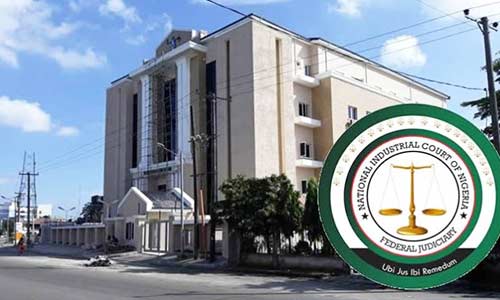
Hon. Justice Muhammad Hamza of the Port Harcourt Judicial Division of the National Industrial Court has declared that Mr Christopher, Mrs Bunmi, and Mr Chijioke were not qualified to contest the 2018 Correspondents Chapel election of the Nigeria Union of Journalists (NUJ), Rivers State Council, having failed to possess the educational qualifications prescribed under the Union’s applicable election guidelines.
The Court reasoned that to be a member of NUJ is one thing and to be eligible to contest in the union election is another; that evidence of Degree Certificates cannot salvage them, and the position of the Nigeria Union of Journalists (NUJ), Rivers State Council in disqualifying Mr Christopher, and others from contesting the election was never done in bad faith, but was a proper application of internal regulation.
However, the Court held that Sir Ernest Chinwo and Chief Azubuike were qualified to contest the election notwithstanding allegations that they had exceeded the constitutional tenure limit, holding that the earlier two-year tenure served through a bye-election could not be equated with a full constitutional term of three years contemplated under the NUJ Constitution.
Justice Hamza declared that the suspension of Mr Christopher and 4 others by officials of the Nigeria Union of Journalists as unlawful and accordingly set the same aside, while also awarding them the sum of N5m damages and cost of action against the Nigeria Union of Journalists (NUJ), Rivers State Council.
From facts, the Claimants, Mr Christopher and 4 others had argued that the subsequent disqualification carried out by officials of the Rivers State Council of the NUJ on the basis that they did not possess Diplomas in Journalism or Mass Communication was unconstitutional, unlawful, and contrary to the NUJ Constitution, insisting that the Constitution merely required possession of a Diploma together with cognate journalism experience.
Mr Christopher and 4 others maintained that the Rivers State Council of the NUJ acted outside its constitutional supervisory powers by interfering in the election process, screening candidates, and imposing conditions not contemplated by the Constitution of the Union, while further contending that their suspension for instituting the suit amounted to unlawful victimisation and breach of their rights.
In defence, the Defendants, Nigeria Union of Journalists (NUJ), Rivers State Council submitted that although Mr Christopher and 4 others were members of the Union, membership alone did not automatically qualify them to contest elections into leadership positions, and that the applicable election guidelines expressly required contestants to possess qualifications in Journalism or Mass Communication.
Counsel to the Union, Ifeoma J. Ekedozie, Esq. appearing with I.J. Ositah (Mrs.) and M.M. Solomon Esq. argued that Nigeria Union of Journalists, being a voluntary association, is strictly governed by its Constitution and election guidelines, and that the elections have been conducted with two (2) tenures having elapsed while the third tenure is about to elapse, rendering the suit academic as of no utilitarian value.
In opposition, learned counsel to the claimants argued that the reliefs sought are forward-looking and protective, reinforcing the practical and continuing relevance of the suit, and that Courts retain the jurisdiction to nullify acts done in breach of due process, even if such acts have been completed.
Counsel posited that suspension from a professional body like NUJ or any other professional body carries a stigma and affects the ongoing rights of membership, as can be seen from the depositions of the Claimants, which cannot be dismissed as theoretical simply because time has passed, as suggested by the Union.
Delivering the judgment, Hon. Justice M. A. Hamza held that the suit was not academic despite the expiration of the tenure arising from the 2018 election, stating that the issues relating to the interpretation of the NUJ Constitution and the legality of the suspension of Mr Christopher and 4 others remained issues deserving judicial determination.
Justice Hamza stated that there are subsisting legal interests that require judicial determination, and that the declaratory relief is intended to clarify the legal relationship between the parties for the future.
The Court held that the failure of Mr Christopher and 4 others to exhaust internal dispute resolution mechanisms under the NUJ Constitution did not rob the Court of jurisdiction, particularly as the dispute related to constitutional interpretation and pre-election grievances rather than professional misconduct or ethical violations contemplated under the disciplinary provisions of the Union.
The Court held that membership of the Nigeria Union of Journalists is different from eligibility to contest elections into leadership offices of the Union, and further held that the Rivers State Council of the NUJ acted within the applicable election guidelines in disqualifying Mr Christopher and the 4 others from contesting the election.
The Court held that membership of the Nigeria Union of Journalists is different from eligibility to contest elections into leadership offices of the Union, and further held that the Rivers State Council of the NUJ acted within the applicable election guidelines in disqualifying Mr Christopher and the 4 others from contesting the election.
The Court, however, held that the Rivers State Council of the NUJ exceeded its constitutional powers by interfering with the screening and disqualification of candidates, stating that the powers of the State Council under Article 6(6) of the NUJ Constitution are merely supervisory and do not extend to screening or disqualifying candidates for election.
Justice Hamza further held that the suspension of Mr Akpekwu Christopher and 4 others for instituting the action before the Court was unlawful, having found that the dispute was not one contemplated under the disciplinary framework of Article 7 of the NUJ Constitution and that no adequate internal mechanism existed for the resolution of such constitutional grievances within the Union.
“I ordered that the Defendant shall pay to the Claimants the sum of N5,000,000.00 (Five Million Naira) only as damages and costs of this action.” The Court ruled.