
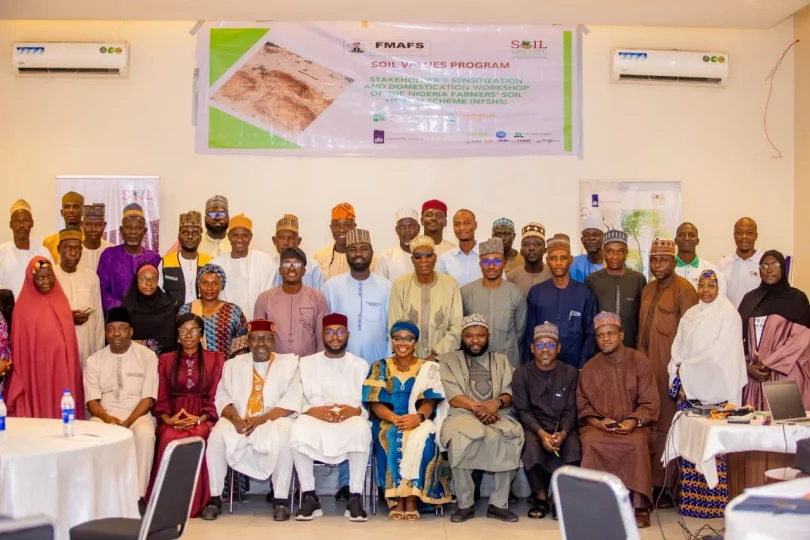

Kano, Jigawa and Bauchi states have established state-level coordination mechanisms to accelerate the implementation of the Nigeria Farmers’ Soil Health Scheme (NFSHS) and promote evidence-based soil management across the three states.
The initiative is aimed at translating Nigeria’s national soil health agenda into locally driven action to improve soil fertility, boost agricultural productivity and strengthen long-term food security.
The NFSHS is being led by the Federal Ministry of Agriculture and Food Security (FMAFS), through its Department of Agricultural Land and Climate Change Management Services (ALCCMS), in partnership with the Soil Values Programme.
According to a statement issued by the Communication Team of the Soil Values Project, the first round of state domestication workshops held in Kano, Jigawa and Bauchi brought together government institutions, researchers, farmer organisations, private-sector actors and development partners.
The workshops focused on adapting the scheme to the agricultural realities of each state while establishing structures to guide implementation and strengthen state ownership.
Stakeholders at the workshops called for a shift from blanket fertiliser recommendations to site-specific soil management based on soil data and local conditions.
They also highlighted the role of the NFSHS in providing farmers with tailored recommendations through Soil Health Cards, while supporting the expansion of the Nigeria Soil Information System (NiSIS), a national database designed to facilitate evidence-based agricultural decision-making.
In Kano, participants identified synergies between the NFSHS and existing state initiatives, including the planting of nearly 20 million trees since 2023 and efforts to develop local compost as an alternative to dependence on chemical fertilisers.
In Jigawa, the workshop featured the release of NFSHS educational materials in Hausa and the integration of women farmers’ organisations into the State Technical Executive Committee (STEC).
The workshop also heard that NiSIS currently contains nearly 8,000 recorded soil data points, with efforts underway to reach the target of 100,000 data points by the end of 2026.
In Bauchi, the state Commissioner of Agriculture, Dr Iliyasu Aliyu Gital, reaffirmed the state’s commitment to implementing the national policy and working closely with the Soil Values Programme to restore soil fertility.
A major outcome of the workshops was the formation of STECs in the three states, each chaired by the respective State Commissioner of Agriculture, as well as Coalitions of the Willing (CoW).
The mechanisms are expected to provide the governance, coordination and multi-stakeholder collaboration required to drive the rollout of the NFSHS at state level and sustain implementation beyond the workshops.
National Coordinator of the Soil Values Programme in Nigeria, Ms Medinah Ayuba Fagbemi, said the alignment between the NFSHS and Soil Values Programme would help drive efforts to restore degraded land, particularly in northern Nigeria.
“The Federal Ministry and the Soil Values Programme are honoured to provide the technical and financial support to facilitate the domestication of the NFSHS,” she said.
Managing Director of the Kano State Agricultural and Rural Development Authority (KNARDA), Dr Faruk Kurawa, said the state had been following the Soil Values Programme since its inception and pledged to provide the necessary support for its implementation.
The Director of ALCCMS, represented by Mrs Afolabi Idowu Fatima, urged stakeholders to ensure that the workshops resulted in concrete implementation measures rather than awareness alone.
The Soil Values Programme is funded by the Directorate-General for International Cooperation of the Netherlands (DGIS) and implemented by a consortium led by the International Fertiliser Development Centre (IFDC), in partnership with the Netherlands Development Organisation (SNV) and Wageningen University & Research (WUR).
The programme is also supported by knowledge and technical partners including AGRA, the Landscape Alliance (CIFOR-ICRAF), the International Institute of Tropical Agriculture (IITA), ISRIC–World Soil Information and the International Water Management Institute (IWMI).
The programme works to promote sustainable agricultural systems and improve soil fertility and soil health in Burkina Faso, Mali, Niger and northern Nigeria.