
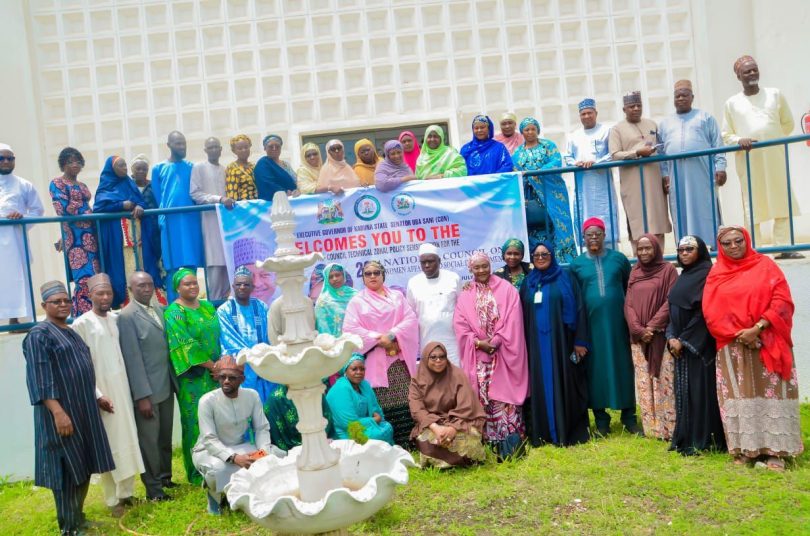
The Kaduna State Commissioner for Women Affairs and Social Development, Dr Rabi Salisu, has called for practical and enforceable policies to combat Gender-Based Violence (GBV), accelerate women’s empowerment, and drive social development across the North-West region and Nigeria at large.
Dr Salisu made the appeal while declaring open the North-West Pre-Council Technical Zonal Policy Sensitisation for the 26th National Council on Women Affairs and Social Development, held at the General Hassan Usman Katsina House, Kaduna.
The three-day forum brought together the Minister of Women Affairs, commissioners from North-West states, permanent secretaries, directors, technical officers, development partners, civil society organisations, traditional rulers, and religious leaders.
Describing the gathering as timely, the commissioner stressed that governments and stakeholders must redouble efforts to strengthen policies and improve outcomes for women, children, families, persons with disabilities, and other vulnerable groups.
She noted that the National Council on Women Affairs and Social Development remains a premier policy platform for shaping national priorities, facilitating peer learning, and fostering coordinated action between federal and state governments.
According to her, the pre-council process offers a vital opportunity for technical reflection, evidence-based dialogue, and regional alignment ahead of the national council meeting. She urged participants to view the sensitisation as a call to action rather than a routine preparatory exercise.
Dr Salisu observed that states across the North-West continue to face evolving social and economic realities demanding innovative, coordinated, and inclusive responses from policymakers and development actors.
She identified key priority areas including women’s economic empowerment, child protection and safeguarding, social protection systems, youth development, disability inclusion, institutional strengthening, and the prevention and response to Gender-Based Violence.
The commissioner warned that the escalating prevalence of GBV requires sustained attention and strategic investment, adding that violence against women and girls continues to undermine social progress, human dignity, and community development.
She therefore urged policymakers, technical experts, and stakeholders to move beyond policy formulation and ensure effective implementation of programmes capable of delivering measurable impact at the grassroots level.
Dr Salisu encouraged participants to contribute actively to discussions and offer practical recommendations reflecting citizens’ realities and aspirations, with a view to developing responsive policy positions that accelerate sustainable social development outcomes.
She reaffirmed Governor Uba Sani’s administration’s commitment to advancing inclusive policies and strengthening partnerships that expand opportunities for women and vulnerable groups, while acknowledging the support of the Federal Ministry of Women Affairs, development partners, and other stakeholders.
The commissioner expressed confidence that recommendations from the zonal sensitisation would enrich deliberations at the 26th National Council on Women Affairs and Social Development and contribute meaningfully to national development priorities.