
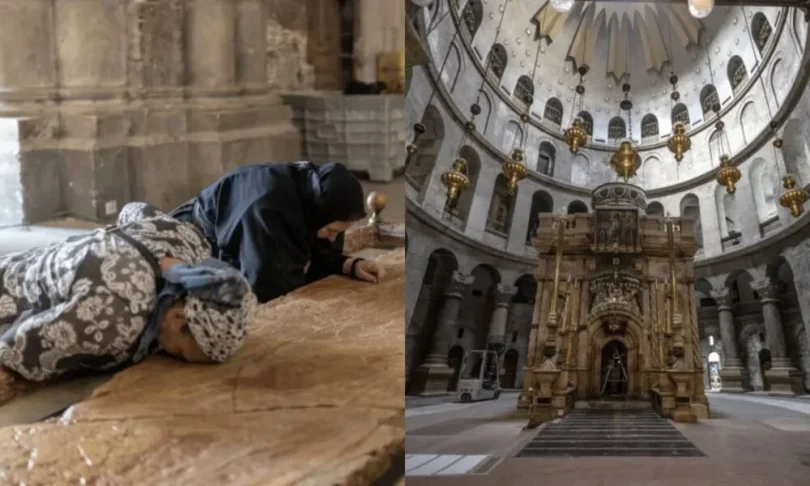
Italian archaeologists excavating beneath Jerusalem’s Church of the Holy Sepulchre have uncovered an ancient funerary landscape that closely matches descriptions of the area where Christians believe Jesus Christ was buried. Get the latest updates on our WhatsApp channel.
The excavation was carried out at the Church of the Holy Sepulchre, a fourth-century church built over a site traditionally identified by Christians as the place where Jesus was crucified, buried and later resurrected.
The research team, led by Francesca Romana Stasolla of the University of Rome “La Sapienza”, had been working beneath the church as part of restoration work that began several years ago.
Speaking to the Daily Mail, Stasolla said:
“We have found evidence of a funerary landscape”
During the final stages of the excavation in 2025, researchers uncovered an abandoned quarry, cultivated areas, an ancient garden and several rock-cut tombs beneath the church.
The discovery is particularly interesting because it bears similarities to the biblical account of Jesus’ burial.
The Book of John describes the location by saying:
“At the place where Jesus was crucified, there was a garden, and in the garden a new tomb, in which no one had ever been laid.”
Researchers noted that the location also fits other descriptions in the Bible. John 19:20 places the crucifixion near Jerusalem, while Hebrews 13:12 describes it as taking place outside the city gate.
The rock-cut graves discovered during the excavation also resemble the type of burial described in the accounts of Matthew, Mark and Luke.
The archaeological evidence also revealed that one particular chamber had been blocked by a Roman structure constructed during the reign of Emperor Hadrian in the second century.
Around two centuries later, workers associated with Emperor Constantine’s construction project removed the Roman structure and exposed the burial area. The chamber was then separated from the surrounding tombs.
Although archaeologists have not discovered human remains that can be identified as Jesus, researchers believe the way the site was preserved could indicate that early Christian communities already regarded the location as sacred.
Stasolla explained that the importance of the discovery goes beyond proving whether Jesus was buried at the site.
“The real treasure we are revealing is the history of the people who made this site what it is by expressing their faith here,” she told the Times.
“Whether someone believes or not in the historicity of the Holy Sepulchre, the fact that generations of people did is objective. The history of this place is the history of Jerusalem, and at least from a certain moment, it is the history of the worship of Jesus Christ.”