
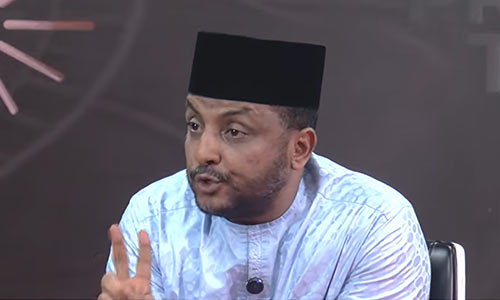
A spokesman for the All Progressives Congress (APC) Presidential Campaign Council, Mr. Alwan Hassan, has cited the case of an orphaned student in Niger State who diverts a portion of her monthly student upkeep allowance to her mother as evidence that the Tinubu administration’s education intervention is reaching the poorest Nigerians.
Speaking in a television interview in which he was pressed repeatedly on the gap between macroeconomic indicators and the lived experience of ordinary Nigerians, Hassan, who is the second spokesperson for the campaign council, offered the account as a direct answer to the question of what the party would place before a voter who says they are poorer today than before the government came in.
“Charles, I’ve seen a child, an orphan in Niger,” Hassan said. “She was explaining how she never thought she was going to go to the tertiary institution. She said when her first alert came for feeding, 25,000 naira, she cried. And in that 25,000 naira, she sends 10,000 to her mother to feed every month.”
The anecdote was offered in support of his wider claim about the Nigerian Education Loan Fund (NELFUND), which he described as the clearest expression of the administration’s social intervention.
The account, however, raises a question the spokesman was not asked in the studio and did not address.
The sum he describes is the monthly upkeep allowance paid to NELFUND beneficiaries, a component distinct from the institutional fee loan that covers tuition and charges payable to the institution. On the spokesman’s own account, the student is not spending forty per cent of that allowance on herself. She is remitting it to her mother as household feeding money.
Whether that is a success story or a warning depends entirely on what the upkeep component is designed to do. If the allowance exists to keep a student fed, housed and in class for the duration of a semester, then a beneficiary who routes N10,000 of N25,000 out of the campus economy every month is, by definition, meeting her own subsistence needs on N15,000. If the allowance is intended more broadly as a poverty transfer attached to a student, the remittance is unremarkable.
The Student Loans (Access to Higher Education) Act, which establishes the fund and governs disbursement, draws the distinction between the institutional loan and the student upkeep component precisely because they answer different needs, and the fund’s own guidelines set the terms on which the upkeep sum is paid. Nothing in the spokesman’s account suggests the student has breached any condition, and there is no indication that NELFUND has raised any question about her conduct. But the anecdote was advanced as proof that the intervention is working. It is equally capable of being read as evidence that a stipend calibrated for one student’s feeding is being stretched across a household because nothing else in that household is working, which is the precise point the interviewer spent the segment putting to him.
Asked how he would convince a Nigerian who says they are poorer today than before the administration took office, Hassan said the answer lay in the government’s record.
“Nobody doubts that the macro economy is doing very well in Nigeria today under President Tinubu. Nobody does that. Our stock market is one of the best, if not the best, in the developing economy. Nobody argues about it,” he said. “Then the question people ask is the micro. How does it touch the people? So there is a lot to say, from education to health to security. Efforts have been made, things have happened, and they are still happening.”
Put to him that he was asking Nigerians to vote on macroeconomic indicators rather than lived experience, and that gross domestic product figures do not pay a market woman’s food bill, he said that was precisely why he wished to begin with education.
Hassan said the student loan scheme is now servicing more than 1.3 million students across over 350 federal and state owned tertiary institutions, covering both tuition and monthly upkeep.
“The president is paying university school loans for over 350 tertiary institutions, federal owned and state owned. Over 350. Kids that could not go to school or might have dropped out are being given loans for their tuitions and stipends at the end of the month to feed. This is servicing over 1.3 million students.”
Challenged that the number reached is small against the national population, he cited admission figures: “As at January, the NUC said the amount of intake of students in tertiary institutions are between 2.5 to 3 million every year. So if you have the opportunity to first get 1.7 in just two years, if we add two years, we’re getting like 3 million. So at least anybody that comes in as a new student will have that loan to access in federal and state tertiary institutions.”
Challenged that the number reached is small against the national population, he cited admission figures: “As at January, the NUC said the amount of intake of students in tertiary institutions are between 2.5 to 3 million every year. So if you have the opportunity to first get 1.7 in just two years, if we add two years, we’re getting like 3 million. So at least anybody that comes in as a new student will have that loan to access in federal and state tertiary institutions.”
The spokesman said the President visited 18 tertiary institutions across the six geopolitical zones last year and made direct grants to their medical schools.
“He went to their medical school. Gave every medical school in the 18 tertiary institutions 4 billion naira to renovate their workshop and their science lab. After that he gave the schools 1.5 billion, the 18 selected across the six geopolitical zones, 1.5 billion naira to build more rooms, that’s more hostels, so as to get more doctors and more nurses that can still come to school, to double the intake.”
“Then this year the same president approved 250 billion naira to the same medical schools, 18 in 18 tertiary institutions, for the schools to buy equipment. You think that is not touching the lives of the poor?”
He added that the beneficiaries of federal institutions are not the wealthy: “The rich don’t take their kids to the federal universities, to the tertiary institutions.”
On technical and vocational education, he said: “Today, every technical school that is federal is free in Nigeria. Vocational schools, training schools are free in Nigeria. What you need to do is to take your child to a technical school with the clothes you wear and they will give them stipends of 22,500 naira. It is happening. You can fact check me.”