
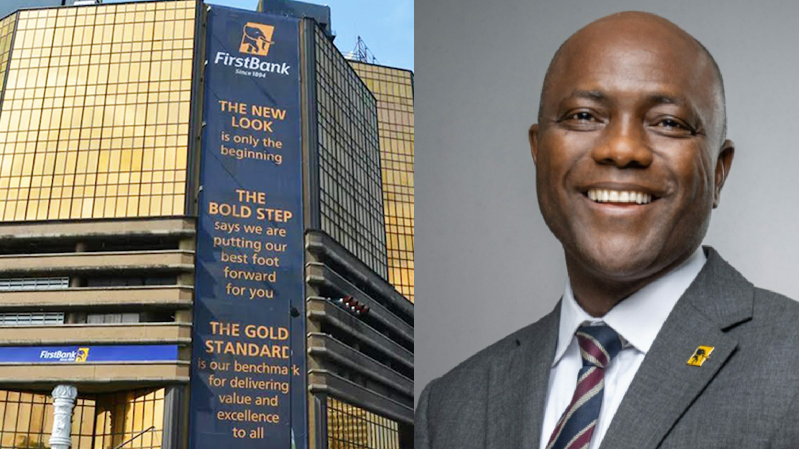
A staff member of First Bank Nigeria Plc is on the run after allegedly stealing billions of naira from the bank over a period of nearly two years routing the money through a network of over a thousand accounts, including one belonging to his wife.
The suspect, Tijani Muiz Adeyinka, was a manager in the Electronic Products team at First Bank’s Iganmu branch in Lagos. On the surface, he was just doing his job. But investigators say he spent nearly two years quietly looting the bank through a function he was trusted to perform every day.
To understand how this fraud worked, you need to understand what Adeyinka’s role involved. 👈
In banking, failed transactions happen regularly. A customer tries to make a transfer, the transaction fails, but their account has already been debited. The bank then processes what is called a reversal crediting the customer’s account with the amount that was wrongly taken.
Adeyinka’s team handled exactly that. He had system-level access to initiate and approve these reversals. It was a sensitive function, the kind that should have had multiple layers of oversight. But it appears that for a long time, it did not or at least not enough to catch what he was doing.
Instead of crediting the legitimate customer accounts when processing reversals, Adeyinka allegedly redirected the funds to accounts he controlled. He did not need to hack anything. He did not need anyone else’s credentials. He just used the access he already had and pointed the money somewhere else.
He did this over and over, for close to two years, without being caught.
How the Fraud Was Discovered
The scheme unravelled the way many internal frauds do through a customer complaint.
A customer flagged a suspicious transaction, which triggered an internal investigation. What the bank’s investigators found was not a one-off error. It was a pattern. Numerous suspicious transactions, all pointing in the same direction.
The deeper they looked, the worse the numbers got.
The initial estimate of what had been stolen was ₦12 billion. That alone would be a serious crisis for any bank. But as investigators continued pulling threads, the figure kept climbing. By the time the full scope of the scheme became clear, the number had reached ₦40 billion roughly $29 million at the prevailing exchange rate.
That is not a rounding error. That is a catastrophic internal failure that went undetected for nearly two years inside one of Nigeria’s oldest and most prominent financial institutions.
How the Money Was Moved
Once the funds left the bank, Adeyinka needed to make sure they were hard to trace and harder to recover. He used a layered approach.
The first stop was his wife’s Zenith Bank account. From there, the money was moved to 34 other accounts. Those 34 accounts then distributed the funds further to 1,190 accounts spread across multiple banks in Nigeria.
By the time investigators started following the trail, the money had passed through over 1,200 accounts. Each transfer added distance between the stolen funds and their source, making recovery difficult and time-consuming.
But moving money through bank accounts was not the only trick used. Some of the stolen funds were converted into USDT a dollar pegged stablecoin through cryptocurrency traders. This added another layer of complexity. Crypto transactions are harder to reverse, and once funds are converted and moved on-chain, tracing them requires a different set of investigative tools.
The crypto traders involved claim they had no knowledge that the money they were receiving was stolen. Regardless, First Bank has pursued legal action against them, and their accounts have been frozen pending the outcome of the case.
FirstBank’s Response
After completing its internal investigation, First Bank formally reported the matter to the Nigeria Police Force on March 25, 2024.
Between April 4 and April 8, 2024, the bank moved quickly through the courts and secured orders to freeze hundreds of accounts tied to the fraud spread across Lagos and Jalingo. Three separate court orders were obtained to cast as wide a net as possible.
On May 10, 2024, First Bank wrote directly to the Lagos State Commissioner of Police, formally requesting a thorough investigation and the arrest of all those involved in the scheme.
Despite those steps, Adeyinka remains at large. He had apparently fled before or shortly after the bank’s investigation concluded. His wife, whose account served as the first destination for the stolen funds, has also not been publicly accounted for.
First Bank has not made any official public statement about the case. The Nigeria Police Force has also declined to comment. That silence has frustrated those watching the case, given the scale of what allegedly took place.
Money Recovered So Far
Even as Adeyinka remains on the run, some recovery has happened.
Authorities recovered ₦1.17 billion in cash, along with £35,070 and $392,818 in foreign currency. All of it was forfeited and transferred to First Bank.
Several properties linked to the couple were also recovered and transferred to the bank. In Lagos, the recovered assets include:
- A three-bedroom flat at Le Moriah Residences Estate, Off Kusenla Road, Ikate Ancient City, Lekki Peninsula, Eti-Osa LGA
- Plot 9, Block 28, Itunu City, Veritas Homes & Properties Ltd., Aiyetoro, Epe
- Block L1, Plot 13, Amen Estate Phase III Extension, Abomiti Zone, Lekki/Epe Expressway, Epe LGA
- Block 3, Plot 13, Arizon Estate, Idera Scheme Allocation, Eleko Junction, Ibeju-Lekki LGA
- A plot of land within Arizone Estate, Idera Scheme, Ibeju-Lekki LGA
- A plot within Itunu Residential, Aiyetoro, Ibeju-Lekki LGA
- Plot 7, Block 4, Itunu City, Veritas Homes & Properties Ltd., Aiyetoro, Epe LGA
- Block Q, Plot 25, Tiara by Amen City Limited, Lekki/Epe Expressway, Yeguda Resettlement Scheme
In Abuja, one property was also recovered Plot 1, Ido Gwari 2 Extension, Ochacho Real Homes, Life Camp.
These recoveries, while significant, represent a fraction of the ₦40 billion that allegedly left the bank.
Now The Bigger Problem for First Bank
This fraud could not have come at a worse time for First Bank.
The Central Bank of Nigeria recently put new recapitalisation requirements in place for commercial banks, requiring them to shore up their capital base within a set timeframe. First Bank is among the banks working to meet those requirements.
A ₦40 billion fraud even partially recovered creates real pressure on a bank’s balance sheet and its public credibility. It raises questions about internal controls, oversight structures, and how a single employee was able to move that kind of money without anyone noticing for two years.
The case is ongoing. Adeyinka is still at large. And the full picture of how much money can ultimately be recovered remains unclear.
What is already clear is that the damage financial, reputational, and institutional is significant.