
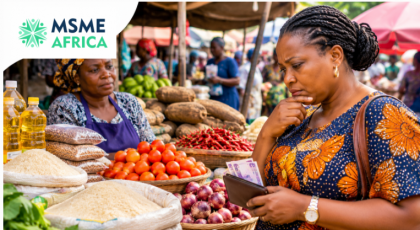
Nigeria’s inflation rate has declined for the fifth consecutive month, offering some encouragement that the country’s cost-of-living pressures may be easing. But for millions of households, the improvement in the official figures is yet to translate into meaningful relief at the market, supermarket or neighbourhood food shop.
The latest Consumer Price Index (CPI) report released by the National Bureau of Statistics (NBS) shows that headline inflation fell to 14.06 per cent in October 2026, from 14.63 per cent in September.
Food inflation also moderated, declining to 19.13 per cent from 19.59 per cent in the previous month.
At first glance, these figures suggest that the cost of living is improving. However, food inflation remains considerably higher than headline inflation, and many of the food items Nigerians buy regularly are still expensive.
There is also another important detail in the latest report: although food prices declined on a month-on-month basis in October, the decline was slower than in September.
So, why are Nigerians still struggling with food prices despite the fall in inflation?
1. Falling inflation does not mean food prices have returned to normal
This is perhaps the most important thing Nigerians need to understand about the latest inflation figures.
Inflation measures the rate at which prices are increasing over time. It does not tell us that prices have returned to the levels they were several months or years ago.
For example, imagine that a bag of rice increased from ₦50,000 to ₦100,000 over a period of time. If inflation subsequently slows, it does not automatically mean that the bag of rice will return to ₦50,000.
It may simply mean that the price is increasing more slowly, or that it has stopped rising as quickly as before.
This is why Nigerians can hear that inflation has fallen while still paying significantly more for food, transportation, cooking gas, rent and other household expenses than they did previously.
In simple terms, inflation coming down means prices are rising more slowly; it does not necessarily mean prices are falling.
2. Food inflation is still higher than overall inflation
The October NBS report shows a clear difference between headline inflation and food inflation.
| Inflation indicator | September 2026 | October 2026 |
|---|---|---|
| Headline inflation | 14.63% | 14.06% |
| Food inflation | 19.59% | 19.13% |
| Month-on-month headline inflation | 0.06% | 0.43% |
| Month-on-month food inflation | -1.55% | -0.75% |
While headline inflation declined to 14.06 per cent, food inflation remained at 19.13 per cent.
This matters because food accounts for a substantial part of the spending of many Nigerian households, particularly lower-income families.
A household may spend less on certain services or postpone purchases of non-essential goods, but it cannot simply stop buying food.
Consequently, even when other components of inflation moderate, persistent food price pressures can continue to make life difficult for households.
3. Food prices declined in October, but the pace of the decline slowed
There is an encouraging part of the October figures that deserves attention.
Food inflation on a month-on-month basis stood at -0.75 per cent in October, compared with -1.55 per cent in September.
A negative monthly food inflation rate indicates that the average price level of food items in the measured basket declined during the month.
However, the decline was smaller than the one recorded in September.
In practical terms, the relief from falling average food prices became less pronounced in October.
The NBS attributed the movement to changes in the average prices of selected items, including vegetable oil, sardines, green peas, frozen mackerel, croaker fish, locally produced rice, fresh catfish, beef tripe, palm oil and millet flour.
This means the picture is not entirely negative. Some food items experienced price reductions, but the improvement was not uniform across the market or across all products.
4. Food prices vary significantly across states
Another reason the official inflation figure may not reflect what every Nigerian experiences is that prices differ across states and locations.
The October report showed significant differences in food inflation across the country.
Ondo recorded the highest annual food inflation rate at 31.74 per cent, followed by Lagos at 31.43 per cent and Imo at 29.75 per cent.
Nasarawa recorded the lowest rate at 3.70 per cent.
These differences show why a national average may not fully reflect the experience of a household in Lagos, Abuja, Port Harcourt, Kano or a rural community.
The NBS also cautions that consumption patterns and the weights assigned to items differ across states. This makes direct comparisons between states potentially misleading.
For a family living in Lagos, where food inflation remained particularly high, the improvement in the national headline figure may not feel as significant.
5. Transportation and distribution costs continue to affect food prices
The price Nigerians pay for food is influenced by much more than the cost of producing it.
Food must be harvested, processed, transported, stored and distributed before it reaches consumers.
Each stage adds costs.
Farmers need to pay for seeds, fertiliser, labour, equipment, fuel and other inputs. Traders and distributors also face transportation, storage, handling and market charges.
Where these costs remain high, reductions in some production expenses may not immediately translate into lower retail prices.
For perishable products such as tomatoes, vegetables, fish and fresh produce, poor storage facilities and inadequate cold-chain infrastructure can also lead to losses that eventually affect prices.
Nigeria’s agricultural supply chain therefore remains an important part of the inflation conversation.
Improving farm productivity alone may not be enough if the cost of moving food from farms to urban markets remains high.
6. The effect of food prices on small businesses
The inflation debate is not only about households. It also has serious implications for micro, small and medium-sized enterprises (MSMEs).
Food vendors, restaurants, caterers, bakeries, supermarkets, neighbourhood shops and small food processors all depend on the cost and availability of food products.
When the prices of ingredients rise, these businesses face difficult choices.
They can increase selling prices and risk losing customers, maintain their prices and accept lower profit margins, or reduce portion sizes and adjust their product offerings.
For example, a small restaurant that spends more on rice, cooking oil, meat, fish, vegetables and transportation may find it increasingly difficult to maintain the same meal price.
A bakery may face similar challenges when the cost of flour, sugar, butter, electricity and packaging increases.
Some businesses may respond by buying in bulk, negotiating directly with suppliers, changing their product mix or reducing wastage.
However, these options are not equally available to every small business, particularly those operating with limited working capital.
For MSMEs, food inflation is therefore both a household concern and a business operating-cost challenge.
7. Why the cost-of-living pressure may continue into December
The approach of the festive season may create additional pressure on household budgets and selected food markets.
Demand for rice, poultry, meat, cooking ingredients, drinks and other consumer goods typically rises around Christmas and New Year.
However, higher seasonal demand does not automatically mean that prices will rise. The eventual effect will depend on available supply, production levels, imports, transportation costs, exchange-rate movements and the ability of traders to meet demand.
For households, this makes early budgeting and careful purchasing particularly important.
For food retailers and other businesses, the festive period may provide an opportunity to increase sales, but only where inventory management and pricing are handled carefully.
Businesses should avoid tying up too much working capital in stock without considering demand, storage costs and the risk of unsold inventory.
8. What should households and small businesses do?
While individual Nigerians cannot control the national inflation rate, there are practical ways to manage its effects.
For households:
- Prepare a realistic monthly food budget.
- Compare prices across different markets and retailers.
- Plan meals and shopping lists to reduce waste.
- Buy non-perishable essentials in sensible quantities where savings justify it.
- Consider seasonal food alternatives where they offer better value.
- Avoid unnecessary borrowing to finance routine household consumption.
For small businesses:
- Review the cost of ingredients, inventory and transportation regularly.
- Track profit margins rather than focusing only on sales revenue.
- Negotiate with suppliers and explore alternative sourcing arrangements.
- Reduce spoilage, waste and avoidable operating expenses.
- Review prices carefully instead of making sudden increases.
- Monitor customer demand before committing substantial funds to festive-season inventory.
9. What should Nigerians expect next?
The next important development to watch is the Central Bank of Nigeria’s Monetary Policy Committee meeting scheduled for November 23 and 24, 2026.
The CBN reduced its benchmark interest rate to 23 per cent in September. The latest moderation in headline inflation may provide some room for policymakers to consider their next move.
However, the increase in month-on-month headline inflation from 0.06 per cent in September to 0.43 per cent in October, alongside persistent food inflation, suggests that price pressures have not disappeared.
The MPC will have to consider inflation trends, exchange-rate developments, food supply, economic growth and other financial conditions before deciding whether to reduce, maintain or increase the policy rate.
For businesses, the outcome matters because monetary policy influences borrowing costs, investment decisions and the wider economic environment.
But even if interest rates decline, food prices will not automatically fall. Sustainable relief will also depend on improvements in agricultural production, transportation, storage, energy supply and distribution.
Final thoughts
Nigeria’s October inflation report offers some positive news, but it does not mean the cost-of-living crisis is over.
Headline inflation has declined to 14.06 per cent, and food inflation has eased to 19.13 per cent. Yet food prices remain significantly higher than they were a year ago, and the latest monthly figures show that the pace of food price reductions slowed.
For ordinary Nigerians, the real test is not simply whether inflation falls in the monthly NBS report. It is whether families can afford more food with their incomes and whether businesses can operate profitably without continually increasing prices.
The government will need to sustain efforts to improve food production, reduce distribution costs, strengthen infrastructure and address the structural challenges affecting the agricultural value chain.
Until these improvements translate into more affordable food and better purchasing power, many Nigerians may continue to experience a gap between the improving inflation statistics and the reality of their household budgets.
For Nigerian households and MSMEs, the question is no longer just whether inflation is falling. It is when that improvement will become something people can actually feel in their pockets.