
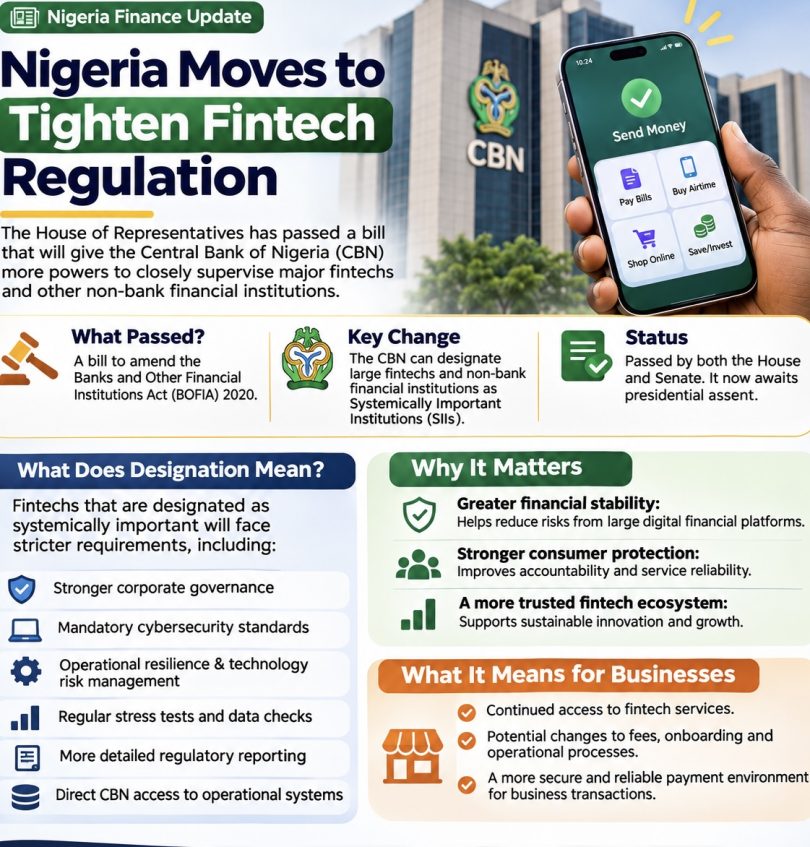
Nigeria’s House of Representatives has passed a bill seeking to strengthen regulatory oversight of major financial technology companies and other non-bank financial institutions, potentially subjecting them to supervisory requirements similar to those applicable to commercial banks.
The proposed legislation, which amends the Banks and Other Financial Institutions Act (BOFIA) 2020, would empower the Central Bank of Nigeria (CBN) to designate qualifying fintech companies and non-bank financial institutions as Systemically Important Institutions (SIIs).
The bill passed its third reading in the House of Representatives on November 18, 2026, following the Senate’s earlier approval of its version. The legislation is expected to proceed through the remaining legislative processes before being presented for presidential assent.
The proposed amendment reflects growing regulatory attention to Nigeria’s rapidly expanding digital financial services industry, where fintech companies increasingly play significant roles in payments, financial inclusion and commercial transactions.
What the Proposed Regulation Means for Fintech Companies
Under the proposed Section 62A of BOFIA, the CBN Governor would have the authority to designate a non-bank financial institution as systemically important based on its operational scale, market share, customer base, transaction volumes and connections to the broader financial system.
Institutions whose operations are closely integrated with banks, payment infrastructure or other financial service providers could also qualify for designation, particularly where their failure could disrupt financial stability.
Once designated, affected institutions would face enhanced regulatory requirements covering corporate governance, cybersecurity, operational resilience, technology risk management and financial reporting.
The legislation also provides for regular stress testing, data-integrity assessments and increased regulatory access to operational systems, enabling the CBN to monitor risks associated with large financial technology platforms.
Additional provisions address beneficial ownership transparency, regulatory disclosures and penalties for non-compliance.
Why Nigeria Is Strengthening Fintech Oversight
The proposed reforms come amid the rapid expansion of digital financial services in Nigeria, with fintech companies increasingly handling significant transaction volumes and serving millions of customers.
During legislative deliberations, the bill’s sponsor in the House of Representatives, Julius Ihonvbere, expressed concerns about regulatory gaps, market concentration, foreign investment flows and the accountability of large financial technology companies.
He specifically referenced OPay, one of Nigeria’s major fintech operators, while discussing the growing influence of digital financial institutions.
According to figures cited in the reports, OPay recorded approximately 50 million monthly active users as of July 2026 and processed transactions valued at $358 billion in 2025, compared with $166.2 billion in 2024.
The company’s operational scale illustrates why lawmakers are considering additional regulatory measures for financial institutions whose activities could have wider implications for Nigeria’s financial system.
How the New Bill Could Affect Fintechs and Small Businesses
For major fintech operators, the proposed legislation could introduce additional compliance responsibilities, including increased investment in cybersecurity infrastructure, internal controls, governance systems and regulatory reporting.
These requirements may increase operational costs for designated institutions, particularly those required to strengthen their risk management and technology infrastructure.
However, enhanced supervision could also improve financial system resilience, strengthen consumer protection and promote greater accountability among institutions handling substantial volumes of financial transactions.
For Nigerian micro, small and medium-sized enterprises (MSMEs), the potential implications are significant, given the growing reliance on fintech platforms for payment collection, money transfers, business transactions and other financial services.
Stronger cybersecurity and operational resilience requirements could help reduce the risks associated with service disruptions, data breaches and weaknesses in payment infrastructure.
At the same time, businesses may need to monitor potential changes to fintech service charges, onboarding requirements and operational procedures as affected institutions respond to additional regulatory obligations.
It is important to note that the proposed legislation does not automatically introduce new charges or compliance requirements for individual small businesses.
What Happens Next?
Although both chambers of the National Assembly have passed versions of the proposed amendment, the legislation must complete the necessary legislative procedures, including reconciliation of any differences between the two versions, before being presented for presidential assent.
Until the amendment becomes law, the proposed Systemically Important Institution designation framework should not be treated as an already operational regulatory requirement.
If enacted, the legislation would provide the CBN with additional authority to supervise major non-bank financial institutions whose activities are considered significant to Nigeria’s financial stability.
For fintech companies, investors and businesses that depend on digital financial services, the development signals a continued shift towards stronger regulatory oversight of Nigeria’s financial technology industry.
The proposed reforms seek to balance financial innovation with institutional accountability, consumer protection and the stability of the broader financial system.