
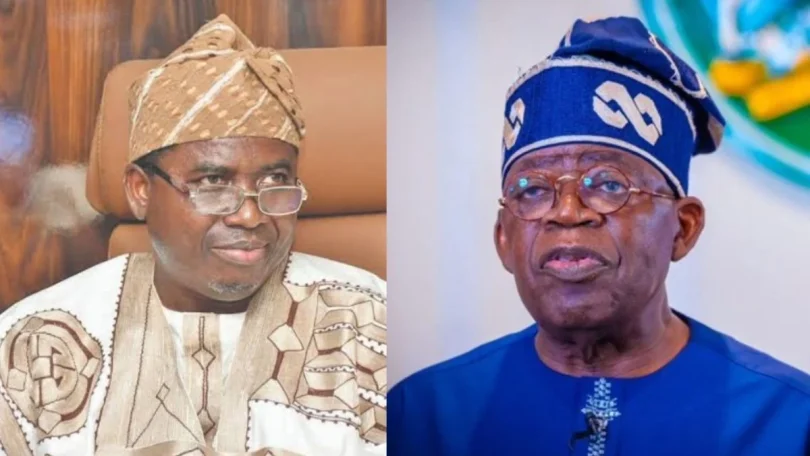
The Chairman of the Independent National Electoral Commission (INEC), Joash Amupitan, has ruled out accepting political or diplomatic appointments after completing his tenure at the electoral commission.
Amupitan made the declaration on Thursday during a panel discussion at Chatham House in London, titled “Nigeria’s 2027 Elections: Democratic Trajectory and Regional Stability Beyond the Ballot”.
He was responding to a question on whether he would reject political or diplomatic appointments after leaving office, unlike his predecessor, Mahmood Yakubu, who was nominated by President Bola Tinubu as a non-career ambassador to Qatar after overseeing the 2023 general elections.
Yakubu was among 32 ambassadorial nominees whose names Tinubu forwarded to the Senate for confirmation last November.
Responding to the question, Amupitan said his appointment as INEC chairman was based on public trust and that he had sworn an oath to remain neutral and ensure credible elections.
“I’m not going to accept any appointment from anybody because coming to serve here is based on trust,” he said.
He added, “And then I took an oath of allegiance, not only to be neutral, but to ensure that the conduct of the election is free, fair, and credible.”
The INEC chairman described his position as a national assignment, noting that he had spent much of his life in public service and would also want time to pursue personal interests after leaving office.
Amupitan, a professor of corporate governance, also suggested that he could explore opportunities in the private sector after his tenure.
On public confidence in INEC, he acknowledged that glitches in the transmission of election results during the 2023 general elections had damaged the commission’s credibility.
He, however, said the commission had introduced measures to prevent a recurrence in the 2027 elections, particularly by ensuring that inaccurate results from polling units would not be uploaded to the INEC Result Viewing Portal (IReV).
“We found, for instance, that the problem of election result declaration and management in Nigeria is not even at the polling unit, it’s at the collation centres,” he said.
He attributed the 2023 transmission problems to the failure to upload results to IReV, adding that the commission had introduced safeguards to ensure only accurate polling unit results were uploaded.
Amupitan further disclosed that INEC had reduced the number of voters assigned to each Bimodal Voter Accreditation System (BVAS) device from 1,250 to 850 to speed up voter accreditation.
He also said the commission was strengthening its collaboration with security agencies to improve voter safety during the elections.
Meanwhile, INEC has also disclosed that it has produced Permanent Voter Cards (PVCs) and concluded the procurement of non-sensitive materials ahead of the 2027 general elections.
The commission made this known on Thursday when members of the Independent Electoral and Boundaries Commission (IEBC) of Kenya paid a courtesy visit to its headquarters.
Represented by a National Commissioner, Rhoda Gumus, INEC said preparations for the elections were progressing, with the deployment of election materials to some states already underway.
Gumus said the commission had completed its assessment of preparations across its zonal offices and was satisfied with the progress recorded.
She disclosed that PVC production had been completed, while the first and second batches had been received in most states. Collection of the cards was also ongoing.
She added that staff training and capacity-building exercises were underway at the commission’s headquarters and state offices, while the procurement and deployment of BVAS machines had also been completed and commenced, respectively.
On diaspora voting, Gumus said the commission could not implement the arrangement because it was not provided for under the existing electoral law.
She explained that the law would have to be amended before Nigerians living abroad could participate in elections from their countries of residence.
Gumus also disclosed that INEC had arranged interactive sessions between its directors and the Kenyan delegation to enable them to share information on the operations of their respective departments.