
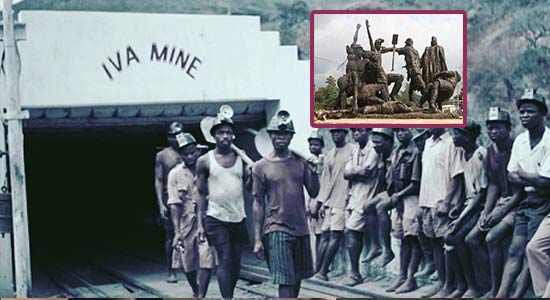
Families of the 21 Nigerian coal miners killed by British colonial police during the November 18, 1949, Iva Valley Coal Mine massacre in Enugu have staged a peaceful protest at the British High Commission in Abuja, demanding compliance with an Enugu State High Court judgment ordering the United Kingdom to pay £420 million in compensation.
The protesters, who carried lighted candles and memorial banners, gathered at the British High Commission on Wednesday, November 18, 2026, to commemorate the 77th anniversary of the massacre and draw international attention to what they described as the British Government’s continued failure to comply with the judgment.
The protest followed the February 5, 2026, judgment delivered by Justice A. O. Onovo of the Enugu State High Court in Suit No. E/909/2024, which held the British colonial administration responsible for the killing of 21 unarmed Nigerian coal miners.
The court described the massacre as an unlawful and extrajudicial violation of the victims’ right to life and ordered the payment of £20 million in compensation for each deceased miner, amounting to £420 million.
Justice Onovo also ordered formal apologies and diplomatic action in connection with the killings.
In the judgment, the court held that the miners were engaged in a legitimate protest over their working conditions and had not undertaken any violent action that justified the use of lethal force against them.
“These defenseless coal miners were asking for improved work conditions; they were not embarking on any violent action against the authorities, but yet were shot and killed,” the judge held.
The court consequently directed the respondents identified in the judgment to pay compensation for the violation of the victims’ right to life.
“The 1st, 2nd, 5th and 6th respondents should pay £20 million per victim, totalling £420 million, payable by the British government as effective remedy and compensation for the violations of the right to life,” Justice Onovo ordered.
The court further awarded post-judgment interest at the rate of 10 per cent per annum until the compensation is fully paid.
“They will also pay post-judgment interest at 10% per annum until fully paid while claims for pre-judgment interest and exemplary damages are hereby refused,” the judge held.
However, more than nine months after the judgment, the families maintained that the British Government had neither complied with the compensation order nor challenged the decision through an appeal.
They argued that the continued delay in implementing the judgment had prolonged their struggle for justice and denied the surviving dependants the compensation awarded by the court.
Speaking on behalf of the victims’ families, Professor Yemi Akinseye-George, SAN, who represented human rights activist Mazi Greg Nwachukwu Onoh and the surviving dependants of the deceased miners, called on the British Government to respect the judgment and fulfil its obligations.
In a statement issued in connection with the anniversary protest, Akinseye-George emphasised the principle that judicial proceedings should not operate to the prejudice of those seeking justice.
He cited the legal maxim, actus curiae neminem gravabit, meaning that an act of the court shall prejudice no one, while drawing attention to the prolonged denial of redress for the massacre.
The senior advocate disclosed that the Federal Government of Nigeria had exercised its constitutional right of appeal against the Enugu State High Court judgment.
He acknowledged that the matter was therefore subject to appellate proceedings but maintained that the victims’ right to compensation for the unlawful deprivation of life remained central to the dispute.
“While we await the ultimate wisdom of the appellate court, the sacrosanct principle remains that ubi jus, ibi remedium (where there is a right, there is a remedy); the breach of the right to life must be accounted for, and dependants adequately compensated,” he stated.
Akinseye-George distinguished the Federal Government’s appeal from the position of the British Government, which he said had neither appealed nor challenged the judgment since its delivery on February 5, 2026.
“The British Government, whose colonial administration bore direct liability, has neither appealed nor challenged the judgement since its delivery on February 5, 2026 to date,” he stated.
He argued that the failure of the British Government to challenge the judgment through the available appellate procedures raised questions about its continued refusal to comply with the compensation order.
“Having failed to invoke appellate mechanisms for reasons best known to them, equity demands that the British Government cease its unconscionable delay,” the senior advocate said.
He also relied on the legal maxim, vigilantibus, non dormientibus, jura subveniunt, meaning that the law aids the vigilant, not the indolent.
According to him, the British Government had no justification for continued non-compliance in the absence of an appeal or stay of execution operating on its behalf.
The senior advocate maintained that the families had waited decades for judicial recognition of the unlawful killings and should not be subjected to further delays in obtaining the remedies awarded by the court.
He consequently called on the British Government to demonstrate respect for the rule of law and the integrity of the Nigerian judicial system by implementing the judgment.
“On behalf of our clients, we hereby urge the British Government to demonstrate respect for the rule of law and judicial integrity by immediately complying with the judgment in Suit No: E/909/2024 of the Enugu State High Court,” he stated.
Akinseye-George explained that the anniversary protest was intended to honour the memory of the deceased miners while reminding the international community that violations of fundamental human rights could attract obligations extending beyond the period in which they occurred.
“As the families march peacefully today with lighted candles and memorial banners, we remind the world that historical atrocities carry enduring liabilities,” he said.
“The memory of the 21 Iva Valley martyrs must be honoured through prompt and equitable restitution,” the statement added.
The Iva Valley Coal Mine massacre occurred on November 18, 1949, when British colonial police opened fire on Nigerian coal miners who were protesting poor working conditions, wage disputes and discriminatory labour practices.
Twenty-one unarmed miners were killed during the incident, which became the subject of the legal action instituted more than seven decades later.
In 2024, human rights activist Mazi Greg N. Onoh commenced proceedings before the Enugu State High Court, seeking judicial redress for the killings and compensation for the surviving families.
The suit, marked E/909/2024, sought acknowledgment of liability, a formal apology from the British Government and comprehensive financial compensation for the loss of the miners’ lives.
Following consideration of the case, Justice Onovo delivered judgment on February 5, 2026, holding the British colonial administration liable for the massacre and awarding £420 million in compensation to the victims’ families.
The court also ordered post-judgment interest at 10 per cent annually until payment was completed, while declining the claims for pre-judgment interest and exemplary damages.
Despite the judgment, the families maintained during Wednesday’s protest that they had yet to receive the court-ordered compensation or secure compliance with the other reliefs granted.
Their legal representatives acknowledged the pending appeal filed by the Federal Government of Nigeria but insisted that the British Government’s failure to independently challenge the judgment should not be used to justify further delays.
The families therefore renewed their demand for payment of the £420 million compensation, compliance with the orders for formal apologies and diplomatic action, and recognition of the suffering endured by the dependants of the 21 miners.
They maintained that the 77th anniversary of the massacre should serve not only as a remembrance of the victims but also as a renewed call for accountability, justice and the implementation of the court’s judgment.
Post Title: “Historical Atrocities Carry Enduring Liabilities” — Families Of 21 Enugu Coal Mine Massacre Victims Protest UK’s Failure To Pay £420m Compensation By Naijaonpoint.