
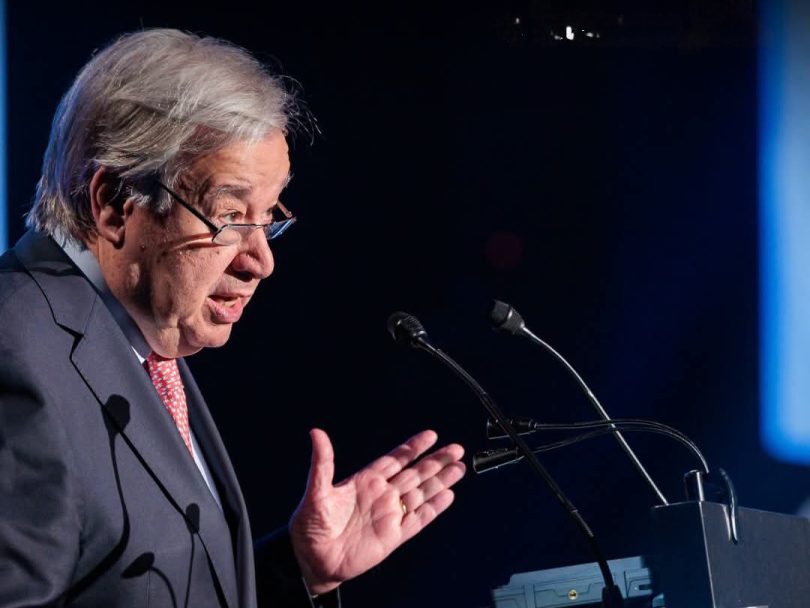
UN Secretary-General António Guterres has demanded an end to the plundering of Africa’s mineral resources, insisting the continent’s wealth must create jobs and prosperity for Africans.
“No more plundering,” Guterres declared, calling for critical minerals to be processed locally rather than shipped abroad largely as raw materials.
“We must ensure that Africa’s vast natural resources, particularly critical minerals, create local value and decent jobs, rather than simply being shipped overseas,” he said.
The UN chief also demanded permanent African seats on the Security Council and sweeping reforms of a global financial system he described as “created by the rich, for the rich.”
He spoke at the fifth annual Global Africa Business Initiative, “Unstoppable Africa” gathering in New York.
Guterres said Africa’s growing economic weight must now translate into greater control over its resources and stronger influence in global decision-making.
“Africa also needs permanent seats on the United Nations Security Council, where it can contribute to dialogue and action for the whole globe,” he said.
He described Africa as a “double victim of colonialism,” saying most African countries were absent when today’s major global institutions were created.
According to him, both the Security Council and international financial institutions failed to adequately reflect Africa’s interests.
Guterres said the continent was now emerging as a major global economic force with a three-trillion-dollar market opportunity.
Africa, he said, has the world’s fastest-growing labour force, about 30 per cent of global mineral resources and 60 per cent of solar-energy potential.
“The shift you long envisioned is taking place: from doing business in Africa, to doing business with Africa,” he said.
He highlighted Nigeria, South Africa and Senegal for producing music and films attracting audiences across the world.
He cited Kenya, which generates more than 90 per cent of its electricity from renewable sources, and Rwanda’s pioneering nationwide drone-delivery system.
Tunisia, he said, was competing globally in artificial intelligence and computer-vision software.
Guterres said Africa’s fintech sector had become the continent’s biggest draw for investment capital.
He added that trade under the African Continental Free Trade Area was on course to reach about 230 billion dollars this year.
Africa’s economy, according to him, grew 4.4 per cent last year in spite of wars and turbulence in the global economy.
The UN chief, however, warned that unpredictable tariffs, competition over critical minerals and conflicts in Ukraine and the Middle East were disrupting food, fertiliser, fuel and other supply chains.
He said those pressures should accelerate Africa’s transition from dependence on raw-material exports to local processing and manufacturing. (NAN)