
•We should choose dialogue before confrontation —Awolowo Dosumu
•Treaty, important documents in modern Yoruba history —Akintoye
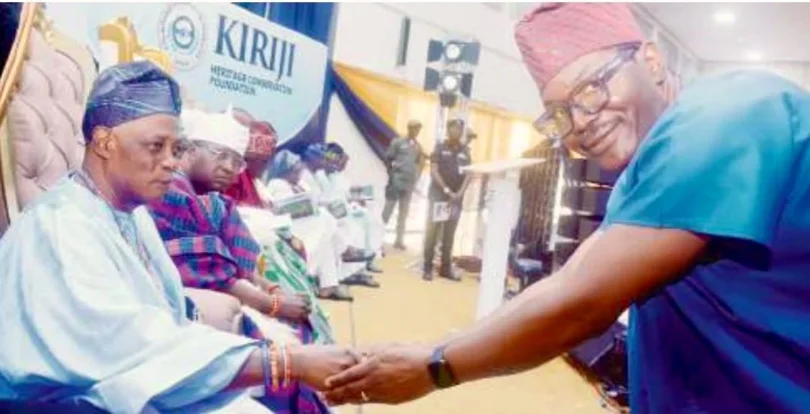
TRADITIONAL rulers, scholars and prominent Yoruba leaders, on Monday, gathered in Ibadan, the Oyo State capital, to celebrate the 140th anniversary of the Kiriji Peace Treaty.
At the event, the Kiriji Heritage Conservation Foundation (KHCF), unveiled the proposed Kiriji Peace City (KPC) layout, aimed at building a modern city, in commemoration of the end of the Yoruba war in 1886.
Welcoming dignitaries to the occasion, the Co-Chairman and former Nigerian Ambassador to the Netherlands, Dr Olatokunbo Awolowo Dosumu, noted that there were many lessons to be learnt from the story of Kiriji war and the peace initiative that was embarked upon by the forebears of the Yoruba.
According to Awolowo Dosumu, who spoke through the chairman of the Editorial Board of the Nigerian Tribune, Professor Remi Ayede, the war warned that people bound together by history, culture, language and ancestry can still become divided when grievances deepen, dialogue fails and mistrust takes hold.
She said, “None of us here heard the guns of Kiriji. We did not witness the suffering or the long years of conflict.
And yet, Kiriji belongs to us.
It is part of our inheritance, both as a warning and a lesson.
“That, for me, is the enduring significance of Kiriji.
Peace did not mean that every grievance suddenly disappeared. Former adversaries still had painful memories. But eventually, the future had to become more important than the quarrels of the past.
“There is something deeply relevant in that for our own times. Across our country and indeed, our world, we see what happens when grievances are allowed to fester and differences become hardened into hostility. Kiriji, therefore, asks us a question that remains as important today as it was 140 years ago.
“Must we always wait until the cost becomes unbearable before we choose peace? For us as Yoruba people, the message is particularly poignant. We are a people of many proud communities and distinctive traditions.
But, our diversity need never become division. Unity does not mean uniformity.
“We can cherish our individual identities while recognising the larger inheritance we share: our history, our culture, our language and the values of omolúàbí: character, responsibility and respect for others. And we must pass these lessons to our children.
They should know Kiriji not simply as a war fought long ago, but as a reminder that peace must be deliberately built, reconciliation patiently nurtured and unity constantly protected.
“140 years later, therefore, we should not merely celebrate the peace our forebears made. We must prove ourselves worthy of it”.
She, however, noted that 140 years after the peace treaty, we should not merely celebrate the peace our forebears made, adding that we must prove ourselves worthy of it and “choose dialogue before confrontation, understanding before suspicion, and bridges rather than walls”.
Delivering the keynote address, foremost historian, Professor Banji Akintoye, noted that peace treaty of September 23, 1886 should be recognised as one of the most important documents in modern Yoruba history.
Speaking on the topic: “Yoruba heritage: Reflecting on the legacy of the Kiriji peace treaty”, he said,
“Its significance lies partly in the breadth of the political communities and authorities represented in the peace process.
“The settlement emerged from recognition that the prolonged conflict had become destructive and that a new relationship among the contending forces was necessary. The Treaty was, therefore, more than an agreement to stop fighting.
It was an attempt to create a framework for coexistence”.
Akintoye, who was represented by the deputy national leader, Yoruba Self Determination Movement (YSDM), Architect George Akinola, added that the peace treaty taught the Yoruba people many things which included that there is courage in fighting, but there is another kind of courage in making peace.
“There is courage in recognising that yesterday’s enemy may become tomorrow’s neighbour. There is courage in sitting across a table with people against whom one has fought. There is courage in accepting compromise when compromise is necessary to preserve the larger community.
“And there is extraordinary wisdom in understanding that the future belongs to those who can transcend the grievances of the past. This is perhaps, the greatest lesson of Kiriji. The greatest victory of Kiriji was not a military victory. It was the victory of peace over the continuation of war”, he stated.
Speaking further on the importance of the Kiriji war, the historian said it told the Yorubas that there would always be division among us, but efforts should be made to resolve our differences.
Akintoye said: “Kiriji, therefore, speaks directly to us. It tells us that disagreements are inevitable. But permanent division is not. It tells us that competition may be unavoidable. But cooperation is possible.
“It tells us that political differences do not have to destroy cultural relationships.
And it tells us that a people who share a common destiny must continually rediscover the means of working together.”
The Yoruba self determination proponent added that the anniversary placed an enormous responsibility upon the Yoruba monarchs, saying they are not merely ceremonial figures, but custodians of memory and guardians of identity.
He said: “A traditional ruler who preserves history performs a service to the future.
The palace must, therefore, become a place where young people can encounter history.
“Our traditional institutions should collaborate with universities, historians, museums, cultural organisations and government agencies to document oral traditions and preserve historical materials.”
The president of KHCF, Dr Florence Folami-Adeoye, said the foundation was put together in the bid to preserve Kiriji and ensure its development.
She stressed: “Kiriji must be preserved, interpreted, developed and presented to Nigeria and the world as a living heritage of peace, courage, reconciliation, identity and human possibility.
“We envision a world-class Kiriji Heritage and Peace Destination, a place where history can be experienced, knowledge can be transmitted, culture can flourish, families can visit, young people can learn, researchers can investigate, tourists can stay, investors can participate, communities can prosper and the story of peace can speak to generations yet unborn”
The traditional rulers of the major towns and city involved in the Kiriji war and the peace treaty also graced the event and pledged their support for the proposed KPC.