
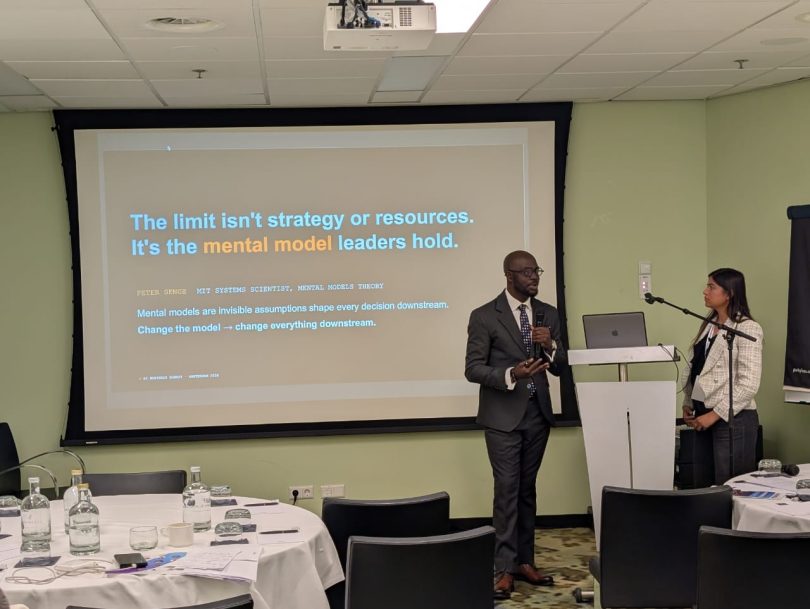
Fikun Aluko, an AI, cybersecurity and technology leader and Chevening Scholar, has challenged business leaders to move beyond simply adopting artificial intelligence (AI), urging organisations to embed the technology into their core strategy if they want to remain competitive.
Aluko made the call while delivering a presentation titled “From AI Strategy to AI Reality” at the 6th International AI in Business Summit held in Amsterdam, the Netherlands, on June 1, 2026.
Addressing founders, investors, engineers, researchers and enterprise executives, he argued that although AI adoption has become widespread, only a small percentage of organisations are using it to create lasting business transformation.
“Almost every organisation is using AI. Almost none are leading with it,” Aluko said.
Citing McKinsey research, he noted that 88 per cent of organisations now use AI, yet only six per cent qualify as high-performing AI-driven businesses. He also referenced the WRITER 2026 Enterprise AI Survey, which found that 75 per cent of executives admitted their AI strategies were largely symbolic rather than practical, while 48 per cent described AI adoption in their organisations as a major disappointment.
Drawing from his experience leading enterprise-wide AI adoption across five business divisions at a leading Europe, Middle East and Africa (EMEA) business services company, Aluko argued that successful AI implementation begins long before any technology is deployed.
“The leadership team believed AI would make their operations faster. My job was to change that model entirely,” he said, adding that reframing AI as organisational infrastructure rather than a productivity tool produced measurable improvements across all five divisions.
He identified three common misconceptions preventing organisations from achieving meaningful AI outcomes: viewing AI solely as a productivity tool, expecting it to solve broken organisational systems without structural change, and treating it only as a compliance or risk issue while competitors advance.
Instead, he urged executives to recognise AI as a strategic business capability that requires ownership at board level and alignment with long-term organisational objectives.
“The six per cent have not found better technology,” he said. “They have made a different foundational decision about what the technology is.”
Aluko also argued that governance should be viewed as a competitive advantage rather than an obstacle to innovation.
Drawing on his experience building enterprise cybersecurity and risk frameworks aligned with standards such as ISMS, BCMS, SOC 2, the EU AI Act, NIS2 and the Digital Operational Resilience Act (DORA), he said organisations that establish governance before deploying AI often innovate more quickly because decision-making becomes clearer.
“What I observed was the opposite,” he said. “The anxiety driving reckless speed dissolved once governance was embedded. In its place was permission to move faster.”
He contrasted Goldman Sachs’ structured AI deployment, which reportedly enabled more than 46,500 employees to use its AI platform while improving productivity and reducing client onboarding times, with the case of US pharmacy chain Rite Aid, whose AI facial recognition programme resulted in enforcement action by the US Federal Trade Commission after governance failures.
Aluko warned that African organisations serving European clients or processing data subject to European Union regulations must also prepare for the requirements of the EU AI Act, which provides for penalties of up to €35 million or seven per cent of global annual turnover for serious breaches.
He also highlighted the importance of developing AI skills within organisations, particularly among managers responsible for translating AI capabilities into business decisions.
Referring to his experience coaching 78 engineers and 50 engineering managers at UK-based education technology company Multiverse, as well as leading the Beyond Limits Tech Startup Fellowship across 30 countries, Aluko said many organisations underestimate the human capability required to implement AI successfully.
“The translation sits in the manager layer and it is where most enterprise AI training never reaches,” he said.
He cited DataCamp’s 2026 State of Data and AI Literacy Report, which found that although 82 per cent of organisations provide AI training, 59 per cent still report critical skills shortages.
Concluding his presentation, Aluko presented business leaders with a 12-question diagnostic covering leadership, governance and workforce capability.
“The difference between the six per cent and the 88 per cent was never going to be technology,” he said.
“It was always going to be the quality of one decision about what AI fundamentally is. The organisations that make that decision clearly do not just use AI better. They become a different kind of organisation entirely. That is the distance between adoption and leadership. And it is available to any organisation willing to close it.”
Aluko is the founder of Hikestack, an innovation studio operating across the Europe, Middle East and Africa region. Over the past decade, he has worked across organisations including Deloitte, NITDA Nigeria, Beyond Limits, Skillharvest and Multiverse UK, leading AI, cybersecurity and technology initiatives across more than 30 countries.