
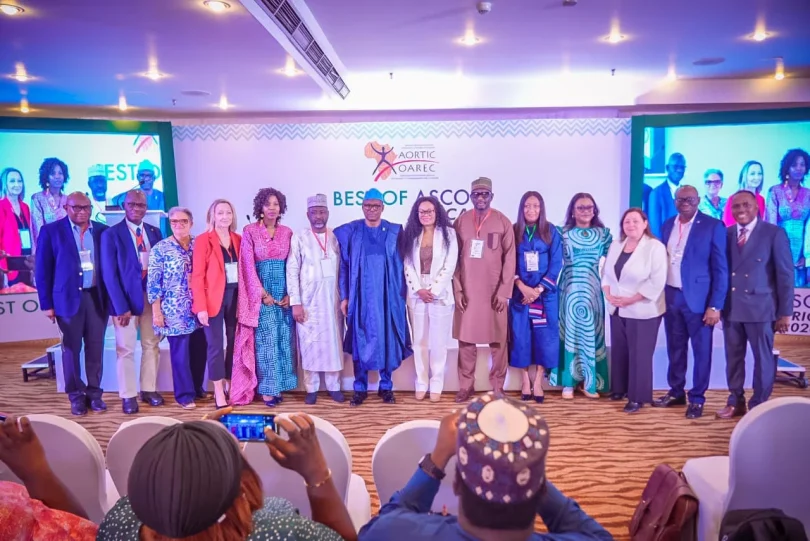
The Federal Government has reaffirmed its commitment to reducing Nigeria’s cancer burden by at least 30 per cent by 2030, while calling for stronger Pan-African collaboration in research, financing and healthcare delivery to tackle the continent’s rising cancer crisis.
The Minister of State for Health and Social Welfare, Dr Iziaq Adekunle Salako, made the commitment on Friday at the African Organisation for Research and Training in Cancer (AORTIC) Best of ASCO Africa 2026 conference held in Abuja.
Salako said Nigeria was prioritising cancer prevention, research and treatment under President Bola Ahmed Tinubu’s Renewed Hope Agenda, noting that the country had developed and was implementing the National Cancer Control Plan (2026–2030) with the ambitious goal of reducing the nation’s cancer burden by 30 per cent before the end of the decade.
According to him, the conference, which brings together leading oncologists, researchers, policymakers and health professionals across Africa, provides an opportunity to translate global scientific discoveries into practical solutions suited to African realities.
He described the theme of the conference, “From Global Discovery to Local Recovery: Driving Africa to the Cutting Edge of Cancer Care,” as timely, saying it underscored the need to convert advances in global oncology into equitable and context-specific interventions across the continent.
Citing Global Cancer Observatory (GLOBOCAN) data, the minister said Africa recorded about 1.19 million new cancer cases and 721,629 cancer-related deaths in 2024, adding that Nigeria accounts for approximately 10.5 per cent of the continent’s cancer burden alongside Egypt and South Africa.
“With 1,187,697 new cancer cases and 721,629 cancer-related deaths in 2024 according to GLOBOCAN data, Africa faces a substantial challenge from this scourge which kills more than war and is killing more Africans than AIDS, malaria and tuberculosis combined,” Salako said.
He attributed the high mortality to increasing lifestyle and environmental risk factors, ageing populations, weak early detection systems, inadequate treatment infrastructure and persistent health inequities across Africa.
“The unacceptable morbidity and mortality figures are largely due to increased prevalence of lifestyle and environmental risk factors, ageing population, non-implementation or near lack of early detection strategies and poor treatment infrastructure exacerbated by health inequities across the continent,” he added.
Salako said Nigeria’s National Cancer Control Plan covers prevention, diagnosis, treatment, patient navigation, research, survivorship, artificial intelligence, partnerships, workforce development and resource mobilisation.
He disclosed that the government had inaugurated a multi-sectoral National Technical Working Group comprising clinicians, researchers, cancer survivors, civil society organisations, the private sector and development partners to coordinate implementation of the plan.
“The Technical Working Group has so far demonstrated capacity to assist with the implementation of the Nigeria National Cancer Control Plan using an implementation science approach to turn the plan into impact,” he said.
The minister urged African researchers not to adopt international findings without validation but to generate local evidence capable of improving treatment outcomes on the continent.
“My challenge to you all, eminent cancer professionals, is not to take findings from other terrain and apply them hook, line and sinker, but to replicate the research work presented at the ASCO conferences in order to demonstrate applicability of the findings in our environment,” Salako said.
He stressed that Africa must begin treating cancer as more than a health challenge.
“Africa must rise to tackle the cancer burden not just as a health issue, but as a matter of human security, economic progress and sustainable development,” he said.
Calling for greater continental cooperation, Salako said politics, security and trade had dominated Pan-African conversations for decades, adding that healthcare should now occupy a central place in regional integration efforts.
“Time is now to push for more Healthcare Pan-Africanism to collaboratively tackle African health challenges,” he stated.
He added that Nigeria was ready to provide leadership in advancing what he described as “Cancer Care Pan-Africanism” through education, research and advocacy tailored to Africa’s socio-economic realities.
Also speaking, the Director-General of the National Institute for Cancer Research and Treatment (NICRAT), Prof. Usman Malami Aliyu, said Africa’s cancer burden was projected to more than double over the coming decades if urgent action was not taken.
Presenting a paper titled “Reducing Africa’s Cancer Burden: Insights from the Nigeria Model – Translating Innovation into Equitable Cancer Care in Nigeria,” Aliyu said annual cancer cases across Africa were projected to rise from 1.2 million to 2.6 million, while annual deaths could increase from 727,000 to 1.6 million.
He noted that Africa currently has the highest mortality-to-incidence ratio for cancer globally, reflecting poor access to early diagnosis and effective treatment.
According to him, Nigeria records more than 127,000 new cancer cases and over 80,000 deaths annually, with the disease burden expected to continue rising through 2040.
Aliyu identified limited screening, late diagnosis, shortage of oncology specialists, poor access to treatment, weak data systems and inconsistent governance as major obstacles to effective cancer control across Africa.
He said the establishment of NICRAT under the NICRAT Act 2017 had strengthened Nigeria’s institutional response by providing national leadership across the entire cancer care continuum, from prevention and early detection to treatment, survivorship and palliative care.
Aliyu said the institute was coordinating scientific research, supporting implementation of national cancer policies, strengthening collaboration among stakeholders and investing in evidence-based interventions.
Drawing lessons for other African countries, he said, government leadership, strong partnerships, reliable data, integrated healthcare systems, sustainable financing and equitable access to care remained essential for reducing cancer deaths.
“Africa does not lack innovation; our challenge is translating it into access. By strengthening institutions, financing systems, collaboration and local research, we can ensure every cancer patient benefits from modern advances,” Aliyu said.