
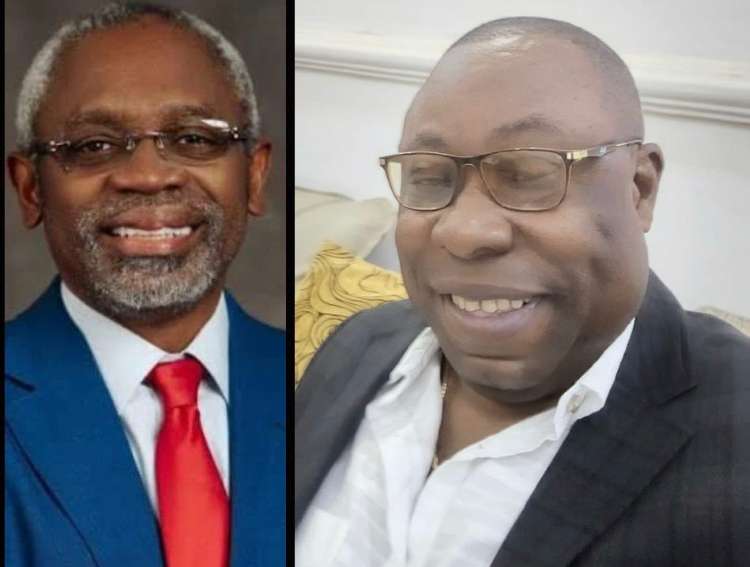
Femi Gbajabiamila has long occupied a distinctive and often debated place in Nigeria’s political landscape.
He is frequently described as an enigma—not because he is obscure or unpopular, but because his political journey reflects a rare combination of strategy, loyalty, adaptability, and quiet influence.
From his years in the legislature to his tenure as speaker of the house of representatives, and now as chief of staff to the president of the federal republic of Nigeria, Gbajabiamila has come to embody a form of political relevance that is at once visible and understated—assertive yet restrained.
What makes him compelling is not that he is universally admired, but that he consistently resists easy political categorisation.
As a former consultant to the House of Representatives Committee on Financial Crimes, I had observed him from a distance for years. I had visited his office once or twice during his time as Majority Leader, but I did not have the opportunity to engage him directly until his election as Speaker of the House of Representatives in June 2019.
Immediately after assuming office, he moved swiftly to assemble a team of experienced legislative aides and assistants who shared his vision and were prepared to contribute meaningfully to nation-building.
At the time, President Muhammadu Buhari had demonstrated what appeared to be a genuine commitment to the fight against corruption, and Gbajabiamila was determined to support that effort with every necessary legislative instrument.
A respected member of the House of Representatives from Lagos State recommended my name to the new Speaker as a possible assistant on anti-corruption matters.
He promptly invited me to his residence at the Legislative Quarters in Apo for a discussion.
During that meeting, he came across as remarkably simple, approachable, and focused. He had a clear sense of what he wanted to achieve—and, more importantly, how to achieve it.
By the end of our conversation, he appeared satisfied with our exchange, and I was equally pleased to be considered for the assignment.
From that first direct encounter in 2019 until today, my impression of him as an enigma has only deepened.
Gbajabiamila was first elected to the House of Representatives in 2003 under the platform of the Alliance for Democracy to represent Surulere I Constituency of Lagos State.
He would go on to serve six consecutive terms before becoming Speaker in 2019.
In 2023, he was appointed Chief of Staff to President Bola Ahmed Tinubu.
Before becoming Speaker, he had already built a formidable legislative résumé.
He served as Minority Whip from 2005 to 2007, Minority Leader from 2007 to 2015, and House Leader from 2015 to 2019.
His rise through the legislative ranks was neither accidental nor merely opportunistic.
Trained as a lawyer in both Nigeria and the United States, he brought to public service a disciplined, procedural, and institution-minded approach.
Over time, he established himself as a skilled parliamentarian—one who understood not only the letter of the law but also the delicate art of negotiation that sustains democratic institutions.
As Speaker, he presided over a House that was often described as more cooperative with the executive than confrontational.
To some, this reflected political maturity, stability, and responsible governance.
To others, it raised legitimate concerns about the possible weakening of legislative independence.
Yet it is precisely this dual interpretation that reinforces the complexity surrounding his political persona.
What distinguishes Gbajabiamila most is his capacity to remain influential across changing phases of power.
Many politicians struggle to make the transition from legislative prominence to executive relevance.
His appointment as Chief of Staff, however, revealed a deep reservoir of trust, political capital, and administrative competence.
In that office, he operates less in the public eye but arguably wields greater strategic influence.
The Chief of Staff is often the gatekeeper to the presidency—shaping access, managing priorities, and ensuring policy coordination.
That Gbajabiamila has occupied this position effectively speaks not only to loyalty but also to discretion, organisational discipline, and strategic judgement.
In a political environment where shifting alliances often disrupt policy direction, he represents an unusual thread of continuity.
He understands the legislature from the inside and now operates at the very centre of executive power.
That dual vantage point gives him a rare capacity to interpret, translate, and manage relations between both arms of government.
The enigma, therefore, lies in the fact that he is both a product of the system and one of its quiet stabilisers.
He is not a populist in the conventional sense.
He does not rely on fiery rhetoric, dramatic symbolism, or mass mobilisation.
Nor is he entirely technocratic.
Rather, he occupies a middle ground—one defined by institutional continuity, strategic pragmatism, and disciplined restraint.
Critics argue that this pragmatism sometimes leans too heavily toward accommodation, particularly in a political system that requires robust checks and balances.
Supporters, however, regard the same quality as evidence of maturity and a commitment to stability in a fragile democratic environment.
That disposition is also evident in contemporary Lagos politics.
For some time, Gbajabiamila has been widely regarded as eminently qualified for the governorship of Lagos State, and his name has often surfaced in conversations around the 2027 race.
Yet, in keeping with his preference for stability and internal cohesion, he was among the first notable political figures in Lagos to support and endorse Obafemi Hamzat as a consensus candidate of the All Progressives Congress.
In many ways, his career invites a broader reflection on the nature of power in Nigeria.
Influence is not always loud.
Effectiveness is not always dramatic.
Some of the most consequential political actors are those who work within institutions, shaping outcomes incrementally rather than theatrically.
Gbajabiamila belongs to that category—a political figure whose significance lies as much in what he does quietly as in what he does publicly.
His legislative record as Speaker from 2019 to 2023 remains particularly notable.
Under his leadership, the House of Representatives passed approximately 510 bills—arguably one of the highest legislative outputs in the history of the National Assembly.
Among the major legislative milestones were the Police Act 2020, which modernised the legal framework for policing and strengthened accountability and human rights protections; the Electoral Act 2022; the Petroleum Industry Act 2021, a landmark reform of the oil and gas sector; the Companies and Allied Matters Act 2020, which improved the ease of doing business; and the Students Loans (Access to Higher Education) Act.
Equally significant is his political longevity without defining scandal.
This is not to suggest that he is beyond criticism—no serious political actor is.
But unlike many public figures whose reputations become overshadowed by controversy, Gbajabiamila has managed to remain relevant across multiple administrations and evolving political contexts.
That durability points to a careful calibration of alliances, judgement, timing, and public posture.
Ultimately, the “enigma” is less about mystery than about complexity.
He represents a distinctive kind of political adaptability that resists simplistic labels.
He is at once a loyal party man, a seasoned legislator, a strategic risk-taker, and a consequential executive actor.
A quiet achiever, he has also been associated with philanthropy, community-building initiatives, and trust-building efforts across different parts of the country.
He is frequently close to where important decisions are shaped, even when he is not the public face of those moments.
This quiet centrality is perhaps the most revealing feature of his political identity.
His importance cannot be measured by visibility alone, but by proximity to decision-making and his capacity to influence outcomes without theatrical display.
Taken together, these qualities do not make him mysterious in the sense of being unknown.
They make him layered.
His enigma is, in truth, a study in controlled visibility, strategic loyalty, institutional patience, and adaptive power.
The more closely one examines his career, the clearer it becomes that the mystery is not accidental—it is part of the method.
Whether history ultimately remembers him as a stabiliser of governance or as a symbol of closer alignment between the executive and the legislature remains to be seen.
What is already clear, however, is that Femi Gbajabiamila remains a consequential Nigerian patriot whose journey continues to shape—and be shaped by—the evolving dynamics of Nigerian politics, with a discernible commitment to strengthening, nurturing, and protecting Nigeria’s fragile democracy in whatever capacity he serves.