
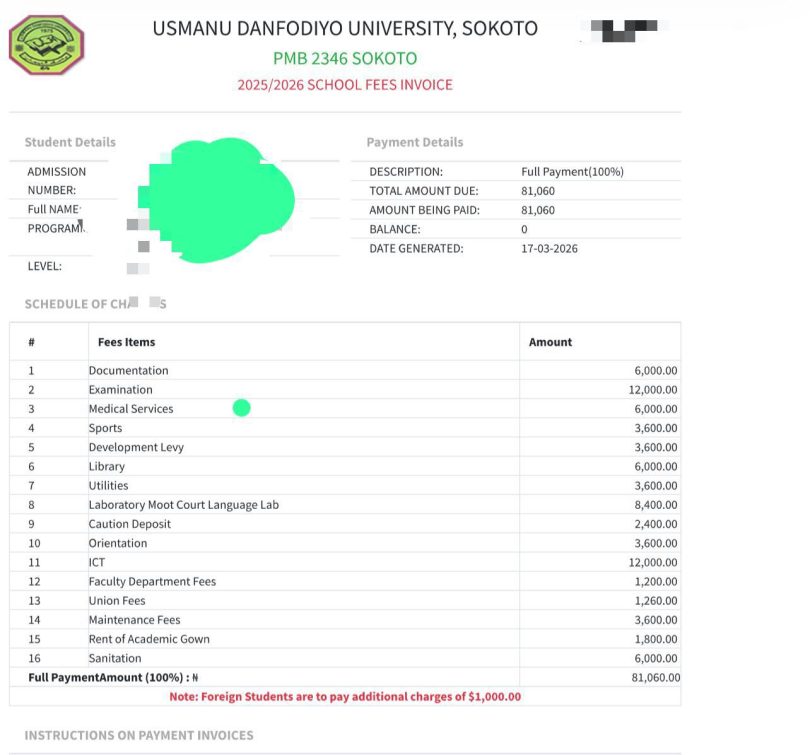
Students of Usmanu Danfodiyo University, Sokoto (UDUS) have raised concerns over an alleged shortage of essential medicines and basic laboratory supplies at the institution’s clinic, despite being compelled to pay a N6,000 medical levy every academic session.
SaharaReporters’ findings show that UDUS has more than 20,000 active students, meaning the N6,000 levy could translate to over N120 million in a single academic session, as all students are required to pay it.
However, students who spoke with SaharaReporters said they are often unable to obtain medications prescribed by doctors at the university clinic, while basic laboratory tests are allegedly unavailable because of shortages of reagents.
The development has raised questions among students about the management and utilisation of the medical levy and whether sufficient resources are being provided to the clinic to meet the healthcare needs of the university community.
The N120 million-plus figure is a projection based on the reported N6,000 charge and the university’s more than 20,000 active students.
But students say the services currently available at the clinic do not correspond with the financial burden imposed on them.
A student who recently visited the clinic after falling ill told SaharaReporters that he was examined by a doctor and prescribed medication for malaria, only to discover that the prescription was unavailable at the facility.
“The doctor attended to me and prescribed drugs for typhoid fever and others I needed, but when I went to get them at the clinic, I was told they were not available. I had to look for them outside the university,” the student said.
The student said the situation was particularly frustrating because students are already required to pay a compulsory medical levy.
“When you are sick and you have already paid the medical fee, you expect that the clinic should at least have the basic drugs commonly prescribed by its doctors. Having to go outside again means spending more money,” the student added.
Another student said the problem extends beyond the availability of drugs to diagnostic services.
The student alleged that after being referred by a doctor for routine laboratory investigations for a common ailment among students like typhoid fever, the clinic could not conduct the tests because the necessary reagents were unavailable.
“I was asked to go for laboratory tests, but when I got to the lab, I was told that the reagents needed for the tests were not available. I was directed to go into town to do them,” the student said.
According to the student, the tests were routine investigations involving urine and should ordinarily be within the capacity of a university clinic.
“What is worrying is that these are not complicated tests. If a student is sick and the doctor needs a basic test before deciding on treatment, the student should not have to leave campus because there are no reagents,” the student said.
Another student described the clinic’s available medication as severely limited.
“From what students experience, there are times when you go there and the drugs available are just a few basic items. You may see things like paracetamol and normal saline, but the medication prescribed for your particular condition may not be there,” the student said.
The students stressed that their complaints were not targeted at the doctors or other medical workers at the clinic.
They said medical personnel could only work with the drugs, equipment and laboratory supplies provided to them.
“This is not about blaming the doctors. The doctors can prescribe what they believe is appropriate, but if the medicine is not available, there is very little they can do. The problem is the resources available to the clinic,” another student said.
Where is the medical levy going?
At the centre of the students’ concerns is the compulsory N6,000 medical levy.
With more than 20,000 active students reportedly enrolled at UDUS, multiplying the figure by N6,000 gives a potential revenue of over N120 million per academic session.
Students, however, are demanding greater transparency.
They want the university management to disclose how much has been generated from the medical levy and how the money is being spent.
One student said the university should be able to explain why essential healthcare supplies are reportedly unavailable despite the compulsory payment.
“If students are paying a medical levy every session, there should be accountability for that money. Students deserve to know what the money is being used for and why the clinic still struggles with basic drugs and laboratory materials,” the student said.
Another student called for the university to publish details of its expenditure on healthcare.
“We are not saying every drug must always be available. But there should be a system that ensures essential and commonly prescribed medicines are regularly stocked. There should also be enough reagents for basic tests,” the student said.
‘Outsiders Using University Clinic’
The students also raised concerns over the alleged access being granted to residents of communities around the university.
According to several students, people who are neither students nor members of staff of UDUS are allowed to use the university clinic.
The students said they were concerned that this could put additional pressure on an already limited supply of medicines and laboratory materials.
One student said the university should clarify whether members of the public are officially permitted to access the clinic.
“If the clinic is meant primarily for students and staff, management should explain why people from outside the university are also using it, especially when students are complaining that drugs and other medical supplies are not enough,” the student said.
Another student said the university should disclose whether outsiders are charged for treatment and what happens to any revenue generated from such services.
“If outsiders are being treated there, are they paying? If they are paying, where does that money go? And are drugs purchased with students’ medical fees being used for people who are not students?” the student asked.
Students Demand Restocking, Transparency
The students are also calling on the university management to urgently restock essential medicines and laboratory reagents at the clinic.
They also want the institution to improve its diagnostic capacity so that students do not have to leave campus for routine investigations.
They called for regular monitoring of drug inventories and transparent procurement procedures to prevent essential medicines from becoming unavailable.
The students further want the university to provide a breakdown of the medical levy, including the total amount collected, the amount allocated to the clinic and expenditure on drugs, laboratory consumables, equipment and maintenance.
One student said the issue should be treated as a welfare matter rather than a political or administrative dispute.
“We are students and we just want a functional healthcare system. When someone falls sick on campus, the person should be able to go to the clinic and receive proper attention without worrying about whether the prescribed drug is available or whether the laboratory has the reagents to conduct a simple test,” the student said.
Another student urged the university management to engage students directly.
“Management should investigate what is happening at the clinic and give students a clear explanation. If there is a procurement problem, tell us. If the money is not enough, explain why. But students should not be left paying medical fees and still struggling to access basic healthcare,” the student said.
Dean Of Students’ Affairs Silent
SaharaReporters contacted the Dean of Students’ Affairs at Usmanu Danfodiyo University, Professor Zayyanu Umar Usman, for his response to the allegations.
He was asked to clarify the reported shortage of essential drugs and laboratory reagents, the N6,000 medical levy, the amount generated from the charge and how the funds are utilised.
He was also asked to respond to the allegations that residents of communities around the university are allowed to access the clinic and whether the university has an official policy governing such access.
Professor Usman did not respond to messages sent to him before this report was published.