
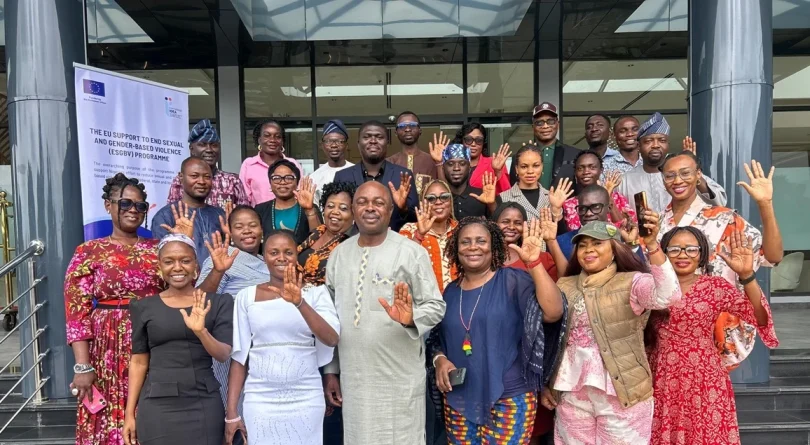
…inaugurate Oyo State SGBV media corps
The European Union (EU), International IDEA and the National Agency for the Prohibition of Trafficking in Persons (NAPTIP) have moved to strengthen reporting of sexual and gender-based violence (SGBV) in Oyo State with the establishment of an SGBV Media Corps.
- …inaugurate Oyo State SGBV media corps
- ALSO READ: SGBV: FG denies claims of abandonment of survivors
The initiative, aimed at strengthening public engagement on SGBV in the FCT, Benue, Kaduna and Oyo, is being implemented by International IDEA with support from the European Union Support to End Sexual and Gender-Based Violence in Nigeria (EU-SGBV) programme and began with a two-day capacity-building training for selected media practitioners in the state.
Director-General of NAPTIP, Binta Lami Adamu Bello, in her address delivered by the agency’s Director of Media and Publicity, Mr Vincent Adekoye, said the media had played an important role in exposing abuses, amplifying survivors’ voices and influencing public responses to SGBV.
She said, “The media is not merely a channel for information; it is a partner in protection, prevention and justice.”
Bello stated that SGBV remained one of the most pervasive human rights violations in Nigeria, affecting women, girls, boys and men across different social groups.
“While exact figures are likely conservative because of widespread underreporting, the reality we confront daily is clear: many survivors do not come forward due to fear, stigma, lack of trust in society, or economic dependence on perpetrators,” she explained.
According to her, Oyo State faces challenges ranging from sexual assault and intimate partner violence to trafficking for sexual exploitation, with cultural norms, stigma and limited awareness of legal rights contributing to underreporting.
ALSO READ: SGBV: FG denies claims of abandonment of survivors
Bello said NAPTIP’s approach to survivors was anchored on “dignity, confidentiality and holistic care”, adding that the agency had continued to implement the Violence Against Persons (Prohibition) Act, 2015.
She also identified technology-induced abuse as an emerging dimension of SGBV, citing non-consensual sharing of intimate images, sextortion, cyberstalking, grooming of minors, deepfakes and coordinated online harassment.
“To effectively address this development, NAPTIP has increased collaboration with a wide range of partners in the technology sector and sister Law enforcement agencies to keep pace with innovation and outsmart the syndicates,” she further said.
Bello urged journalists to report SGBV cases responsibly, saying they had the power to raise awareness, hold institutions and perpetrators accountable and inform the public about available support services.
“Our responsibility now is to move from awareness to measurable behavioural change,” she said. “We want Nigerians not only to know that SGBV is wrong, but to recognise the warning signs, report them, protect vulnerable people and support survivors.”
While speaking, the Civil Society and Community Mobilisation Specialist, ESGBV Programme at International IDEA, Mrs Wynyfred Achu-Egbuson, said the EU-SGBV programme was focused on supporting the implementation of the VAPP Act and other policies aimed at reducing SGBV at federal and state levels.
According to her, Oyo was one of the programme’s focal states alongside Benue and Kaduna, with the Federal Capital Territory (FCT) also covered.
Achu-Egbuson said the programme would support access to services for survivors, including increasing the number of Sexual Assault Referral Centres (SARCs) and strengthening the capacity of personnel providing services.
She added that the programme would also support primary health centres to provide essential services to survivors in rural communities.
On the media component, Achu-Egbuson said the training was only the beginning of a longer engagement with practitioners.
“This media core, this training you are attending, is only the start of your relationship with the EU-SGBV programme,” she noted, adding that members of the media corps would become “champions that will speak up and speak out against sexual and gender-based violence in your respective communities and also as a state.”
According to her, the media would also be expected to help inform the public about SGBV, promote positive social norms and encourage communities to take action against the practice.
The programme, she said, would run until 2029, with a formal launch expected during the 16 Days of Activism campaign in Abuja around November 30.
Achu-Egbuson urged the participants, inaugurated as Oyo State SGBV media corps, to use their position to strengthen advocacy and ensure that SGBV was addressed through a holistic approach involving government, communities, service providers and other stakeholders.
The two-day workshop, facilitated by Mrs Toyin Adewale Gabriel, Media Mentor and Lead Facilitator for the EU-International IDEA Programme on ESGBV; Mr Armsfree Ajanaku, Media Mentor for the programme in Oyo; and Mr Vincent Adekoye, featured a series of interactive sessions on media stereotypes, media role in reporting SGBV, existing legal frameworks, including identifying gaps in the Violence Against Persons Prohibition (VAPP) Act, available referral pathways and principles of Do No Harm in SGBV reporting, among others.