
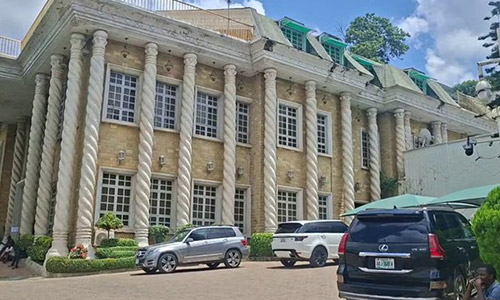
Enforcement proceedings have commenced in Nigeria against assets linked to Alhaji Abdulrahman Musa Bashar, Chairman of the Rahamaniyya Group of Companies, following orders of the Federal High Court giving effect in Nigeria to an English judgment arising from a petroleum-products debt dispute valued at approximately US$40 million.
The enforcement action, which commenced on Wednesday, September 23, 2026, follows a February 25, 2026 order of the Federal High Court, Lagos Judicial Division, granting Petrichor Energy FZCO leave to register a judgment of the High Court of Justice of England and Wales for enforcement in Nigeria.
The Federal High Court subsequently issued writs of attachment and sale dated May 15, 2026. One writ was directed against assets belonging to Bashar, while another concerned Bashar and Ultimate Oil & Gas FZCO. Court enforcement documents have now been served and posted at properties connected with the respondents in Lagos and Abuja as the creditor moves to recover the judgment debt.
The Nigerian proceedings represent the latest stage of a commercial dispute that has moved through courts and arbitration processes in England, the United Arab Emirates and Nigeria.
At the centre of the dispute is Petrichor Energy FZCO, formerly known as CE Energy DMCC, and Ultimate Oil & Gas FZCO, formerly Ultimate Oil & Gas DMCC, an offshore trading company chaired and owned by Bashar.
Court records show that between 2022 and 2023, CE Energy supplied Ultimate with several cargoes of gasoil and jet fuel. By January 2024, substantial indebtedness had accumulated. The parties subsequently entered into a payment arrangement, while Bashar provided a personal guarantee supporting Ultimate’s obligations.
The dispute eventually reached the Commercial Court of the High Court of Justice of England and Wales.
On February 14, 2025, Paul Stanley KC, sitting as a Deputy High Court Judge, granted summary judgment in favour of CE Energy in proceedings numbered CL-2024-000225 and CL-2024-000426.
The court ordered Ultimate Oil & Gas to pay AED22,846,944.69, together with interest and costs, in respect of an outstanding cargo debt. Bashar was separately ordered to pay AED122,189,310, together with interest and costs, under his personal guarantee.
Although permission was initially granted to appeal on a limited point concerning Section 49(2) of the United Kingdom’s Sale of Goods Act 1979, that appeal was ultimately not pursued following further agreements between the parties. DIFC Court records later described the English judgments as final and unappealable, noting that appeals and applications for stays had been refused.
The parties subsequently entered into what the later court proceedings described as a New Payment Agreement on April 24, 2025, which was intended to produce a full and final settlement if its terms were completely performed.
Under that arrangement, enforcement of the English judgments was restricted while agreed payments were being made, but the agreement allowed Petrichor to resume enforcement following specified defaults.
According to the English High Court’s later findings, by the end of January 2026, Ultimate should have made 10 instalment payments totalling AED45,777,172.70, but had paid AED8,731,683.56, leaving a shortfall of more than AED37 million at that stage. Further payments were subsequently made in February.
As the creditor pursued enforcement across jurisdictions, Petrichor returned to the English High Court seeking a post-judgment worldwide freezing order against Bashar and Ultimate.
As the creditor pursued enforcement across jurisdictions, Petrichor returned to the English High Court seeking a post-judgment worldwide freezing order against Bashar and Ultimate.
On March 30, 2026, Mr Justice Bryan granted the application in Petrichor Energy FZCO v Bashar & Anor [2026] EWHC 914 (Comm).
The application sought to preserve assets while Petrichor pursued enforcement of the existing judgments. The court distinguished the application from an earlier pre-judgment worldwide freezing order granted in 2024, which had subsequently been discharged because the evidence then available had not sufficiently demonstrated a risk of dissipation.
By March 2026, however, Mr Justice Bryan held that the circumstances had materially changed.
The court referred to evidence concerning disposals of property after judgment, repeated defaults under payment arrangements, shortcomings in asset disclosure and a March 15, 2026 telephone conversation in which, according to sworn evidence accepted for purposes of the without-notice application, Bashar said he would begin disposing of assets if Petrichor refused the proposed payment terms.
The judge ultimately concluded that there was a sufficient risk of dissipation to justify a post-judgment worldwide freezing order.